1880’s Escalloped Salmon

ingredients for escalloped salmon

Maria Parloa blessed us with a recipe for escalloped fish in Miss Parloa’s New Cook Book, which Washburn-Crosby Co. published in 1880.  This company’s successor General Mills brought her proven receipts back to America, by republishing them in their Special Silver Dollar City Edition of this book, at an unknown date during the twentieth century.

Both these companies are known for their production of Gold Medal flour, which they successively produced; thus, this product has been on the market for nearly two and a half centuries.  (For more details on Miss Parloa, Washburn-Crosby Co., General Mills, and 19th century American cooking, see 1880’s Clam Chowder-2017/01/30, 1880’s Minced Cabbage-2017/04/24, and 1880’s Ozark Honey-Oatmeal Cookies-2017/10/30.)

This 19th century cook book was one of many written by Maria Parloa, who was an important figure in the gastronomical world of her day.  She taught an abundance of classes at her own two schools, as well as the Boston Cooking School, the home of Fannie Farmer’s Boston Cooking School Cook Book, which was forerunner to the renowned Fanny Farmer Cook Book.

In Miss Parloa’s New Cook Book, Parloa shared modern techniques and included 93 “essential” utensils for the kitchen, which boasted of such items as an apple corer, melon mold, and squash strainer.  Her writings catered to the affluent, for she recommended that a dinner for twelve need cost no more than $25, this at a time when an unskilled worker made about $1 per day.

In this book’s preface, the author’s desire for clear, complete, and concise directions is set forth, but these are vague compared to our present standards.  Her instructions, however, have far greater detail than those in many of the contemporary cook books of her day.

This recipe called for five pounds of fish, that which was normally required to sustain a family of six at the main, mid-day meal; by contrast, this same amount provided for twelve guests at a dinner party, as these hospitable affairs were always profuse in delectable dishes.  My directive only calls for one pound of salmon for four people in this creamy recipe, because this is a rich food for our relatively sedentary bodies; in these former days people were highly active, requiring many more calories than we do today.

As with this outmoded receipt, things call for adaptation; we must learn to adjust to the essential needs of any given time.  Our living God perpetually covers us in all instances of unforeseen change, bringing healthy modification, if we ask believing.  At times this process is slow; thus, patience is critical for success.

This is a joyful race we are running; nothing is too difficult for us!  We simply align our hearts to the “recipe” our Father is dictating at each turn, purposing to not be alarmed when our five pounds of fish becomes one pound, or with equal intention, staying calm when it reverses back to five pounds.

Recently I enjoyed escalloped salmon with friends that I hadn’t seen for a long time; our reunion was marked with excellence in both fellowship and food.  This dish is a winner for special occasions, especially when served with next week’s entry, teaching Miss Parloa’s minced cabbage.

References:

Special Silver Dollar City Edition of Maria Parloa’s Miss Parloa’s New Cook Book (Boston: Estes and Lauriat, 1880); this was published by General Mills at an unknown date during the 20th century.

James Trager, The Food Chronology (New York: Henry Holt and Company, 1995), p. 310.

https://en.wikipedia.org/wiki/Maria_Parloa

https://www.lib.umich.edu/blogs/beyond-reading-room/happy-172nd-birthday-miss-parloa

Click to access c2500.pdf


baked escalloped salmon

1880’s Escalloped Salmon  Yields: 4 servings.  Total prep time: 1 hr & 15 min/  active prep time: 45 min/  baking time: 30 min.  This is adapted from a recipe in General Mills’, 20th century Silver Dollar City Edition of Maria Parloa’s Miss Parloa’s New Cook Book (Boston: Estes and Lauriat, 1880).

Note: this may be prepared ahead of time following steps 1-8; when doing so, reheat this refrigerated dish for a total of 1 hr before serving.  The original recipe calls for white fish; I, however, find this exceedingly bland in flavor, where salmon is perfect.

1/4 c bread crumbs  (May purchase ready-made, or grind 2 slices of stale bread in a dry food processor.  Make extra, as these freeze well; for stale bread, leave pieces out for about 8 hours.)

1-1 1/2 lb salmon fillet  (A minimum of 1 lb is needed if fillet is boneless and skinless, more if there are bones and skin.)

1 tsp salt, or to taste  (Himalayan, pink, or Real Salt is best for optimum health; a fine grind Himalayan salt is available at Costco for $4.95/1b.)

1 c whipping cream  (Heavy whipping cream is best health wise.)

1/8 c water

1 tbsp flour

1/8 tsp white pepper, or to taste

Steamed rice, cooked according to directions on package

  1. Preheat oven to 325 degrees.
  2. If salmon fillet is large, cut in pieces that will fit in a 3-quart saucepan.  Place in pan and cover with salted water (add 1/2 tsp salt); bring to a boil over medium heat.  Cook until center of thickest part of salmon is opaque, when pierced with a fork.  Saving broth, remove fish from liquid and cool.  Reduce broth to about 1/4 c over high heat.
  3. If preparing your own bread crumbs, grind 2 pieces or more of stale bread in dry food processor, pressing pulse button repeatedly until crumbs are fine.  Set aside 1/4 c-freeze extras.
  4. Heat cream over medium heat in a small saucepan, only until a soft boil is formed, stirring frequently; watch carefully.  As soon as it comes to a bare boil, reduce heat to med/low.
  5. While heating cream, dissolve flour in water.  With a wire whisk, stir flour mixture into softly boiling cream, to which you have added 2 tbsp of reduced broth; cook until sauce is thick, beating frequently.  Season with 1/2 tsp salt and white pepper.  Taste and adjust seasonings; set aside.
  6. Start rice, following directions on package (wait if you are preparing salmon ahead).
  7. Butter a small, 1-quart baking dish; place a light layer of sauce in bottom of dish.
  8. Skin and carefully debone fish, placing bite-size pieces in baking dish on top of layer of cream, as you debone it.  When all the salmon is thus prepared, press down on fish to make compact; cover the top with the remaining cream sauce.  (If you are making this ahead of time, place dish in refrigerator; in which case an hour-twice as long- will be needed to bake cold fish; start rice when you place refrigerated salmon in oven.)
  9. Just before placing this in oven, spread bread crumbs on top of sauce.  If a skim has formed on top of cream, gently break apart with a spoon; this makes surface wet again, so crumbs can stick.  Then bake for 30 minutes in preheated oven; all the flavors will meld.
  10. Serve with 1880’s Minced Cabbage, which is next week’s entry.

1880’s Philadelphia Clam Chowder

mincing clams

mincing optional fresh razor clams

My great clam chowder is adapted from a recipe in the General Mill’s 20th century Special Silver Dollar City Edition of Miss Parloa’s New Cook Book; this reproduced cookbook was originally published in 1880, by Washburn Crosby Co., the makers of Gold Medal flour.  (This collection also includes my all-time favorite oatmeal/chocolate chip cookie, which I will share at a later date.)

I have enlarged upon this 19th century method of making this dish, by adding such flavor/texture enhancers as garlic, onion, celery, and unpeeled potatoes.  Miss Parloa calls her receipt Philadelphia clam chowder.  It introduces the technique of straining the clams, thus lending a delicate touch to the fish soup.  I am not a big fan of clam chowder, but I love this because of its mellowness, resulting from the removal of the clam juice.

There is much to be said about the distinctive flavors of shellfish and fish.  Harold McGee shares this apt science in his excellent treatise On Food and Cooking.  He teaches why ocean and freshwater creatures vary so greatly in taste, the former having a much stronger bite.

Ocean water is about 3% salt by weight, while the optimum level of all dissolved minerals inside of animal cells is less than 1%.  Consequently ocean creatures need to balance this substantial salt mineral, that they are breathing in and swallowing; they do this with amino acids, amines, and urea, which their bodies produce.  1

Behold, these substances have different flavors!  For example the amino acid glycine is sweet, while glutamic acid is savory; shellfish are especially rich in these and other amino acids.  Unlike shellfish, finfish rely heavily on the amine TMAO (trimethylamine oxide) for processing salt, which is largely tasteless.  Sharks, skates, and rays make ready the salt water with a slightly salty and bitter urea. However, this urea and the amine TMAO are converted into the stinky substance TMA (trimethylamine), by bacteria and fish enzymes in these dead, ocean-dwelling fish; thus, after they are killed, their meat tastes and smells powerfully bad with age, while that of their freshwater relatives doesn’t.  Note: our kitchen-cleanser ammonia is made from TMA.  2

Freshwater fish have a gentler effect on our taste buds, because the water they live in is actually less salty, than that of their cells; therefore, they do not need to accumulate these pungent amino acids, amines, or urea, which their ocean-dwelling cousins require to process the dissolved mineral salt.  3

You can see that different shellfish and fish supply our mouths with unique experiences.  Seawater varieties use a diversity of amino acids, amines, and urea to balance the salt in their cellular systems; these differing substances boast of a wide variety of powerful tastes.  Their freshwater counterparts, which don’t require these salt equalizers, are bland by comparison.

Miss Parloa counters the strong flavor of clam chowder by straining the clams, removing their excess liquid, which has an abundance of the above mentioned amino acids.  (For more history on Miss Parloa and 19th century American cuisine, see 1880’s Escalloped Salmon-2017/04/17, 1880’s Minced Cabbage-2017/04/24, and 1880’s Ozark Honey-Oatmeal Cookies-2017/10/30.)  I take this illustrious chef’s simple inspiration and provide an even richer experience, with additional textures and mouth-watering thrills.  You will like this delicious-yet mild-chowder!

References:

  1. Special Silver Dollar City Edition of Miss Parloa’s New Cook Book (Boston: Estes and Lauriat, 1880).  This reproduction of Marie Parloa’s cookbook was published by General Mills at an unknown date during the 20th century.
  2. Harold McGee, On Food and Cooking, (New York: Simon & Schuster, 1984, 2004), pp. 188.
  3. Ibid., p. 188.
  4. Ibid., p. 189.

Philadelphia Clam Chowder  Adapted from a recipe in General Mill’s 20th century Special Silver Dollar City Edition of Maria Parloa’s  Miss Parloa’s New Cook Book (Boston: Estes and Lauriat, 1880).

Yields: 8 servings.  Total prep time: 1 hr & 30 min/  active prep time: 30 min/  cooking time: 1 hr.

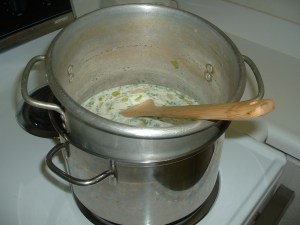
Note: if you don’t have large enough pots for the makeshift double boiler-see below photo and directions-just cook the soup over direct heat; this, however, may cause it to separate some, but this last option will reduce the cooking time.

1 tbsp oil  (Coconut or avocado oil is best; olive oil is carcinogenic at high temperatures.)

1 lg yellow onion, chopped

6 oz drained weight minced clams, or 3 strained 6.5 oz cans  (May use 6 oz fresh razor clams, chopped fine, see top photo.)

2 stalks celery, cut in 1/4″ dice

3 tbsp parsley, minced

1 lb potatoes, unpeeled, chopped in small 1/2″ pieces

5 lg cloves garlic, minced  (May use 3 cubes of frozen garlic from Trader Joe’s for easy prep.)

1 1/2 qt milk  (Whole milk is preferable, for both health and flavor.)

1 1/2 tsp salt, or to taste  (Himalayan, pink, or Real Salt is critical for optimum health; an inexpensive, fine grind, Himalayan salt is available at Costco.)

1/2 tsp white pepper, or to taste

3 tbsp butter

3 tbsp flour

  1. make-shift double boiler

    make-shift double boiler

    Heat oil, over medium heat, in a 4-quart pot that will sit inside a slightly larger pot to make a double boiler; see photo.  (If you don’t have two large pots, cook the chowder over direct heat; cooking will be faster with this last option, however, the cream soup may separate some.)

  2. When a small piece of onion sizzles in oil, add the rest of the onions and sweat, cook until translucent.  Remove from heat when done.
  3. Fill larger pot 2/5’s full of hot tap water, cover, and bring to a boil over med/high heat.
  4. Spray celery, parsley, and potatoes with a safe, inexpensive, effective produce spray: fill a spray bottle with a mixture of 97% distilled white vinegar and 3% hydrogen peroxide.  After spraying vegetables, let sit for 3 minutes, rinse really well.
  5. Drain canned clams in a colander.  If using fresh razor clams, drain and chop fine (see top photo).
  6. Chop all vegetables and garlic; add to pot of cooked onions.
  7. Add milk, clams, salt, and pepper to the pan of vegetables.  Fit this smaller pan into the larger pot, so it sits above the boiling water (see photo).  Watch water level while cooking to make sure water doesn’t boil dry.  Cook chowder until potatoes are soft, about 50 minutes.  Note: if preparing over direct heat, bring soup to a near-or slight-boil over medium heat; lower heat and simmer until potatoes are soft.  This option will lessen the cooking time.
  8. Meantime make roux, by melting butter in a small sauté pan over medium heat.  Add flour and stir constantly with a wire whisk.  Cook until light brown in color, about 2 minutes; set aside.
  9. When vegetables are soft, beat in roux with a big spoon; cook 5 more minutes, or until soup is thickened, stirring constantly.
  10. Adjust seasonings and serve.  May freeze leftovers; when you heat thawed chowder, however, it will be of a thinner consistency.  If desired, you may thicken with a small amount of roux-about 1 tbsp of melted butter cooked with an equal amount of flour-this amount will be adequate to thicken 4 leftover servings.
  11. I am passionate about this soup!