Parmesan Dover Sole

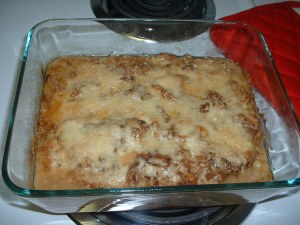
pan of baked Dover sole

Joy found in my gift of hospitality and fine food exploded when I was celebrating a belated Christmas get-together with Carol, a friend of 31 years.  Our time in each other’s company is always rich; my desire for our merrymaking was that my food would give honor, blessing our long-term bond.  This delicious dish answered this ambition beyond my expectations.  I share it here for your use with those close to you.

Friendship and food are both treasured gifts.  When we mix the two together, life pours forth.  I always endeavor to meet my guests’ particular needs, thus making each dinner engagement unique and exceptional.

For instance Carol doesn’t like hors d’ouvres, as they were never served in her family of origin; for her they take away from an acute appetite for the main meal.  Consequently, we just partake in tea and conversation for the first half hour of our gathering.

This sensible person has a heightened awareness of taste.  She knows good food and eats with purpose, maximally enjoying each bite.  This takes concentration; my friend allows herself this luxury; thus, we spend much of our repast in silence, focusing on gastronomic pleasures.

This discipline was first displayed to me when I was 20 years old, while waiting on table in my father’s restaurant.  (Joy unspeakable happened to me then, as I served the public with our exceptional ailments.)

My About Page on this website notes that which is true for each of us: it details the unfolding of my destiny, which has been happening throughout my entire life-I was born a food historian.  An excellent example of this destiny-making process is what I learned about the gift of hospitality, while serving the public in my youth; during that instructive time, a young couple showed me what a treasure stillness brings to eating.

Tourists peopled my family’s eatery in Glacier National Park and this unique pair was probably there on their honeymoon.  I initially approached their table with rousing emotion, my usual display of a genuine heartfelt welcome.  My spirit, however, was quickly corrected.  This excitable enthusiasm, which was normally highly pleasing to those on holiday, was not appropriate in their presence, for there was a holy reverence about them.  My sensitive response was an immediate change of demeanor.

Throughout their lengthy feast, I watched them with awe, as they indulged in each other’s company and our kitchen’s delights, in their unparalleled way.  I intuitively knew how to respect them with a quiet spirit.  This, however, was so foreign to me that I felt like I was walking on egg shells.  But oh the glory of it all!

Since then, God has given me a friend with whom I can practice what these two taught me, forty odd years ago.  Carol and I uphold veracity in all of life’s dealings; thus, even our eating is veracious.  Because of the honesty in our souls, we engage in veneration to God as we consume food; therefore, you can see my need for a dish that would rise to our integrity, which I knew would be present at this gathering.

My heart’s desire was met in this Parmesan Dover Sole recipe; how facile and pleasing it is beyond words.
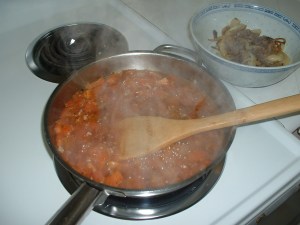
sauce cooking

Parmesan Dover Sole   Total prep time: 1 1/3 hr/  active prep time: 50 min/  baking time: 30 min.  Yields: 3-4 servings.  Note: you may double this recipe, leftovers are great, however fish only keeps for 3 days.

1/2 tsp oil  (Coconut oil is best here for flavor and quality; you may also use avocado oil; olive oil is carcinogenic, when heated to high temperatures.)

1 med yellow onion, halved at the root and cut in even 1/8 inch slices

5 med cloves garlic, minced  (May substitute 2 cubes frozen garlic from Trader Joe’s for easy prep.)

1 lb Roma tomatoes, chopped small  (Organic is best; the organic Roma variety is not that much more expensive than regular tomatoes.)

1/2 tsp sugar, optional  (This brings out the flavor in the tomatoes.)

1/2 tsp salt, or to taste  (Himalayan, pink, or Real Salt is critical for optimum health; a fine grind Himalayan salt is available at Costco for $4.95/5 lb.)

1/4 tsp fresh ground pepper, or to taste

1/2 tsp Better Than Bouillon  (This soup base, in either chicken or vegetable flavor, will do; available at most grocery stores.)

3/4 c boiling water

Spray oil  (Pam coconut spray oil is ideal, available more reasonably in our local Winco brand.)

1 lb Dover sole fillets, or other type of whitefish, such as flounder  (Dover sole is a type of sole that has very thin fillets, which is ideal for absorbing sauces; see Thai Coconut/Lime Flounder, 2016/12/05.)

1 c Parmesan cheese, grated or shaved

Rice, steamed according to directions on package

  1. Preheat oven to 350 degrees.  (If you prepare dish ahead of time, do steps 2 through 9 before hand; then, begin preheating oven 1 hour before serving.)
  2. beginning stages of caramelization

    Heat oil in a large sauté pan over med/low heat; add onions and caramelize, by stirring every several minutes until color starts to form (see photo); then, stir every minute until dark brown (see photo below). Do not crowd onions in pan, or they will sweat, taking much longer to cook.

  3. If using fresh garlic, chop and set aside.  Spray tomatoes with an inexpensive, effective vegetable spray, a mixture of 97% distilled white vinegar and 3% hydrogen peroxide; let sit for 3 minutes; rinse well.
  4. Meantime dissolve Better Than Bouillon in the hot water, set aside.
  5. Chop tomatoes in small pieces and place in another frying pan; add garlic, bouillon mixture, sugar, salt, and pepper, stirring well.  Bring to a boil over medium heat; then, turn heat down to med/low; simmer gently for about 20 minutes, or until a sauce is formed, with the tomatoes somewhat chunky (see above photo).  Adjust seasoning when sauce is complete. (For tips about cooking properly with garlic, see Tomato/Feta Chicken, 2016/07/25.)
  6. onions nearing finish

    Begin steaming the rice while tomatoes are cooking.  (If you are preparing this ahead of time, start this starch when you put cold fish dish in preheated oven, 50 minutes before serving.)

  7. For a single recipe, spray with oil a 9 1/2″ x 7 1/2″ x 3″ pan or 2 1/2-quart baking dish (for a double recipe, use a 9 1/2″ x 13″ x 2″ pan).  Place fish fillets in bottom of pan.
  8. Pour prepared sauce over raw fish and sprinkle with Parmesan cheese, see top photo.  (If preparing this ahead, refrigerate fish dish at this point.)
  9. Bake in preheated 350 degree oven for 30 to 50 minutes-time varies if fish is cold from the refrigerator.  Fish is done when its center is opaque and it flakes with a fork.
  10. Enjoy this incredibly good dish!  Leftovers are also delicious.

Butternut Squash Soup

butternut squash soup

butternut squash soup

Someone once said that a meal at my home is like going to a spiritual spa; with God’s help, I nourish both body and soul.

My creative sister concocted this great soup and gave the recipe to me years ago.  It has frequently graced my table, where my guests experience much peace.

My vision for this blog is to sustain people with wholesome food through the written word; thus, they will build strong bodies.  However, I am fully aware that a vibrant physique isn’t enough to insure complete health-that of body, mind, emotions, relationships, and finances.

How clear it is: we miss the totality of this by lack of knowledge!  My desire is that vital truth, which sets people free, will be revealed here gradually, primarily through the intriguing discipline of preparing food.

My lavish meals in my home feed many, both physically and spiritually; my blog contacts a great number more.  My personal prayers, however, expand to Uganda, England, Germany, Peru, Kenya, India-to mention a few of the nations that constitute the cry of my heart.

Chief among my steadfast petitions is that my writings/recipes, which go around the entire globe, will eradicate our health deficiencies-first those in our bodies and then in every other area of our lives.  God bless our journey together in this!

As an aside, my favorite way to entertain is by having only one or two guests, for the conversation is most intimate then.  I always keep individual containers of soup-holding several servings-in my freezer; thus, delicious soup is easy to serve at my small dinner parties.

May I suggest you buy a three-and-a-half-pound squash?  Save one pound of it for next week’s recipe-sautéed squash with curried yogurt sauce.  Also if you have leftovers of the soup, freeze some for unexpected visitors.

pot of butternut squash soup

soup with soft squash before pureeing

Butternut Squash Soup  Yields: 8-10 servings.  Total preparation time: 1 1/2 hr/ active prep time: 30 min/ cooking time: 1 hr.

2 tbsp oil  (Coconut or avocado oil is best.)

1 extra lg or 2 med onions, chopped

2 1/2 lb butternut squash, unpeeled and cut in chunks  (I prefer organic; you may buy an extra pound to cover next week’s recipe.)

2 quarts broth, preferably bone broth  (See recipe for this power food at Tortellini Soup, 2016/10/10.)

2 c water

1 tbsp cinnamon

1 tsp dried ginger

1/3 tsp nutmeg  (Freshly ground nutmeg is best.)

1/4 tsp ground cloves

2 tbsp fresh ginger, peeled and chopped fine, optional

1 1/2 tsp salt, or to taste  (Himalayan, pink, or Real Salt is critical for optimum health; an inexpensive fine grind Himalayan salt is available at Costco.)

1/4 tsp white pepper, or to taste

Better Than Bouillon, chicken flavor, to taste

  1. Heat oil in a stock pot over medium heat.  Add a small piece of onion; when it sizzles, add the rest of the onions and sweat (cook until translucent).
  2. Meanwhile clean squash with a safe, inexpensive, effective vegetable spray (a mixture of 97% white distilled vinegar and 3% hydrogen peroxide): spray squash, let sit for 3 minutes, rinse extra well.
  3. Cut unpeeled squash in chunks.  Be sure to remove the seeds first.  Add to cooked onions.
  4. Pour broth and 2 c of water in pot. Add spices, fresh ginger, salt and pepper.
  5. Cover and bring to a boil, over med/high heat.  Reduce heat, uncover, and simmer for 40-50 minutes, or until squash is very soft (see above photo).  Check for flavor during cooking and adjust spices to taste.
  6. Remove from heat and puree with an immersion blender.  (This is also known as a blender-on-a-stick; available at Bed, Bath and Beyond at a moderate price.)
  7. Add water, if soup is too thick.  Stir in Better Than Bouillon, to taste, starting with a teaspoonful.
  8. Finally adjust salt and pepper.  Serve hot, freeze any leftovers.

Thai Coconut/Lime Flounder

Salad with leftover Thai flounder

salad with leftover chilled Thai flounder

This delicious white fish dish resulted from a long-awaited-for marriage, which took place in my church in October.  A feast at my bountiful table was part of my wedding present to our venerated couple.

Our bride Dina was particularly interested in learning how to cook, with ease, for her new groom.  My bright idea was to begin my dinner gift in the kitchen with teaching her how to make the meal.  I prepared all the steps, just like you might see on a cooking show: the ingredients were set out in small individual dishes, along with the corresponding pans and utensils. All was in place for the lesson to flow naturally.

My priceless inheritance from my parents was a gene that “knows” food. Therefore I intuitively conceived this delicious dish, which was specifically geared for her husband’s dietary needs.  An exquisite, ultra simple recipe resulted.

Surprise and hesitancy occurred upon my friends’ arrival, as I informed Dina that she was going to make dinner, under my close direction.  She, being true to form, rolled up her sleeves with courage.  Her nervousness soon dissipated, for the facility of my simple instructions comforted her.  Joy unspeakable resulted: a chef was born! I have observed, as an aside, that this woman approaches all of life’s challenges with this same spirit.

Are you timid about stepping into the unknown, either in or out of the kitchen? May you receive encouragement to advance in faith; start by trying my recipes. They look lengthy at times, but are effortless!  The cause for this seeming protractedness is my inclusion of practical details, which make food preparation easy and enjoyable.  You’ll sense that you are in  cooking school, when you use my receipts, as I teach at every point.  Rest assured-I will educate you for the joy of cooking.

My favorite way to serve this smooth flounder, with its slight bite, is over a good pasta (however I used rice for my newly weds); either will bless the taste buds. Also, cold leftovers of this fish top off a salad superbly.

This feast pleased Dina and Dale; and me as well!

Thai coconut lime flounder dinner

Thai coconut/lime flounder dinner

Thai Coconut/Lime Flounder  Yields: 4 servings.  Total prep time: 40 minutes.

Note: flounders closely relate to soles; thus, you may substitute any sole here (also see Parmesan Dover Sole, 2017/03/27).

1 tsp coconut oil  (Other oils will do, but coconut is best for flavor and quality here.)

1 med yellow onion, halved at the core, and cut in even 1/8 inch slices

1 lime, juiced

7 oz Extra Thick Coconut Cream, or half of a 14 oz can  (This is available at Trader Joe’s.)

3/4 tsp dried, crushed red pepper  (Save spice jars and refill yearly with fresh, inexpensive “bulk’ spices.)

1/4 tsp salt

4 fillets of flounder, approximately 1 pound  (Wild-caught is best; may substitute a pound of sole, which is a close relative to flounder.)

Steamed rice or pasta, regular or gluten-free

  1. beginning stages of caramelization

    Start cooking rice, according to directions on package.  If using pasta, begin boiling water in a big pot; to which you add 2 tsp salt and 2 tbsp oil-any kind of oil will do.

  2. Place 4 individual dinner plates in oven; set the temperature on warm.
  3. Heat oil in a large sauté pan over med/low heat; stir in onions well; caramelize, by stirring every several minutes until they start to turn color (see photo); then, stir every minute until dark brown (see photo below); watch carefully while going to next steps.  (Do not crowd pan with onions, or they will sweat, taking much longer to cook.)
  4. Meanwhile roll lime on counter; press down hard with your hand, until the meat of the fruit is broken down and softened; juice lime; set aside.
  5. Place whole can of coconut oil in a small storage container; be sure first to gently stir milk and cream together thoroughly in can (this prevents a mess when emptying the can).
  6. Add half of the coconut cream (7 oz), lime, red pepper, and salt to caramelized onions.  Stir well and slowly bring to a soft boil over medium heat.  If preparing for guests, you may choose at this point, to set aside coconut/onion mixture and heat it 15 minutes before serving.  If you are waiting, be sure to have the plates warm, rice cooked, or water boiling when you start to cook the flounder.  (Note: you can freeze leftover coconut cream, or use within a week.)
  7. caramelized onions approaching finish

    Start cooking pasta in boiling water about 10 minutes before dinner time. Boil until it is al dente, about 7 minutes, do not over cook. Drain and place on heated dinner plates when done.

  8. Meanwhile add two fillets of flounder (more if using smaller sole) to hot coconut cream/onion mixture, which has been heated over medium temperature.  Poach briefly on each side, only until color in center is opaque.  Do not overcook.  Remove to heated dinner plates, on which you have placed pasta or rice.  Repeat this step with the remaining fillets.  Cover with sauce.
  9. Serve it forth!

Cooking with Kale Made Extra Easy

Chopping kale in food processor

chopping kale in food processor

Last week’s easy kale recipe may be simplified even further.

A dear one from my church shares my passion for excellence with food.  She recently rolled out the red carpet for a small group of us; a repast of splendor marked the celebration of what would have been the 49th anniversary of her marriage; she commemorated this occasion with her friends, as her husband went to heaven ten years now.  Her exquisite home and meal spoke volumes of exuberant love to my soul!  It foreshadowed the “marriage supper of the Lamb” for me.

This couple started the coffee movement.  Her husband trained a person who participated in creating one of the most popular, international, corporate franchises.  (Note: I will be doing a future post on this married team and the coffee development.)

My beloved fellow lover of foods has gifted me with new ailments; one such blessing was a bottle of Cherry Pomegranate Habanero Sauce from Robert Rothschild Farm; this inspired me to cook kale with a ready-made sauce.  Order this on-line or get it at Costco; any prepared sauce will work for the following recipe, of which a number are available at Trader Joe’s; thus, healthy fresh greens are made with the shortcut described below.

My other church friend, that provides the kale from her organic garden, shared her version for

Assembly of chopping attachment

assembly of chopping attachment

my receipt, which is makes this even easier.  She added a prepared spicy chicken, which she purchased from our upscale Whole Season’s Natural Foods; this eliminated the additional step of cooking the meat for this dish. The result was optimum health, heightened taste, and even greater culinary ease.

I use the food processor to chop all my leafy vegetables. (See how the assembled blade looks in the photo.)  Sometimes I have other greens on hand, such as beet tops, mustard greens, or spinach, which I mix in with my kale; this adds nutrition, when available. It only takes minutes to chop the prepared greens in this manner; I can’t encourage you enough to try these simple, healthy instructions.


Kale with Beef or Turkey and a Prepared Sauce  Yields: 4-6 servings.  Total prep time: 45 minutes.

8 1/2 teaspoons oil  (Coconut oil enhances flavor and quality here.)

1 medium yellow onion, halved at the core and cut in even 1/8 inch slices

1 lb ground turkey or beef  (Natural is best; Foster Farms natural ground turkey is inexpensive; a prepared meat from a deli is even quicker.)

Salt and pepper  (Himalayan, pink, or Real Salt is critical for optimum health; an inexpensive fine grind Himalayan salt is available at Costco.)

1-1 1/2 lb fresh kale  (Organic is best.)

4 carrots, thinly sliced, at a diagonal

8-12 oz jar of prepared sauce

Avocado, sliced

  1. beginning stages of carmelization

    Heat 1/2 teaspoon of oil in a saute pan over medium heat.  Test for readiness by placing small piece of onion in hot oil; the temperature is right when it sizzles. Reduce heat to med/low, add onions, and carmelize (cook until dark brown): stir once every several minutes until color starts to change (see photo); then, stir every minute until dark brown (see photo below). Watch carefully, as you go to next steps.

  2. Spray carrots and kale with produce spray (a mixture of 97% distilled white vinegar and 3% hydrogen peroxide is a safe, cheap, and effective cleaning solution).  Let vegetables sit three minutes; rinse three times in a sink full of water.
  3. Cook meat in 2 teaspoons of oil, in a large frying pan, over medium temperature; salt and pepper heavily before cooking; place in a bowl when done.  Set aside pan for future use.  (If using a prepared meat, omit this step.)
  4. Chop the wet kale in a food processor, by using the straight edge attachment (this is the large, round disk that fits onto the provided white “stem”-place this tall, assembled cutting disk in the food processor, where you normally put the smaller blade-see above photo).  Be sure to pick out large pieces of stem before setting aside chopped kale.  Note: you may chop this by hand, by first cutting out stems, then cutting kale into small pieces, using a sharp knife.
  5. finished carmelized onions

    Scrape cleaned carrots with knife (this preserves the vitamins just under the skin); slice carrots thinly, at a diagonal; set aside.

  6. Heat 1 tablespoon of oil over medium heat in pan the meat was cooked in; add carrots when a small piece sizzles in hot oil; cook covered for 2-3 minutes, or until tender, stirring occasionally.
  7. Place another tablespoon of oil in pan; add 1/2 the kale to carrots and distribute the oils, stirring well. (Be sure to check for big pieces of stem.) Repeat these steps with remaining kale; cook covered for 10 minutes, or until kale is limp; stir occasionally.
  8. When onion is caramelized, add meat and blend well.  Mix in  a generous amount of your favorite prepared sauce; flavor should be strong, as it will lighten, with the addition of vegetables.  Heat thoroughly.
  9. Add hot meat mixture into vegetables, when kale is cooked.
  10. Serve topped with fresh avocado slices.

Sprouted Quinoa and Yam Salad


sprouted quinoa and yam salad

sprouted quinoa and yam salad

Sherry, my beloved friend from Montana, sent me this healthy recipe, which I improved on.  It literally sings in your mouth!

I learned about quinoa from a woman who healed terminal illnesses with food; she was on my sister’s prayer team many years ago.  People from all over the United States were going to Jeanette for her healing ministry with diet; thus, her culinary wisdom became a gold mine for my sister Maureen and me.  Many things that I now recommend originated with her.

We learned that sprouted quinoa was considered the number one power food on planet earth.  Eggs and quinoa are the only foods that have all the amino acids, thus making them a complete protein.

I was a vegetarian for six years in my twenties.  Back then, much of my knowledge for healthy eating came from the marvelous cookbook by Francis Moore Lappe, Diet for a Small Planet (New York: Ballantine Books, 1971).  These recipes utilized balanced combinations of plant foods and dairy; the combining of their differing amino acids complimented each other to make complete proteins.  For instance, its memorable Indian Pudding called for a balance of cornmeal, soy grits, milk, and eggs to form a strong protein; how I relished it hot, with rich vanilla ice cream melting around the edges, and I still do.

I was quite skilled in cooking this way in the 1970’s.  Just prior to moving to Tokyo in the fall of 1981, however, I began eating meat once again.  My father gently reproved me, for waiting until this move to do so, because beef was exorbitantly expensive in Japan, while being relatively cheap in America.  My thinking was that  I needed to be prepared for gracious Oriental hospitality.

Recently I made my friend Sherry’s simple recipe for quinoa and yam salad; nevertheless, I tweaked it.  Its food value is amplified by using what I learned from my sister’s prayer partner, the healer Jeanette.  Here I sprouted this ancient grain from Peru, which increases its food value dramatically.  Also I worked with the colors of the foods (color is real important); I incorporated red raspberries, purple sweet potato, and orange carrots.  Another important recommendation is the use of coconut or avocado oil, which is critical, as olive oil is a carcinogenic when heated to high temperatures.

This healthy salad is dynamite!  Make an abundance of it for leftovers.

To learn the differences between sweet potatoes and yams, go to African Nkyemire; for another great recipe using this tuber, go to Sweet Potato Pie, 2016/12/19.

Sprouted Quinoa and Yam Salad  Yields: 4 servings.  Total prep time 2 days (for sprouting quinoa)/  active prep time: 1 hr.

1 c quinoa, sprouted  (Sprouting directions are below; make 2 days ahead.)

1 tsp oil  (Coconut or avocado oil is best; olive oil is carcinogenic when heated to high temperatures.)

1 med yellow onion,  cut in even 1/8-inch slices

1 1/2 c yams, peeled and cut in 5/8-inch cubes  (Organic purple sweet potatoes are ideal; sweet potatoes and yams are just differing names for the same vegetable; they are interchangeable.)

2 med carrots, cut in 5/8-inch cubes

2 stalks celery, cut in 5/8-inch cubes

4 lg garlic cloves, chopped fine  (For easy preparation, may use 2 frozen garlic cubes from Trader Joe’s.)

2 tbsp freshly squeezed lemon juice

1 tbsp Bragg’s Amino Acids  (Available in any health store.)

1 tbsp real maple syrup

3/4 tsp dried cumin

Spinach or lettuce leaves

Fresh raspberries or dried cranberries, for garnish

Agave-roasted nuts  (See recipe in ‘Healthy Green Salads’, 2016/08/15.)

  1. Soak quinoa in ample water for 8 hours; drain well and let sit for 1-2 days, rinsing about every 8-12 hours.  The sprouting is complete when legs are at least 1/4 inch long.  (The sprouting may be done in a special sprouting jar, a bowl, or on a tray-if your choice is a tray, use parchment paper both under and on top of the grain.)  Note: this process brings the enzymes alive and increases food value dramatically.  For more details on sprouting see wikihow.com/Sprout-Quinoa
  2. For saving sprouted quinoa, place it in a sealed storage bag or jar, and refrigerate for up to 2 weeks.  Optional: if you are not ready to use the sprouts immediately, you may, with the use of clean parchment paper, spread them on a tray or large plate, to allow excess moisture to dry from sprouts (be sure not to rinse again before you start this drying process).  They should dry in about 12 hours; this aids in long-term storage.
  3. Heat oil in a large frying pan over med/low heat; add onion and caramelize, cook slowly until deep brown in color.  Stir every few minutes until onions begin sticking to bottom of pan and color just starts to turn; then, stir every minute, until dark brown.  For more detail on caramelizing onions, see Caramelized Onions and Carrots (2017/06/19).
  4. In the meantime, spray vegetables with an effective, safe solution (combine 97% distilled white vinegar and 3% hydrogen peroxide in a spray bottle); let sit for three minutes; rinse really well.  This kills parasites and cleanses inexpensively.
  5. Rather than peel carrots, scrape them with a sharp knife, to preserve vitamins just under the skin.  Peel yams.  Cut all vegetables into small, 5/8-inch cubes, set aside.
  6. Combine lemon juice, Braggs, maple syrup, and cumin in a large bowl; set aside.
  7. Add vegetables to hot caramelized onions; stir well to distribute oils.   Place 1/4 c water in with vegetables and cook covered, over medium heat,  for about 15 minutes, or until yams are tender, stirring occasionally.
  8. Blend fresh garlic into vegetable mixture; sauté only until you can smell the herb, about 20 seconds (if you are using frozen garlic, cook just until it thaws, stirring well).
  9. Place yam mixture and quinoa in bowl with salad dressing, mix well, chill several hours.
  10. Serve on a bed of lettuce or fresh spinach.
  11. Top with fruit and nuts.

Healthy Green Salads

building a healthy salad

building a healthy salad

Strength-giving salads have been the mainstay of my evening meals for many years; they delight me. Recently I taught a class on how to maintain robust bodies by building wholesome salads.  This next series spells pleasure in hearty recipes for glorious greens and more.  Here I begin with the basic steps for creating these leafy dishes.

Healthy Salads

A variety of vibrant greens are good for the body. Spinach is high in iron, but too much of this raw vegetable is not wise.  So balance raw and cooked spinach.  A little vitamin C (tomatoes, citrus, pineapple, etc.) helps the absorption of the iron.

Beef or chicken can be added.  These meats are high in iron and protein.  Good quality eggs, beans, tuna, and cheese are also excellent protein sources.

Dried fruit (dates, cranberries, apricots, figs, raisins…organic is best) add a beautiful contrast of sweetness.  Avocados are dynamite!

Choose an assortment of fresh vegetables, such as carrots, celery, radishes, bell peppers, etc.  It’s important to use organic peppers, as this vegetable really absorb pesticides.   Organic carrots are really inexpensive.

Roasted agave nuts (see recipe below) and homemade croutons (see recipe below) add texture and protein.  Note: organic bread is a good protein source.

Nourishing homemade dressings save lots of money and explode with good flavor. (Recipes to follow in upcoming posts.)

Roasted Agave Nuts  Yields: 1 lb.  Total prep time: 50 min/  active prep time: 10 min/  baking time: 40 min.

  1. Buy 1 lb of an assortment of whole raw pecans, almonds, walnuts, and cashews in the bulk food section.  (Cashew pieces work well and are cheaper.)  I like to weigh out ¼ lb packages of each at the store.
  2. Preheat oven to 265 degrees.
  3. In a large bowl, pour 1/4 cup Organic Raw Blue Agave Sweetener.  (Available at a good price at Trader Joe’s.)  Blend in 3/4 tsp cayenne pepper (or to taste) and 2 tsp cinnamon.
  4. Add 1 lb of mixed raw nuts.  Stir well, until all the nuts are coated.
  5. Cover an 11 ½ x 17 ½ cookie sheet with a piece of parchment paper. Spray parchment really well with spray oil (Pam Coconut Spray Oil is best.)  This is essential, or nuts stick to the paper.
  6. Spread nuts evenly on oiled parchment.  Bake for 40 minutes.
  7. Remove from oven.  Sprinkle generously with salt WHILE HOT.  (Himalayan, pink, or Real Salt is critical for optimum health; an inexpensive fine grind Himalayan salt is available at Costco.)
  8. Nuts must be hot for salt to stick.  IF you forget to salt while hot, place them in hot oven again, until they are reheated.  Then salt and cool.  Break apart and store in sealed container at room temperature. Keeps well.

Homemade Croutons  Yields: 1/2 gallon-size storage bag.  Total prep time: about 1 1/4 hr/ active prep time: 15 min/  baking time: about 1 hr.  Note: dry bread out, for 8 hr ahead of time, on a cookie sheet.

  1. May use gluten-free, homemade bread, Dave’s Killer Bread, or Franz organic Great Seed. (I grind my own organic wheat berries for my bread, however, croutons from store-bought bread aren’t as hard as that made from my homemade bread.  I prefer Franz organic bread, which makes an excellent crouton high in nutrients and protein.)
  2. Make sure bread is stale.  May partially dry by leaving it exposed to the air for up to 8 hours.  You may store bread in a sealed plastic bag after drying, if you are not ready to bake immediately.  Don’t get bread super stale, or the butter won’t distribute evenly.  Expose slices for about 8 hours in the humid Northwest; adjust time for a drier climate.  Bread should be somewhat dried out, firm to the touch, but not hard.
  3. Preheat oven to 265 degrees.
  4. Cut bread in cubes.  Use 1/2 of 1 lb loaf of bread for one large cookie sheet.
  5. Melt 6 ounces of butter in a large frying pan.
  6. Add 3/4 tsp cayenne pepper, or to taste.  Stir in 1 tsp salt (Himalayan, pink, or Real Salt is best).  Mix seasoning well into melted butter.
  7. Add bread cubes.  Stir thoroughly, until bread is fairly evenly coated.
  8. Place bread cubes on an 11 ½ x 17 ½ inch cookie sheet, distributing evenly so heat can reach all.
  9. Bake for 45 minutes.  Check for dryness; if not crunchy, bake for 15 more minutes.  Repeat this last step until croutons are completely dried.
  10. Cool and store at room temperature in a sealed gallon-size storage bag. They keep indefinitely.

Tomato/Feta Chicken

Tomato/feta chicken

tomato/feta chicken

An explosion of creativity occurred in my sister’s upscale kitchen this month: my siblings and I collaborated over one of my recipes during a trip home for my mother’s 93rd birthday.  Our three strong cooking minds worked together to perfect a dish I created years ago.

Nearly a decade has passed since I helped a friend every Monday, for she was bogged down in her professional responsibilities.  Aromatic ailments filled pots and pans, as I prepared her family’s nourishment for each upcoming week.

This particular friend had been to cooking school in Italy; her excellent input and feed-back sharpened my skills, while I was helping her family.  At her home, I created this recipe for tomato/feta chicken, which my siblings Maureen and Paul helped perfect recently.

One thing I learned from my friend was to add the garlic at the close of the sautéing process; she said this keeps it from burning.  I was adding it before this, as I was cooking the meat.  My friend’s ingenious tongue could taste the burnt garlic; thus, she suggested that I add it at the very end, which is how I had cooked with this herb since.

However, my siblings suggested that adding it early on allows for more flavor.  My brother explained the proper process: when you add garlic, while sautéing, cook only until you can smell it; then, immediately add the liquid for the sauce, to keep it from burning.

My sister employs an even more advanced method: she roasts lots of whole peeled cloves on a cookie sheet, in a preheated 300 degree oven, for at least an hour (or until golden brown). She stores this in the refrigerator, adding about three tablespoons per four-serving dish, while the dish is cooking-only cook briefly, however, if dish is dry.

After tasting our finished work, I am sold on cooking this herb longer, employing these safe ways.  The following recipe reflects this new directive; here the fresh garlic is cooked for a lengthy time in the wet tomatoes.

There was another point I learned from my siblings’ expertise.  Both urged me not to bother with washing pieces of cut meat; it is only necessary to clean the inside of the carcasses of fowl, where blood has collected.  This has made cooking easier for me.

This tomato/feta chicken recipe is exceptionally good; enjoy it!

Tomato/Feta Chicken  Yields: 4-6 servings.  Total prep time: 1 1/4 hr.

1 med/lg yellow onion, halved and cut in even 1/8″ slices

5 tsp oil  (Coconut or avocado oil is best, as olive oil is carcinogenic when heated to high temperatures.)

8 chicken tenderloins, thawed in water  (The frozen ones at Trader Joe’s are all natural and a good price.)

Salt and pepper to taste  (Himalayan, pink, or Real Salt is critical for optimum health; a fine grind Himalayan salt is available inexpensively at Costco.)

4 ripe tomatoes, chopped  (These must be ripe; organic is best.)

3/4 tsp dried oregano  (Organic is available at Trader’s; it is of excellent quality and very inexpensive.)

1 tsp dried basil

3-5 lg cloves of garlic, chopped fine  (2 cubes of frozen garlic from Trader’s is a much easier prep.)

1-16 oz package frozen broccoli florettes  (An inexpensive, organic variety is available at Trader’s.)

4 oz feta cheese  (This is best, when purchased in an 8-oz block, rather than the pre-crumbled version, which has been treated.)

Shaved or grated Parmesan cheese

Steamed brown rice (I prefer basmati brown rice)

  1. Take frozen broccoli out of freezer; it cooks better when partially thawed.  (Better yet, leave it in the refrigerator over night.)
  2. If chicken tenderloins are frozen, you may thaw them in warm water.  Pat dry with paper towel.
  3. caramelized onions

    In a large heavy-bottom frying pan, heat 1 tsp oil over med/low heat. Add onion and caramelize, cook slowly until dark brown.  Note: do not crowd onions in pan, or they will sweat and it takes longer to caramelize them.  Stir every few minutes for about the first 30 minutes; then, stir every minute afterwards, as onions begin to stick to pan and browning process accelerates; see photo. (For more details on caramelizing, see Caramelized Onions and Carrots-2017/06/19.)  Meanwhile go to next step.

  4. Chop tomatoes and garlic; set each aside separately.
  5. Heat remaining 1 1/2 tbsp oil in another large skillet.  Salt and pepper tenderloins generously; place chicken in hot oil, sautéing over medium heat quickly.  Cut tenderloins with spatula, as cooking, to check for doneness (should be slightly pink in center as they will cook more later).   As pieces are done, place in a bowl, saving juices in pan.  May add onions to this bowl, when they are done.
  6. Add tomatoes to hot pan in which you cooked the chicken; simmer over med/low heat for 10 minutes. Add dried herbs and garlic; cook down to a chunky sauce, about 20 minutes more.  Season with salt and pepper to taste.
  7. When onions, chicken, and tomatoes are cooked, may set all aside and finish recipe just before serving, if desired.
  8. When you are ready to serve, add thawed broccoli to pan of tomatoes and simmer over medium heat; cook until vegetables are tender and hot.
  9. Distribute chicken and onions in tomato sauce/broccoli; heat mixture.  Stir in feta, crumbling it with your fingers; adjust seasonings.  Cook briefly, so feta doesn’t completely melt.
  10. Serve over rice; top with shaved Parmesan cheese.

Chicken a l’Oignon

Preparation of Chicken a l'Oignon

preparation of Chicken a l’Oignon

I will be giving easy recipes for a complete 19th century French dinner over the next three posts.  The main entrée for this meal is Chicken a l’Oignon (chicken with onion); this receipt was created by Louis Eustache Ude, chef to King Louis XVI, at the time of the French Revolution.

Our chef of renown escaped France during the tumult and moved to England; here he wrote the cookbook The French Cook, published in 1813.  His English was poor; thus, he lapsed into his native tongue when he couldn’t recall the proper English words; the title Chicken a l’Oignon demonstrates this trait of Ude.

His food preparations tended to be very simple and exceptionally elegant, of which the following is a perfect example.  Here thinly sliced onion is stuffed under the skin over the breast meat of a roaster; you do this by gently making a cavity under the skin with your hand; hence, the onion juices seep into this succulent meat, as it is roasted to perfection.  The results are tantalizing!

The ease with which you make this dish will astound you. Trust me it will become a family favorite.

Be sure to save the carcass for bone broth; instructions for this are given in Tortellini Sausage Soup; meanwhile freeze your leftover carcasses, until you have the needed three for the recipe.

Note: Bone broth is a power food, extremely high in protein; it is packed with nutrients that aid the digestive system and build up your adrenal glands; one cup of regular chicken stock has one gram of protein, while one cup of bone broth has nine grams of this essential food item!  The manner of preparation makes all the difference in producing these two diverse broths.  Buying prepared bone broth is highly expensive, while making your own is practically free!

Chicken a l’Oignon   Adapted from a recipe in Esther B. Aresty’s The Delectable Past (New York: Simon and Schuster, 1964).  Yields about 5 servings.  Total prep time: about 2 1/4 hr/  active prep time: 10 min/  cooking time: about 1 3/4 hr/  inactive prep time: 15 min.

4 ½-5 pound chicken  (Foster Farms is all-natural and inexpensive.)

1 large yellow onion, halved and sliced thinly

Spray oil

Salt and pepper  (Real Salt is best; available in the health section of your local supermarket.)

Steamed brown rice  (I prefer basmati brown rice.)

  1. Preheat oven to 450 degrees.
  2. Wash the inside of the chicken.  (Note: it isn’t necessary to wash meat, which is cut; only whole fowl, where blood is caught inside the carcass.)
  3. Cut off excess fat at neck; salt and pepper inside of chicken.
  4. Gently working your hand under the skin, make a cavity between the skin and the breast meat.  Go down into the thigh meat with your fingers, being careful to not tear skin.
  5. Gently stuff onion slices in the cavity over the breast meat, pushing them down over the thigh meat area by the legs.
  6. Using a cheap, canola spray oil, thoroughly spray the inside and top (also the underside of upper rack and edges) of a broiler pan; this makes cleaning extremely easy!
  7. Place chicken on pan, salt and pepper generously.
  8. Put in oven, reducing heat to 350 degrees immediately.  Bake for 20 minutes for each pound; temperature should be 165 degrees when done-legs should move fairly freely and juices should come forth, when skin is pierced.
  9. Remove from oven and let stand for 15 minutes before carving.
  10. Serve with steamed brown rice.