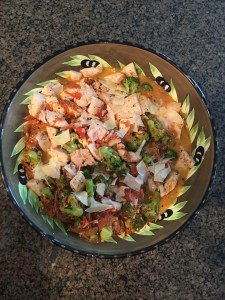
A Simple “Frittata”

dinner with Dave

dinner with Dave

My pastors provide our congregation with fruits of their labors during the harvest season; this year’s bumper crop of tomatoes and zucchini inspired Pastor Dawn to create this frittata-like dish, which I have expanded on here. It boasts of these rich autumn vegetables. The receipt is so easy that it cries out for many encores.

The traditional frittata, or Italian omelette, has a two-stage cooking process.  You normally begin making this egg dish on the stove top and finish it in the oven. One may even purchase special pans for preparing this.  However my simplified version is made in a frying pan, solely on top of a burner.

The original frittata is a cross between an omelette and quiche, which is comprised mostly of eggs with some vegetables.
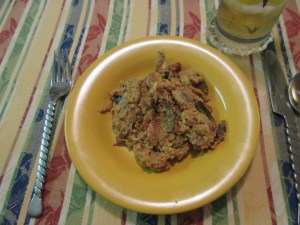
"frittata"

“frittata”

On the contrary, my “frittata” is mostly vegetables with several eggs scrambled in.  There is no guessing with these easy steps of preparation. The result is intense flavor, good protein, and creative cooking with fall produce.

My beloved cousin and his wife, whom I hadn’t seen since 1995, were here for dinner several weeks ago.  We indulged in this European creation and my honeyed-lime kale with turkey. (See Cooking with Kale, 2016/09/07.) The presence of God and this delicious food nourished our souls during our lavish repast.

You will relish this “frittata”-it is so good!  Enjoy.

A Simple “Frittata”  Yields: 4-6 servings.

1 tbsp oil  (Coconut or avocado oil is best.)

1 med yellow onion, halved at the core and thinly sliced

3 med/large tomatoes cut in eighths

2 med/small zucchinis, thinly sliced

½ tsp dried oregano  (A great, inexpensive, organic variety is available at Trader Joe’s.)

3/4 tsp dried basil

4 lg cloves of garlic, minced  (May use 2 cubes of frozen garlic from Trader’s.)

Salt and pepper to taste  (Real Salt is best, available in health section of local supermarket.)

4 lg white mushrooms, brushed, with mushroom brush, and sliced

3 oz good quality cheese, grated

3 lg eggs, beaten  (I like to use duck eggs, which are creamier and higher in protein.)

  1. Heat oil in a large frying pan over medium heat. Place a small piece of onion in hot oil. When it sizzles, add the rest of the onions.  Cook until golden brown; stir occasionally.
  2. Add chopped tomatoes, zucchini, herbs, garlic, salt, and pepper. Reduce heat to med/low. Cook vegetables about 40 minutes, or until liquid is gone and sauce is thick. Be sure to stir occasionally. Watch carefully toward the end of cooking, so vegetables don’t burn.  (May set aside at this point and reheat, to finish recipe, just before serving.  Watch carefully when reheating, so as not to burn the sauce.)
  3. Add mushrooms and cheese to hot sauce. Stir well.
  4. Add eggs to vegetables; stir gently several times, as they cook. Cook until eggs are done. Mixture will be soft.
  5. Adjust seasonings.
  6. This is delicious served hot, room temperature, or ice cold.  Leftovers are great!
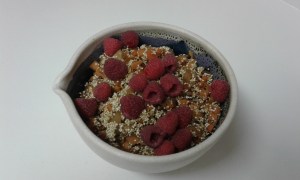
Sprouted Quinoa and Yam Salad


sprouted quinoa and yam salad

sprouted quinoa and yam salad

Sherry, my beloved friend from Montana, sent me this healthy recipe, which I improved on.  It literally sings in your mouth!

I learned about quinoa from a woman who healed terminal illnesses with food; she was on my sister’s prayer team many years ago.  People from all over the United States were going to Jeanette for her healing ministry with diet; thus, her culinary wisdom became a gold mine for my sister Maureen and me.  Many things that I now recommend originated with her.

We learned that sprouted quinoa was considered the number one power food on planet earth.  Eggs and quinoa are the only foods that have all the amino acids, thus making them a complete protein.

I was a vegetarian for six years in my twenties.  Back then, much of my knowledge for healthy eating came from the marvelous cookbook by Francis Moore Lappe, Diet for a Small Planet (New York: Ballantine Books, 1971).  These recipes utilized balanced combinations of plant foods and dairy; the combining of their differing amino acids complimented each other to make complete proteins.  For instance, its memorable Indian Pudding called for a balance of cornmeal, soy grits, milk, and eggs to form a strong protein; how I relished it hot, with rich vanilla ice cream melting around the edges, and I still do.

I was quite skilled in cooking this way in the 1970’s.  Just prior to moving to Tokyo in the fall of 1981, however, I began eating meat once again.  My father gently reproved me, for waiting until this move to do so, because beef was exorbitantly expensive in Japan, while being relatively cheap in America.  My thinking was that  I needed to be prepared for gracious Oriental hospitality.

Recently I made my friend Sherry’s simple recipe for quinoa and yam salad; nevertheless, I tweaked it.  Its food value is amplified by using what I learned from my sister’s prayer partner, the healer Jeanette.  Here I sprouted this ancient grain from Peru, which increases its food value dramatically.  Also I worked with the colors of the foods (color is real important); I incorporated red raspberries, purple sweet potato, and orange carrots.  Another important recommendation is the use of coconut or avocado oil, which is critical, as olive oil is a carcinogenic when heated to high temperatures.

This healthy salad is dynamite!  Make an abundance of it for leftovers.

To learn the differences between sweet potatoes and yams, go to African Nkyemire; for another great recipe using this tuber, go to Sweet Potato Pie, 2016/12/19.

Sprouted Quinoa and Yam Salad  Yields: 4 servings.  Total prep time 2 days (for sprouting quinoa)/  active prep time: 1 hr.

1 c quinoa, sprouted  (Sprouting directions are below; make 2 days ahead.)

1 tsp oil  (Coconut or avocado oil is best; olive oil is carcinogenic when heated to high temperatures.)

1 med yellow onion,  cut in even 1/8-inch slices

1 1/2 c yams, peeled and cut in 5/8-inch cubes  (Organic purple sweet potatoes are ideal; sweet potatoes and yams are just differing names for the same vegetable; they are interchangeable.)

2 med carrots, cut in 5/8-inch cubes

2 stalks celery, cut in 5/8-inch cubes

4 lg garlic cloves, chopped fine  (For easy preparation, may use 2 frozen garlic cubes from Trader Joe’s.)

2 tbsp freshly squeezed lemon juice

1 tbsp Bragg’s Amino Acids  (Available in any health store.)

1 tbsp real maple syrup

3/4 tsp dried cumin

Spinach or lettuce leaves

Fresh raspberries or dried cranberries, for garnish

Agave-roasted nuts  (See recipe in ‘Healthy Green Salads’, 2016/08/15.)

  1. Soak quinoa in ample water for 8 hours; drain well and let sit for 1-2 days, rinsing about every 8-12 hours.  The sprouting is complete when legs are at least 1/4 inch long.  (The sprouting may be done in a special sprouting jar, a bowl, or on a tray-if your choice is a tray, use parchment paper both under and on top of the grain.)  Note: this process brings the enzymes alive and increases food value dramatically.  For more details on sprouting see wikihow.com/Sprout-Quinoa
  2. For saving sprouted quinoa, place it in a sealed storage bag or jar, and refrigerate for up to 2 weeks.  Optional: if you are not ready to use the sprouts immediately, you may, with the use of clean parchment paper, spread them on a tray or large plate, to allow excess moisture to dry from sprouts (be sure not to rinse again before you start this drying process).  They should dry in about 12 hours; this aids in long-term storage.
  3. Heat oil in a large frying pan over med/low heat; add onion and caramelize, cook slowly until deep brown in color.  Stir every few minutes until onions begin sticking to bottom of pan and color just starts to turn; then, stir every minute, until dark brown.  For more detail on caramelizing onions, see Caramelized Onions and Carrots (2017/06/19).
  4. In the meantime, spray vegetables with an effective, safe solution (combine 97% distilled white vinegar and 3% hydrogen peroxide in a spray bottle); let sit for three minutes; rinse really well.  This kills parasites and cleanses inexpensively.
  5. Rather than peel carrots, scrape them with a sharp knife, to preserve vitamins just under the skin.  Peel yams.  Cut all vegetables into small, 5/8-inch cubes, set aside.
  6. Combine lemon juice, Braggs, maple syrup, and cumin in a large bowl; set aside.
  7. Add vegetables to hot caramelized onions; stir well to distribute oils.   Place 1/4 c water in with vegetables and cook covered, over medium heat,  for about 15 minutes, or until yams are tender, stirring occasionally.
  8. Blend fresh garlic into vegetable mixture; sauté only until you can smell the herb, about 20 seconds (if you are using frozen garlic, cook just until it thaws, stirring well).
  9. Place yam mixture and quinoa in bowl with salad dressing, mix well, chill several hours.
  10. Serve on a bed of lettuce or fresh spinach.
  11. Top with fruit and nuts.

Tomato/Feta Chicken

Tomato/feta chicken

tomato/feta chicken

An explosion of creativity occurred in my sister’s upscale kitchen this month: my siblings and I collaborated over one of my recipes during a trip home for my mother’s 93rd birthday.  Our three strong cooking minds worked together to perfect a dish I created years ago.

Nearly a decade has passed since I helped a friend every Monday, for she was bogged down in her professional responsibilities.  Aromatic ailments filled pots and pans, as I prepared her family’s nourishment for each upcoming week.

This particular friend had been to cooking school in Italy; her excellent input and feed-back sharpened my skills, while I was helping her family.  At her home, I created this recipe for tomato/feta chicken, which my siblings Maureen and Paul helped perfect recently.

One thing I learned from my friend was to add the garlic at the close of the sautéing process; she said this keeps it from burning.  I was adding it before this, as I was cooking the meat.  My friend’s ingenious tongue could taste the burnt garlic; thus, she suggested that I add it at the very end, which is how I had cooked with this herb since.

However, my siblings suggested that adding it early on allows for more flavor.  My brother explained the proper process: when you add garlic, while sautéing, cook only until you can smell it; then, immediately add the liquid for the sauce, to keep it from burning.

My sister employs an even more advanced method: she roasts lots of whole peeled cloves on a cookie sheet, in a preheated 300 degree oven, for at least an hour (or until golden brown). She stores this in the refrigerator, adding about three tablespoons per four-serving dish, while the dish is cooking-only cook briefly, however, if dish is dry.

After tasting our finished work, I am sold on cooking this herb longer, employing these safe ways.  The following recipe reflects this new directive; here the fresh garlic is cooked for a lengthy time in the wet tomatoes.

There was another point I learned from my siblings’ expertise.  Both urged me not to bother with washing pieces of cut meat; it is only necessary to clean the inside of the carcasses of fowl, where blood has collected.  This has made cooking easier for me.

This tomato/feta chicken recipe is exceptionally good; enjoy it!

Tomato/Feta Chicken  Yields: 4-6 servings.  Total prep time: 1 1/4 hr.

1 med/lg yellow onion, halved and cut in even 1/8″ slices

5 tsp oil  (Coconut or avocado oil is best, as olive oil is carcinogenic when heated to high temperatures.)

8 chicken tenderloins, thawed in water  (The frozen ones at Trader Joe’s are all natural and a good price.)

Salt and pepper to taste  (Himalayan, pink, or Real Salt is critical for optimum health; a fine grind Himalayan salt is available inexpensively at Costco.)

4 ripe tomatoes, chopped  (These must be ripe; organic is best.)

3/4 tsp dried oregano  (Organic is available at Trader’s; it is of excellent quality and very inexpensive.)

1 tsp dried basil

3-5 lg cloves of garlic, chopped fine  (2 cubes of frozen garlic from Trader’s is a much easier prep.)

1-16 oz package frozen broccoli florettes  (An inexpensive, organic variety is available at Trader’s.)

4 oz feta cheese  (This is best, when purchased in an 8-oz block, rather than the pre-crumbled version, which has been treated.)

Shaved or grated Parmesan cheese

Steamed brown rice (I prefer basmati brown rice)

  1. Take frozen broccoli out of freezer; it cooks better when partially thawed.  (Better yet, leave it in the refrigerator over night.)
  2. If chicken tenderloins are frozen, you may thaw them in warm water.  Pat dry with paper towel.
  3. caramelized onions

    In a large heavy-bottom frying pan, heat 1 tsp oil over med/low heat. Add onion and caramelize, cook slowly until dark brown.  Note: do not crowd onions in pan, or they will sweat and it takes longer to caramelize them.  Stir every few minutes for about the first 30 minutes; then, stir every minute afterwards, as onions begin to stick to pan and browning process accelerates; see photo. (For more details on caramelizing, see Caramelized Onions and Carrots-2017/06/19.)  Meanwhile go to next step.

  4. Chop tomatoes and garlic; set each aside separately.
  5. Heat remaining 1 1/2 tbsp oil in another large skillet.  Salt and pepper tenderloins generously; place chicken in hot oil, sautéing over medium heat quickly.  Cut tenderloins with spatula, as cooking, to check for doneness (should be slightly pink in center as they will cook more later).   As pieces are done, place in a bowl, saving juices in pan.  May add onions to this bowl, when they are done.
  6. Add tomatoes to hot pan in which you cooked the chicken; simmer over med/low heat for 10 minutes. Add dried herbs and garlic; cook down to a chunky sauce, about 20 minutes more.  Season with salt and pepper to taste.
  7. When onions, chicken, and tomatoes are cooked, may set all aside and finish recipe just before serving, if desired.
  8. When you are ready to serve, add thawed broccoli to pan of tomatoes and simmer over medium heat; cook until vegetables are tender and hot.
  9. Distribute chicken and onions in tomato sauce/broccoli; heat mixture.  Stir in feta, crumbling it with your fingers; adjust seasonings.  Cook briefly, so feta doesn’t completely melt.
  10. Serve over rice; top with shaved Parmesan cheese.

Curried Pineapple Ahi Tuna

Curried pineapple ahi tuna

curried pineapple ahi tuna

I had a fresh pineapple crying out to be used and a dinner guest about to arrive. This easy, outstanding dish resulted that tantalized my company. The sauce may be prepared ahead of time; you may cook the tuna just prior to serving it.

Nearly every person in my family (parents, siblings, nieces, and nephews) possesses this gift of developing imaginative, delicious recipes. Many are, or have been, professional chefs.  My brother Paul and sister Maureen were the backbone of inspiration behind my family’s restaurant high in the Rocky Mountains, at the east entrance to Glacier National Park in Montana.  This establishment belonged to my family for just over 50 years; it was famous in its day for its cherished food.  Paul and Maureen brought their polished innovations to our eatery.

My sister has taught me so much about cooking with optimum health benefits.   She is a master at creating beautiful foods that nourish body and soul.  I am so indebted to her for her nutritive excellence in my skills.

Intuitive wisdom about the preparation of ailments is in my family’s genes. It’s my fundamental inheritance:  I just know how to cook. My “formal” training in this endeavor is limited to one day, as a visitor, at Cordon Blue Cooking School in Paris, France.  The lesson was taught in French, of which I understood very little, but the dishes looked, smelled, and tasted glorious!  Note: I am the only one in my clan that applied higher education in food history to our joy of cooking.

Curried Pineapple Ahi Tuna  Simple and superb!  Yields: 4 servings.  Total prep time: 1 1/4 hr.

1 1/2 tbsp oil  (Coconut or avocado oil is best, as olive oil is carcinogenic when heated to high temperatures.)

1 med yellow onion, halved and thinly sliced

3 lg carrots, thinly sliced at a diagonal

10 oz frozen broccoli florettes, partially thawed  (Trader Joe’s has a good buy on organic.)

2 tbsp butter

4 tbsp flour

1-15 oz can of chicken, vegetable, or fish broth

2 c of fresh pineapple, cut in small pieces  (May substitute well-drained, canned crushed pineapple.)

4 ahi tuna steaks

salt and pepper to taste  (Himalayan, pink, or Real Salt is critical for optimum health; an inexpensive fine grind Himalayan salt is available at Costco.)

Brown rice, cooked according to directions on package

  1. Caramelize onions, by melting 1/2 tsp of coconut oil in a large frying pan, over medium heat.  When a small piece sizzles in oil, add rest of onion.  Reduce heat to med/low; stir every several minutes until onions begin turning in color; then, stir every minute until they are a dark brown.
  2. Heat remaining coconut oil in another pan; add carrots and broccoli and cook until tender. When done, add cooked onions.
  3. Melt butter in a medium saucepan. Add flour. Whisk and cook over a medium heat for 30 seconds. Slowly add broth, whisking well with each addition. Cook until thickened, stirring with whisk. Add pineapple (sauce will get runny with fruit.) Cook, whisking, until thickened again-it won’t be quite as thick.  Add to vegetables in the large frying pan. Season to taste with salt and pepper.
  4. May set aside at this point and finish, by cooking tuna, just before serving.
  5. Wash tuna steaks and pat dry. Salt and pepper generously.
  6. Place steaks in hot sauce mixture and poach. DO NOT OVERCOOK.
  7. Serve with rice.