1950’s Pear Pie

Fresh pear pie

fresh pear pie

The history of sugar is intriguing, spanning the continents.  Here we will examine the major turning points in the background of this substance.

My mother gave her children the choice of birthday cakes.  I was hard put to choose between banana cake-see 2016/08/08-and fresh pear pie.  My soul still thrills with the beautiful taste of baked pears, rich crumb topping, and the best of pie crusts.

I am so health conscious; thus I have experimented with using sugar alternatives here.  Coconut sugar or sucanat (evaporated cane juice) can not compete with cane sugar in this receipt. Only sugar insures the right texture and flavor in pear pie.

Sugar has been around for the longest time.  Saccharum officinarum, sugar cane, originated in the South Pacific’s New Guinea and was subsequently carried by human migration into Asia.  Sometime before 500 B.C., people in India were producing raw, unrefined sugar.  1

Its first known reference was in 325 B.C., when  Alexander the Great’s admiral Nearchus wrote of reeds in India that produce “honey” without any bees.  The word sugar began to appear frequently in Indian literature around 300 B.C.  This Sanskrit word sarkara, meaning gravel or pebble, became the Arabic sukhar, which finally came to be sugar.  2

The use of Indian sugar cane spread.  Around the 6th century after Christ, it was planted in the moist terrains of the Middle East, where the Persians made sugar a prized ingredient in their cooking.  After Islamic Arabs conquered Persia in the 7th century, they took the cane to northern Africa and Syria; it eventually made its way to Spain and Sicily.  3

Sugar in Europe was barely known until around 1100, and it remained a mere luxury until the 1700’s.  The western Europeans’ first encounter with sugar was during their Crusades to the Holy Lands in the 11th century.  Shortly thereafter Venice became the hub of Arabic sugar trade for western Europe, while the first known large shipment went to England in 1319.  4

At first the western Europeans treated it like other exotic imports-e.g., pepper and ginger-strictly as medicine and flavoring: it was produced in small medicinal morsels, as well as preserved fruits and flowers.  These sweets or candy first began being made by apothecaries, or druggists, which were making “confections” to balance the body’s principles.  The word confection is taken from Latin conficere. meaning “to put together” or “to prepare”.  5

The medieval years brought sugary nonconfections to Europe, such as candied almonds, as well as the use of this substance in recipes for French and English courts.  The chefs of royalty employed sugar in sauces for fish and fowl, for candying hams, and in desserts of various fruit and cream/egg combinations.  Around 1475, the Vatican librarian Platina wrote that sugar was now being produced in Crete and Sicily, as well as India and Arabia.  Columbus carried the cane to what is now Haiti and the Dominican Republic in 1493, on his second voyage.  6

By the 18th century, whole cook books were devoted to confectionery, which had become an art no longer associated with medicine.  During this century, sugar consumption exploded in Europe, with the rise of colonial rule in the West Indies and the enslavement of millions of Africans, resulting in the sugar industry becoming the major force behind slavery in the Americas (one estimate holds that fully two-thirds of the twenty million African slaves worked on sugar plantations).  This industry saw rapid decline later in the 1700’s, with the abolition movements, especially in Britain; the other European countries followed, one by one through the mid-19th century, in outlawing slavery in the colonies.  7

Sugar, however, had now become a world staple.  Presently 80% of its production comes from sugar cane, while most of the rest is derived from sugar beets.  8

Wisdom and moderation are needed with this substance.  Today our nation consumes sugar in unhealthy amounts.  Personally I hold fast to the adage of Mary Poppin’s:  “A spoonful of sugar helps the medicine go down.”  My standard is to substitute more beneficial sweeteners wherever possible.  However, there are times when only cane sugar will do.   My precious pear pie is one of them!

Enjoy this carefree, mess-free recipe.

References:

  1. Harold McGee, On Food and Cooking  (New York: Scribner, 1984, 2004), p. 648.
  2. James Trager, The Food Chronology  (New York: Henry Holt and Company, 1995), p. 19.
  3. Harold McGee, On Food and Cooking  (New York: Scribner, 1984, 2004), p. 648, 649.
  4.  Ibid., pp. 648, 649.
  5. Ibid., p. 649.
  6. Ibid., pp. 649, 650.
  7. Ibid., pp. 650, 651.
  8. https://en.wikipedia.org/wiki/Sugarcane
Pear pie, whipped cream, and freshly ground nutmeg

pear pie, whipped cream, and freshly ground nutmeg

Pear Pie with Hot Water Pastry Crust  Yields: 1-10″pie.  Total prep time: 1 1/4 hr/  active prep time: 30 min/  baking time: 45 min.

1 1/4 c unbleached white flour  (Bob’s Red Mill is high quality.)

1 1/3  c whole wheat pastry flour  (May grind 1 c soft white winter wheat berries for 1 1/2 c total fresh ground whole wheat pastry flour, carefully measuring needed amounts.)

1 tsp salt (Himalayan, pink, or Real Salt is critical for optimum health; a fine grind Himalayan salt is available very reasonably at Costco.)

2/3 c oil  (Grapeseed or avocado oil is best, available inexpensively at Trader Joe’s and Costco.)

1/3 c boiling water.

1 c sugar  (Organic cane sugar id preferable; available in 2 lb packages at Trader’s, but more economical  in 10 lb bags at Costco)

1/3 c butter, softened

5 lg Bartlett pears, ripened  (May use Anjou pears as well, but Bartletts are best, must be ripened.)

1 c heavy whipping cream  (Lightly sweeten this with powdered sugar.)

Nutmeg  (Freshly ground is superb!)

  1. Preheat oven to 450 degrees.
  2. Blend unbleached white flour, 1 c of whole wheat pastry flour, and salt in a large bowl.
  3. Add oil and boiling water; mix lightly with a fork.
  4. Divide into two balls, one much larger than the other; cover balls with plastic wrap and place on hot stove to keep warm.  (You will need to use 3/5’s of dough for this single crust for a 10″-pie plate; may bake leftover 2/5’s of dough in strips with butter and cinnamon sugar.)
  5. Roll out the large ball of dough between 2-18″ long pieces of wax paper. Form a very large, oblong circle which reaches to the sides of the paper.
  6. Gently peel off the top sheet of wax paper; turn over and place piece of rolled dough, wax paper side up, over a 10″-pie plate. Very carefully peel off the second piece of wax paper.
  7. Patch any holes in crust by pressing warm dough together with fingers. Form rim of crust on edge of pie plate by pressing dough together gently, using excess dough from heavier areas to make up for areas where dough is sparse.
  8. Mix 1/3 c of whole wheat pastry flour and sugar in same bowl in which you made the pie crust.  Blend in butter with a fork, until mealy in texture.
  9. Sprinkle 1/3 of this mixture in bottom of unbaked pie shell.
  10. Fill crust with peeled pear halves.  Fill in spaces with smaller pieces.
  11. Evenly spread remaining flour mixture on top of pears.
  12. Bake at 450 degrees for 15 minutes.  Reduce heat to 350 degrees and bake for 30 minutes more, or until crust is golden brown.
  13. Cool, serve with whipped cream and freshly grated nutmeg.  Mouthwatering!

1950’s Sweet and Sour Meatloaf

When we were young, my siblings and I chose the meals for our birthdays and holidays; we always picked sweet and sour meatloaf.  How we loved it!  There was never a Christmas Eve that our home didn’t boast of its tantalizing smells, for they arose from the roasting of beef, with its contrast of vinegar and brown sugar, mustard and tomato sauce.  The aroma was remarkable.

My memory of festivities back then was that of heightened anxiety, with my troubled soul.  Celebrations  made me deeply aware of the void in my being, as I suffered greatly from lifelong mental illness.  But no more.  The powerful word of God has completely healed me; it removed all wreckage from my mind and body, just as it promises to do.

I asked Jesus into my life on December 16, 1994, but my healing didn’t begin to materialize with clarity until Mother’s Day of 2013; this marked the start of my attendance at Abundant Life Family Church (alfc.net), where the word is taught in all its pure simplicity.

I am indeed set free!  Now I thoroughly enjoy gala affairs; moreover everyday is a glorious party.  May you realize that heaven is here on earth.

My family still holds fast to our traditional repast of sweet and sour meatloaf.  It is ever-present at celebrations, and blesses us on my every trip home.  Always I envision this mouth-watering dish when I think of family and food, for it’s an inseparable part of our clan.  It is extremely easy to prepare; I guarantee you will be wowed by it.

1950's sweet and sour meatloaf

1950’s sweet and sour meatloaf

Sweet and Sour Meatloaf Yields: 4 servings.  Total prep time: 2 hr/ active prep time: 20 min/ cooking time: nearly 2 hr.  Note: You may double this for superb sandwiches from leftovers.

4 med russet or baker potatoes, cleaned and wrapped in tin foil

1 lg egg, beaten

1/2 c fresh bread crumbs

1 med yellow onion, chopped

1 1/3 c tomato sauce

3/4 tsp salt and 1/4 tsp pepper  (Himalayan, pink, or Real Salt is critical for optimum health; an inexpensive fine grind Himalayan salt is available at Costco.)

1 lb ground beef  (Beef fat MUST be 15% /85%; natural or organic ground beef is best; available frequently at a very good price at our local Grocery Outlet.)

2 tbsp brown sugar, packed down  (Organic is best, available at Trader Joe’s.)

2 tbsp apple cider vinegar  (Raw has health benefits; most economical at Trader’s.)

2 tbsp yellow mustard  (Only use yellow mustard, such as Frenchies)

1 c water

  1. Preheat oven to 350 degrees 2 hours before serving.
  2. Place potatoes in oven; bake for nearly 2 hours, for medium-size potatoes.
  3. In a large bowl, mix egg, bread crumbs, onion, 1/3 c tomato sauce, salt, and pepper; then, thoroughly blend the hamburger into the sauce (it works best to use your hand to do this.)
  4. Form a loaf in a 9 1/2 x 7 1/2 x 3 inch Pyrex pan, or other deep baking dish.  Use a 13 x 9 1/2 inch pan if doubling.  Make a deep indentation in the center of the loaf, so it looks like a boat (this will hold the sauce in the center of meatloaf); therefore, basting isn’t necessary.  Place meat in oven.
  5. Using the same bowl, mix all the remaining ingredients: 1 c tomato sauce, brown sugar, vinegar, mustard, and water.
  6. Remove loaf from oven, pour the sauce over the meat, and bake for 1 1/2 hours.
  7. Serve with unwrapped, split baked potatoes, on which lots of sauce is poured.  SO GOOD!

Buzz’ Blue Cheese Dressing

Mom, my siblings, my great nephew, and me at Mom's 93rd birthday

my siblings, mother, great nephew, and me at Mom’s 93rd birthday

This is the world’s best blue cheese dressing, which was made in my family’s restaurant for nearly 50 years.

My heavenly Father bestowed the best parents in the whole world upon me!   Many gifts have been mine through  them: the biggest from my earthly father was his grand heart, while Mom’s was her beautiful faith.

My 93-year old mother always responds to my gratitude for these holy blessings: “Your most treasured present to me was bringing my husband to the Lord.” This took place in a Starbucks two years before Dad passed.

My parents visited me in Portland every October starting in 1986, until age prohibited their travels.  The momentous day of my father’s salvation took place on their last trip here in 2004.  Note: the jubilance of my family’s glorious reunion will reverberate throughout heaven one day soon.

My father and I hung out during their blessed visits, while Mom shopped ‘til she dropped.  My beloved papa always did one thing: he stocked my larder to the brim every year.  I hopefully anticipated this godsend long before their arrival, as times were lean back then.

Dad taught me how to make his famous blue cheese dressing during one of these hallowed, shared days.  It has graced my refrigerator ever since; there is nothing like it; even people who don’t like blue cheese love this!

Buzz’s recipe has a history. My parents purchased our family restaurant in 1954. Traveling salesmen often stopped at our business in the little tourist village of East Glacier Park, Montana, which is on Highway 2.  I was just approaching puberty in the early sixties, when one of these self-promoters sold Dad a mammoth cook book for restaurant owners.  This huge culinary account was about 10 inches thick.  It contained all that was needed to train my father to flawlessly run his eatery, which grew exceedingly in fame over the years.  Thus, a lone man’s fervid, cold call brought a lifetime’s bounty to me and many others.

I share this magnificent recipe for blue cheese dressing, obtained from this book, with great joy!

easy juicing of lemons

Buzz’ Blue Cheese Dressing  Yields: about 1 3/4 quarts.  Total prep time: 30 minutes.

.5-.7 lb. blue cheese, frozen and thawed for easy crumbling  (For quality, do not use pre-crumbled cheese; Cave Age Blue Cheese from Trader Joe’s is ideal; keep thawed cheese refrigerated until ready to use.)

5 extra lg cloves of garlic, or more if smaller, to taste

1/2 med yellow onion, cut in large chunks

36 oz Best Foods mayonnaise  (Use 1-30 oz jar plus 1/5 of another jar.)

2 small lemons, juiced

3/4 tsp salt, or to taste  (Himalayan, pink, or Real Salt is critical for optimum health; an inexpensive, Himalayan salt is available in bulk at our local Winco.)

3/4 tsp fresh ground pepper, or to taste

6 vigorous shakes of Tabasco Sauce, or to taste

1 tbsp Worcestershire Sauce, or to taste

  1. Freeze blue cheese ahead of time; thaw in refrigerator before using; this makes crumbling very easy.  Keep cheese refrigerated until ready to use.
  2. In a food processor, puree garlic and onion; stop processor and scrap down sides twice; set aside.
  3. Place mayonnaise in a large bowl.  (Set aside empty mayonnaise jar.)
  4. Roll lemons on counter, pressing down hard with palm of hand; this loosens the juices in the meat.  Juice fruit, straining seeds, and add to mayonnaise. (Handheld lemon juicers, such as the one in the above photo work really well.  Watch the marketplace to acquire this and a small strainer for bowl.)
  5. Add onion/garlic to mayonnaise to taste-this should taste REALLY STRONG, as the flavor mellows much after several days.  Blend in salt, pepper, Tabasco, and Worcestershire.
  6. Crumble blue cheese into mayonnaise mixture and stir gently, mixing only until blended.
  7. Adjust seasonings.
  8. Fill a sterilized, quart-size, wide-mouth canning jar with dressing.  Place the rest in the empty mayonnaise jar.
  9. Refrigerate, keeps well.

Balsamic Vinaigrette

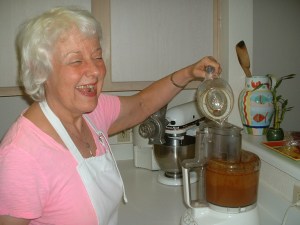
Teaching my balsamic vinaigrette recipe

teaching my balsamic vinaigrette recipe

I acquired my beloved vinaigrette recipe in enchanting Paris.  There I learned the secrets to this simple receipt in the fall of 1985.

At that time I cooked many historical meals at a French friend’s apartment, close to the Louvre. Mornings found me seeking needed ingredients at a profusion of quaint Parisian shops.  There was much mercy for my broken French among the shop owners, who grew to know me.

A flurry of grand entertainment resulted from the hosting of these elaborate meals.  Our varied guests returned warm hospitality in their abodes on alternate nights.  My passion for art galleries quickened during the days when they reciprocated our harmonious feasting.

Indeed, Paris charmed me during that September in the mid-1980s!

My balsamic vinaigrette is extremely simple.  (We used raspberry vinegar for this same recipe in Paris.)  I always dress my famous salads with this balsamic and my father’s blue cheese dressings, which is next week’s tantalizing post.

Peggy’s Balsamic Vinaigrette  Yields: about 22 ounces.  Total prep time: 20 min. Note: may repeat these easy steps to make a double batch; keeps well when refrigerated; any kind of vinegar may be substituted for the balsamic.

5 lg cloves of garlic, more to taste if smaller

3/4 c balsamic vinegar  (Use protected Aceto Balsamico from Modena, Italy, which can be expensive, available reasonably at Trader Joe’s.)

3/4 tsp dried oregano leaves  (A great, organic dried oregano is available at Trader’s for $1.99.)

1 tsp dried basil leaves  (Also a bargain at Trader’s.)

1/4 tsp sugar, or to taste

1/2 tsp salt, or to taste  (Himalayan, pink, or Real Salt is critical for optimum health; an inexpensive fine grind Himalayan salt can be found at Costco.)

1/2 tsp fresh ground pepper, or to taste

1 tsp high quality mustard  (Aiola mustard from Trader’s is ideal.)

1 c Bel’Olio Extra Light Olive Oil  (I prefer this light olive oil, available at Costco; other olive oils are strong in taste.)

  1. Peel and cut garlic cloves in half; place in a dry 11-cup, or larger, food processor; chop garlic, stopping machine to scrape down sides.  IF you are making two recipes, chop the garlic for both at once; set half aside. (If you don’t have a food processor, may chop cloves fine with a sharp knife; may also use a Vita Mix or blender to make dressing.)
  2. Add vinegar, herbs, sugar, salt, pepper, and mustard to the garlic.
  3. Turn on processor; leave running.
  4. pouring oil in feeder

    Fill the feeder with oil. (The feeder is the plunger that fits in the top of the food processor; it has a small hole in the bottom of it; this allows the oil to drip into vinegar mixture slowly, thus emulsifying the dressing; see photo.) Use all the oil in this manner.  If you are using a blender, be sure to add oil very slowly, blending as you go to emulsify dressing.

  5. Adjust seasonings to taste.  Note: the garlic should taste really strong, as it mellows dramatically after a couple of days.
  6. Pour into bottles, using a funnel.  Save used glass jars for this purpose; be sure to sterilize.
  7. Keeps in the refrigerator for months, or at room temperature for several weeks.  It’s often necessary to leave dressing out at room temperature, for at least an hour before using, when stored in the refrigerator, as the cold oil sometimes solidifies.  Hot tap water will melt the solid oil, also.

1960s French Dinner

Cotes de porc braises a la moutarde

cotes de porc braisees a la moutarde

I have a repertoire of what I call my childhood recipes, of which the following is one of my favorites.  It stretches my imagination every time I eat it: I can hardly believe that food tastes this good!

My Culinary Heritage

My mother taught me so much about cooking; she was excellent at this endeavor in her day.  My mentor exercised her expertise with hospitality in our home, rather than in our family restaurant, inspiring me to follow in her footsteps with her extensive gourmet preparations.

The passing on of tradition from generation to generation is so important.  I’ve never married, but I have a vast quiver full of spiritual children-more than I can count!  Thus, I have a desire to give them what was so freely given to me, which is wisdom.  I gaze at this precise diamond through the perspective of food, with all its joys and health-providing benefits.  I am so grateful to God, my parents, and my entire family for this knowledge that was birthed in me.

Childhood Comfort Foods

We all identify with comfort foods, especially those from our youth.  I will offer numerous ones, with which my mother nurtured our family’s souls.  Cotes de porc braisees a la moutarde is my first choice in this marvelous journey into the past.

Time-Life Books Foods of the World

Time-Life Books put out a series of cook books entitled Foods of the World, showcasing the cuisines of numerous countries in the mid-twentieth century.  Mom subscribed to these superb sequel; my family and our guests experienced incredible pleasure as a result.  Hence I grew to appreciate the world, through its food in the confines of my home at a very young age.  This instilled an appetite in me, which was gratified in my twenties and thirties, when I went to the nations to study their eating habits.

Receipts for Braised Pork Chops

For another great pork recipe, using cream and mustard, inspired by Julia Child, see Cotes de Porc Sauce Nenette.

I have greatly simplified the following recipe for pork loin chops from its original complex detail in Time-Life Books.  My version is uncomplicated and literally explodes with unforgettable flavor!  Enjoy…

Cotes de Porc Braisees a la Moutarde  Yields: 4 servings.  This recipe is adapted from Foods of the World: The Cooking of Provincial France, M.F.K. Fisher and the Editors (New York: Time-Life Books, 1968).

4 center-cut, boneless pork loin chops, about 1 1/4″ thick

salt and fresh ground pepper, to taste  (Himalayan, pink, or Real Salt is critical for optimum health; an inexpensive, fine grind Himalayan salt is available at Costco.)

flour for dusting meat

2 tbsp butter, 2 tbsp oil  (Coconut or avocado oil is best, as olive oil is carcinogenic when heated to high temperatures.)

1 lg yellow onion sliced, about 2 c of 1/8″ slices

3 tbsp wine vinegar

3/4 c heavy cream

2 tsp Dijon mustard

1/4 tsp lemon juice

Serve with brown rice  (My favorite is brown basmati rice; available at Trader Joe’s.)

  1. Heat butter and oil in a large, heavy skillet, over medium heat.  Wash pork chops and lightly pat dry; salt and pepper generously.  Dredge in flour, shaking off all excess.  Sautee in hot oil for 2 minutes on each side; do not overcook. Remove from pan; set aside.
  2. Add onions to pan, stirring in pan drippings well.  Sweat onions (cook until translucent).  Add vinegar, scraping the bottom of the pan; cook until most of moisture is gone.
  3. Add cream.  Stir well and bring to a boil over medium heat.  Place pork chops in onion mixture, coating well with onions/sauce.
  4. Cook until pork chops are hot; do not overcook.
  5. Take off heat; stir in mustard and lemon juice, mixing into the onions by moving around the chops with a spatula or spoon.  Adjust seasonings.
  6. Serve immediately with steamed rice and be wowed!