Blum’s Coffee Toffee Pie

Blum’s Coffee Toffee Pie

The following is the colorful story of the arrival of Blum’s Coffee Toffee Pie in my family’s history; more over it marks the beginning of the hand of Providence saving me for my work as a food historian.

Multiple Variations of this Pie

This recipe served as the basis for numerous delightful variations, which we served in our family restaurant in Montana’s glorious Glacier National Park (see Nutty Coconut Pie and Chocolate Mint Pie).

Blum’s Background

It all started with my need for a unique eye operation in San Francisco in 1968.  As we walked these lively streets, we witnessed our nation’s struggle to discover love through the hippie movement.  We, however, nurtured our hungry souls at the beloved Blum’s everyday.

This confectionery, bakery, and restaurant began charming San Francisco in the 1950’s; it closed in the 70’s.  There we devotedly indulged in its famous Coffee Toffee Pie; my strong mother bravely asked for the recipe, which they gave her.  (They must have given it to many others as well, for numerous recipes of this are now available on-line.)

Over the decades through my family’s development of it, this receipt has emerged in ways that are outstanding, making its preparation simply foolproof.  Among many improvements, we freeze this pie for long-term use, preferring it only partially thawed, which gives it an ice cream-like texture.  Numerous tips make this dessert a pure joy, to be made with ease.

My Destiny as a Food Historian

Without any doubt, our lives have purpose, for we are created to fulfill specific works that only we are equipped to do.  My calling, as a writer of food history, has taken shape over my entire life.  Many times death has tried to steal this precious gift from me.  My mother’s prayers, however, have covered me with the required protection, for without prayer God’s hands are tied.

My first monumental memory of our Father’s intervention was in 1967, when I incurred a near fatal concussion from a car accident.  Mom’s simple faith brought me back from what spelled destruction: I was neither dead nor a vegetable, as doctors were declaring.  Though I didn’t yet know Jesus personally in 1967, Mom’s steadfast heart acted as my shield and miracles occurred.

The preservation of my life was the first wonder, but another ensued.  Due to the concussion, the part of my brain that controlled my oblique eye muscle was severely damaged, resulting in intense double vision.

Unique Eye Operation Taking Us to San Francisco

At that time, there were only three doctors in the U.S. that could perform the needed operation, then with only a 50% chance of any correction.  Thus in the spring of 1968, we were off to San Francisco, where Dr. Paul at University Hospital perfected my sight completely!  As always, Mom’s prayer life brought rich dividends.

This surgeon took my eye out of my head to shorten the errant muscle, so I saw this lively city with only half my vision, as a patch covered the deep blood-red of that, where his skillful hands had been.  Nevertheless, San Francisco charmed me.

Celebration Then and Now

Celebrate, with me, God’s good and entire provision for our lives; receive this outstanding historical receipt, with its foolproof directions!

Blum’s coffee toffee pie

Blum’s Coffee Toffee Pie  Yields: 1-10″ pie.  Total prep time: 1 1/2 hr, plus 1/2 hr for cooling/  active prep time: 1 1/4 hr/  baking time: 15 min.

1 c flour  (Optional: may grind 1/3 c organic hard red spring wheat berries and 1/3 c organic soft winter white wheat berries to make a total of 1 c of fresh ground flour.)

1/2 tsp salt  (Himalayan, pink, or Real Salt is important for optimum health; an inexpensive fine grind Himalayan salt is available at Costco.)

3/4 c butter, softened

1/4 c brown sugar, packed down  (Organic is best; available sometimes at Costco and always at Trader Joe’s.)

3/4 c walnuts, chopped fine

2 oz Baker’s unsweetened chocolate, plus extra for garnish

1 tbsp water

1 tsp vanilla extract

3/4 c cane sugar  (Organic is ideal, best buy is at Costco, also available in a smaller quantity at Trader’s.)

2 lg eggs, at room temperature  (If sensitive to raw eggs, may use pasteurized eggs for extra safety, which are available at some grocery stores.)

8 tsp instant coffee

2 c heavy whipping cream

1/2 c powdered sugar  (High quality organic is available at Trader’s.)

  1. grating of chocolate

    IF grinding fresh flour, do so now.

  2. Preheat oven to 375 degrees.  Place a bowl in freezer for whipping cream (the whipping of cream is greatly facilitated when utensils are ice cold).
  3. Combine flour and salt; blend in a scant 1/4 c butter with a fork until mealy in texture.
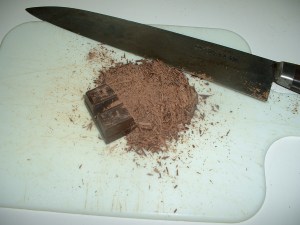
  4. Mix in brown sugar, walnuts, and 1 oz chocolate, grated with a sharp knife (see photo); add water and vanilla; blend well.
  5. Butter a pie plate generously; press pie dough in pan firmly with fingers. Bake for 15-18 minutes, or until light brown; begin cooling on a rack, for about 10 minutes, finish cooling in freezer.
  6. While crust is cooling, melt 1 oz chocolate over med/low heat, watching carefully as not to burn. Set aside and cool.
  7. Beat 1/2 c butter in a large bowl with an electric mixer until creamy.  Gradually add 3/4 c cane sugar, beating well with each small addition.
  8. Add 1 egg; mix on medium speed for 5 minutes.  (The following makes this preparation foolproof.  It is so important to have ingredients at room temperature; if your kitchen is either really hot or cold, this mixture may curdle.  You can easily correct this: if it curdles or breaks because it is too hot, make the addition of the second egg a cold one, directly out of the refrigerator, to bring the filling back to its full volume.  If the butter/sugar/egg combination is too cold and curdles, warm the chocolate a little and mix this in before adding the second egg; then, follow the directions for beating.  Ideally when done, this mixture should be like fluffy whipped butter or soft whipped cream, providing ingredients are room temperature, in a moderate kitchen.  In this way, you will never fail with this recipe!)
  9. assembling of pie

    Blend in cooled chocolate and 2 tsp of coffee into whipped filling.

  10. Add second egg and beat for 5 minutes more.
  11. Wash beaters and put in freezer, for whipping cream.
  12. Place filling in cold pie crust; put in freezer for 30 minutes, for filling to set up.
  13. With ice cold bowl and beaters, beat cream until it starts to thicken.  Add powdered sugar and 2 tbsp coffee; continue beating until stiff.  Cover pie with whipped cream and garnish with chocolate curls.  See photo at top of recipe.
  14. May eat now, or for long-term use return to freezer; when frozen, cover well with plastic wrap, to cut pieces as needed.  Serve partially thawed for optimum pleasure.

Creative Caesar Salads

creative Caesar salad topped with serungdeng kacang

When I was growing up, we lived in the small resort town of East Glacier Park, Montana, which is the east entrance to Glacier National Park; there were only 250 residents at the foot of these glorious Rocky Mountains.  Because of our town’s minuscule size, it was necessary to travel to larger cities to take care of our major shopping needs, such as school clothes every late summer.  Usually we traveled within our State, 150 miles east to Great Falls; on special occasions, we ventured as far away as Spokane, Washington.  I can still feel the thrill as we prepared, in the early morning dark, to leave on these revered journeys.

Memories of Ridpath Hotel in  Spokane, WA during  the 1950’s

During the extra special trips to Spokane, the Ridpath Hotel captivated me; we ate many dinners in its plush dining room, often partaking in their Caesar salad, which came with the pomp and flair of table-side service.  My young heart was even then preparing for my career in food history, for I was fascinated by the coddling of the egg, with the torch used for that purpose; in like manner, I rhapsodized over the delight of the powerful garlic on my tender tongue.

To this day I love Caesar salad; I share a recipe here that lives up to this enduring mental monument.  Be prepared to enjoy.

Origins of Caesar Salad

There are several accounts of how this famous dish began.  After much research, I chose to attribute its origin to the Italian chef Caesar Cardini (1896-1956), who created this American classic at his well-known restaurant in Tijuana, Mexico.  There in 1924, he was serving an unusual number of Californian visitors, escaping for the Fourth of July weekend during prohibition.  This original production was served table side, without anchovies, and included whole lettuce leaves, which were eaten by the stems, using one’s fingers.

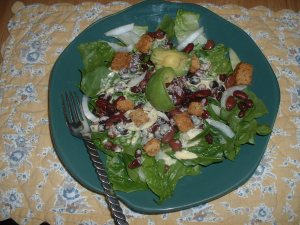
Caesar salad enhanced with beans

Are Coddled Eggs Safe?

There are numerous opposing views on the safety of coddled eggs.  Some profess that they are not a threat: it is adequate to place the eggs in rapidly boiling water, remove the pan from the heat, and then allow the eggs to cook for 60 seconds; indeed, this technique provides the best taste.

Others propound that holding eggs at 140 degrees F (60 degrees C) for five minutes kills potential contaminants, such as salmonella; this can also be achieved instantly by heating them to 160 degrees F (71 degrees C).

Still others declare that uncooked and under-cooked eggs are not safe at all; they rigidly promote the use of either hard-boiled or pasteurized eggs; the latter are available in some grocery stores.  Note: it is important to use caution in highly susceptible populations, such as small children, pregnant women, the elderly, and those with health problems.

Two Resolutions to Problem

Here I cover this dilemma with two good solutions: my favorite version of this dressing is made with coddled eggs, which have been cooked for 60 seconds; nonetheless, for times when extra special care is needed, I provide a method of heating the prepared dressing to 160 degrees; this last procedure, however, thickens our treasured concoction quite a lot.  With both of these two options, the powerful recollected taste from my youth is maintained, which is heightened even further with strong combinations of foods in my creative Caesar salads.

References:

https://whatscookingamerica.net/CaesarSalad.htm

www.reluctantgourmet.com/caesar-salad/

www.foodandwine.com/fwx/food/we-can-thank-tijuana-and-prohibition-caesar-salad

www.ochef.com/447.htm

https://en.wikipedia.org/wiki/coddled_egg

www.safeeggs.com/blog/will-the-real-safe-caesar-salad-recipe-please-stand-up/

finished Caesar dressing (feeder tube in lid at right side)

Caesar Salad Dressing  Yields: about 1 1/2 cups.  Total prep time: 30 min.  If cooking the dressing, total prep time is 45 min.

3 fresh, free-range eggs, at room temperature  (Place in warm water for 10-15 minutes.)

2 tbsp fresh garlic

1 tbsp cider vinegar  (Raw is best; available inexpensively at Trader Joe’s.)

1 scant tbsp Dijon mustard  (Aioli Garlic Mustard from Trader’s is also excellent.)

2 small lemons, juiced

3 dashes of Tabasco

3 dashes of Worcestershire

1/4 c grated Parmesan cheese

1 anchovy, optional

3/4 tsp salt, or to taste  (Himalayan, pink, or Real Salt is critical for optimum health; an inexpensive fine grind Himalayan salt is available available at Costco for $4.95 for 5 lbs..)

1/2 tsp freshly ground pepper, or to taste

3/4 c olive oil  (Personally I prefer a light olive oil for flavor; Trader Joe’s brand, fruity Extra Virgin Olive Oil or Bel’Olio, from Costco, are both great.)

  1. Use room temperature eggs, by placing them in warm water for 10-15 minutes.  For health reasons, it is important that they are washed, free-range, and fresh.  I feel comfortable with coddled eggs, which makes the best dressing.  If, however,  you are sensitive to them (or storing this dressing for more than 4-5 days), take the extra precaution of cooking it as described in step 6, or better yet use pasteurized eggs, which are available in some grocery stores.
  2. coddling eggs

    For coddled eggs, bring a small pan of water to a boil over high heat; prepare an ice bath, using a bowl of cold water with ice cubes.  Place eggs in rapidly boiling water; quickly remove from heat; let them sit for 60 seconds; then, immediately transfer to the ice bath, to the stop cooking process.  Crack them on side of bowl, scooping coddled egg out of shell with a spoon, set aside (see photo).

  3. Meanwhile mince 2 tbsp of garlic: peel cloves, cut in halves; then, chop this in a food processor by repeatedly pressing pulse button; measure 2 tbsp of chopped garlic and place this back in processor.  Set aside.  (TO MAKE DRESSING BY HAND: chop the garlic with a sharp knife; mix all ingredients, except the oil, in a med/small bowl; then, beat in the oil SLOWLY, to emulsify the dressing.  May also make this in a VitaMix or blender.)
  4. Juice the lemons, set aside.
  5. Add all ingredients, except the oil, to the garlic in the processor.  Turn on machine and blend; place oil in the feeder, which is located on the top (see this feeder in above photo of finished product); thus, oil will drip in slowly for an emulsified dressing.  Adjust seasonings.  This will keep in the refrigerator for 4-5 days; for longer storage, go to the next step.  Serve on the creative salads given lastly.
  6. For cooked dressing, prepare an ice bath, using a large bowl with a smaller one inserted in center (see photo).  Prepare Caesar dressing as described in steps 2-

    cooked dressing cooling in ice bath

    5; transfer this mixture to a small, heavy-bottomed saucepan; cook dressing over low heat, stirring constantly, until this egg mixture reaches 160 degrees F (71 degrees C); immediately place in the ice bath to cool, adding more ice as needed.  Note: the dressing will thicken as it cooks. Serve on salads described below.

  7. I like to be creative with my Caesar salads; here are two suggestions for using foods that highly complement this excellent dressing.  First: mix greens, sweet onion, avocado, Parmesan cheese, and homemade croutons (2016/08/15); then, top this with serungdeng kacang, which is crispy coconut chips and peanuts sautéed with a garlic/onion puree (2017/01/09).  Second: mix greens, Parmesan cheese, homemade croutons, and beans; legumes really accentuate the flavor of this dressing!  Enjoy.

1970’s Whole Wheat Banana Bread

cooling bread in pan for 5 minutes

I became a vegetarian during college in the early 1970’s.  When I moved to Tokyo six years later, I gave up this proclaimed role, because of my need to be open to all foods proffered by my Japanese hosts.


While abstaining from meat and fish, I searched for healthy alternatives in an array of natural food cook books.  There I found treasured recipes which I still use today; one was this powerfully good, whole wheat banana bread.

Bananas Date Back to 2000 B.C.

Bananas have a long history.  Alexander the Great discovered them growing in the Indus Valley in 327 B.C.; they had been cultivated, however, in India since 2000 B.C.  1

Background of Bananas in the Time after Christ

Documentation dated in the 7th century shows that China was using them in abundance also.  Portuguese explorers reported this same fruit in western Africa in 1482, where it probably had been grown for a long time; these Europeans adopted its local name Musa sapientum, which was originally given this fruit by Alexander the Great.  In 1496, Spanish conquerors found an intense cultivation of bananas in Tenerife in the Canary Islands.  2

The Emergence of Bananas in the U.S.

Nevertheless, the United States didn’t experience this tropical fruit until 1804, and then only in a limited way for the next 50 years; this delectable was imported infrequently, in such relatively small quantities as 300 stems, by sailing ships coming from the Caribbean or Central American ports.  3

In 1830, during this early inactive period, Capt. John Pearsall brought the first full cargo of bananas, 1500 stems, to New York.  This man later became a N.Y. commission agent, specializing in the import of this prized fruit.  In the mid-nineteenth century, he went bankrupt when his shipment of 3,000 stems arrived too ripe to sell; big money was tied up in each of these loads, for then a “finger” sold at the exorbitant price of 25 cents wholesale.  4   This was at a time when factory workers, consisting of women and children, were making between 25-50 cents per day.  5

More and more, cargoes from Honduras and Costa Rica were reaching New Orleans, New York, and Boston during the two decades before 1870, the year when large-scale banana traffic really began.  As the 70’s opened, the now more abundant bananas were sold, foil-wrapped, at a fair in Philadelphia for 10 cents a stem; it was the first time many of these fair goers had ever indulged in this delight.  6

Popularity of Bananas Established in United States

By 1885, 10,000 stem cargoes were being shipped from Jamaica in 10 to 12 days. Next, just prior to the turn of the century, this exotic fruit spread to inland America by rail express.  7

Now, however, bananas are common and cheap; every American has experienced them, along with this familiar sweetbread.

This 45-year-old banana bread recipe is one of the best among thousands.  Here I have included grams, as someone recently requested this most accurate of measurements, for my baking receipts; measuring in grams insures foolproof baking.

Nevertheless I can’t express how easy and certain this preparation is, even with cup measurements, for I could make it with my eyes closed.  Receive!

  1. James Trager, The Food Chronology (New York: Henry Holt and Company, Inc., 1995), pp. 18, 9.
  2. Ibid., pp. 41, 78, 18, 81.
  3. Ibid., p. 196.
  4. Ibid., pp. 217, 234.
  5. Stanley Lebergott, Chapter: Wage Trends, 1800-1900, The Conference on Research in Income and Wealth, The Trends in American Economy in the Nineteenth Century (Princeton, New Jersey: Princeton University Press, 1960), pp. 449-500.
  6. James Trager, The Food Chronology (New York: Henry Holt and Company, Inc., 1995), pp. 283, 301.
  7. Ibid., pp. 320, 360.

wheat grinding attachment on a kitchen aid

Whole Wheat Banana Bread  Yields: 1 loaf.  Total prep time: 1 hr & 25 min/  active prep time: 25 min/  baking time: 1 hr.   This is adapted from Jean Hewitt’s The New York Times Natural Foods Cookbook (New York: Avon Books, 1971), p. 235.

1 c (136 grams) whole wheat pastry flour  (Bob’s Red Mill is high quality.)

1/2 c (64 grams) unbleached white flour  (May grind 1 c organic, hard red spring wheat berries to make total 1 1/2 c-204 grams-flour.)

1/4 c (60 grams) cream*, or milk, soured with 3-4 squeezes of juice from lemon ball

1/2 c (113 grams) butter, softened

3/4 c (165 grams) brown sugar, packed  (Organic brown sugar is preferable, which is available at Trader Joe’s, or may substitute a healthier 3/4 c-95 grams-coconut sugar.)

1 lg egg (51 grams)

1 tsp (7 grams) baking soda

3/4 tsp (4.26 grams) salt  (Real Salt is important for optimum health; available in health section of local supermarket.)

2 lg or 3 small ripe bananas, (375 grams), 1 1/4 c  (May ripen these overnight by gently, but firmly, squeezing the whole banana, until meat is mushy under the skin; let sit at least 8 hours.)

1 tsp (4.2 grams) vanilla

1/2 c (62 grams) nuts, optional

Spray oil  (Pam coconut spray is best for taste and quality; our local Winco brand, however, makes this preferred spray for less than half the expense.)

Flour for dusting sprayed pan

  1. Preheat oven to 350 degrees.
  2. If using fresh ground flour, begin grinding 1 c hard red spring wheat berries now (this berry makes a dense, nutritious bread, which is extremely high in protein-one serving has the protein of an egg or 7 grams).  See photo.
  3. Measure cream, which is preferable, or milk in a med/large bowl; squeeze 3-4 squirts of lemon juice from a ball over surface; let sit until soured, about 10 minutes.
  4. Beat butter in a large bowl until light and fluffy; mix in sugar thoroughly; add egg, beating well; set aside.
  5. In storage bag, with a seal, shake together flour, baking soda, and salt; set aside.
  6. When cream/milk is soured (cream will appear curdled more than milk), add bananas, and mash well with a fork.  Blend in vanilla, set aside.
  7. Alternately add flour and banana mixture to butter mixture.  When all is incorporated, mix in optional nuts.  Beat only until all is incorporated, as over beating toughens baked goods.
  8. Spray a 9″ x 5″ loaf pan, lightly dust with flour, pour batter in prepared pan.
  9. Bake for 55-60 minutes, or until bread responds, bounces back, when pressed with finger.  May also test with a toothpick; it is done when toothpick comes out clean, from the soft area in crust.  Do not over bake.
  10. Cool in pan for 10 minutes; then, remove and finish cooling on rack; see top photo.  Keeps well in refrigerator, wrapped in paper towel, and sealed in gallon-size storage bag.
  11. This is a staple in my home!

Bolitos de Chocolat y Coco

Bolitos de chocolat y coco

bolitos de chocolat y coco

1985 was a big year for me, for I traveled to Peru-from whence this recipe is derived-that summer to study food, while later in September I went to Paris, with the intent of moving my business there. (Read more about my time in France in Balsamic Vinaigrette, 2016/08/22.)

My jocund days in Peru were filled with the warm blazing sun, but nights were very cold, as July brings winter to this nation in the southern hemisphere.

Machu Picchu met my love for mountains in a grand way.  The ancient trail leading to these ruins made for an arduous climb; we got off the train and labored, with copious sweat, for hours to complete its last leg.  What a memorable day!

My far-reaching, historical catering business was three years old during my time in South America, in the 1980’s, and my mind was a sponge for details about food. While there, every morsel that went into my mouth came out as a comment in my journal.  Most of this keen eating took place in inexpensive cafes, where chickens were always roasting on open hearths.  The better of these humble restaurants had guinea pig and Cebiche, raw white fish “cooked” in lemon juice.  Street vendors’ food also provided me with rich information, but my greatest joy was the private dinner invitations I received, to both rich and poor homes.  Note: there are only these two classes there.

Karen, my then neighbor in Billings, Montana, and her Peruvian boyfriend inspired me to make this colorful sojourn.  Indeed Chino’s family blessed my trip: I may not be alive today, but for them, as great trauma occurred for me in this country. Fortunately for me, his family was extremely influential; for instance, his second cousin was president during my visit.  (This man was ousted a number of days after I left; Chino’s brother-in-law was murdered by terrorists several months later.)

My trouble came when I and my traveling companion, a longtime friend from Paris, let down our guards.  We always covered each other’s backs in the marketplace, as robbery is ever-present in this poor nation; we, however, went our separate ways one day in Cusco.  On my own, I was mesmerized by the wide array of vendor’s goods: blankets on the ground displayed raw meats, brightly dressed women loudly announced their vibrant vegetables, modest pots and pans were set up elsewhere.  Stopping I indulged in a delicious, doughnut-like pastry; next, I reached for my funds to buy freshly squeezed orange juice.  My wallet was gone!

Absolutely everything of importance was in it: my passport, money, travelers’ checks, credit cards, and return ticket home.  This unseasoned traveler was without identity and provision in a volatile place.

God’s grace got me to my homeland safely through a multitude of miracles. The last of these happened just hours before my plane’s departure, for the president of Aero Peru, a friend of Chino’s family, reinstated my plane ticket at this critical moment.

Even before I experienced this culture, my repertoire of catered meals included a Peruvian dinner. The background for this authentic repast came from a cook book, from that country, shared by Chino’s girlfriend; nevertheless, this account was strictly for the upper class.  For hors d’ouvres at these events, I used the youth’s favored dish Ocopa-chunks of boiled, bland purple potatoes, topped with cheese, walnuts, mild chiles, and eggs. The main course boasted of Aji de Gallina, an incredible walnut chicken. Dessert was Suspiro Limeno, a light, airy custard; the feast ended with Bolitos de Chocolat y Coco.  To this day, these chocolate/coconut balls are the finishing touch at ever meal I host.

Chocolate has an interesting history.  Spanish explorer Hernando Cortez introduced cocao beans to Europe in 1528, when he returned from “New Spain”.  There the Aztecs mixed cocao paste with spices to make a thick drink.  In their convent at Oaxaca, creative Spanish nuns added sugar, which made this chocolate beverage even more palatable.  1

Chocolate was highly prized then and still is today; these superb, truffle-like candies-a rich man’s food in Peru-will please any chocolate lover.  This recipe is simple and foolproof; don’t miss this delectable treat.

  1. James Trager, The Food Chronology (New York: Henry Holt and Company, 1995), p. 89.
Making bolitos de chocolat y coco

chocolate after stirring in coconut

Bolitos de Chocolat y Coco (Peruvian chocolate/coconut balls)  Yields: about 6 dozen balls. Total prep time: 45 min.

12 oz unsweetened chocolate  (Baker’s works well.)

1-14 oz can sweetened condensed milk  (It’s important to use Borden’s Eagle Brand.)

2 tsp butter

2 c unsweetened fine-flake coconut  (Available in bulk at our local Winco and other supermarkets.)

  1. Break chocolate into pieces in a medium-size, heavy-bottom saucepan.
  2. Add butter, melt slowly over low heat.  Watch carefully, so as not to burn.
  3. Meanwhile open the can of milk and place 1/2 c of coconut in a measuring cup.  Set aside.
  4. When chocolate is completely melted, quickly add condensed milk.
  5. Stir over low heat for about 30 seconds; it will start forming a soft ball. Toward the end of the 30 seconds, stir in the coconut.  Do not overcook, or chocolate will be dry.  Immediately remove from heat after these 30 seconds; continue to stir vigorously until soft ball is formed all the way.  See photo.
  6. Cool just enough for handling.
  7. Place 1/2 c of coconut in a small bowl.  (You will add more coconut to the dish as needed.)  Form small balls of chocolate and roll in coconut, placing them in an 8×8 inch pan.
  8. Chill chocolate for several hours; then, transfer balls to a freezer-storage bag.  These will keep for a very long time, if you double the bag for long-term freezing.
  9. Excellent chocolate, so easy, absolutely foolproof.