1960’s Portuguese Pork

Portuguese pork roast

My gift of hospitality was birthed during my youth in the mid-twentieth century, for then I watched my mother host elaborate dinner parties.  As an excellent cook, she prepared glorious feasts, often with international themes; this 1960’s recipe for Portuguese pork blessed guests repeatedly.  While in college, I meticulously copied her treasured receipts and began my own journey, fostering nourishment of body and soul.

In 1982, God converted this inherent gift into my lifetime work.  Then I began catering meals and teaching a profusion of cooking classes, utilizing researched historical recipes.  One of these classes was on my mother’s Portuguese foods, on which I expanded, incorporating the salad Ensalada Iberica and dessert Figos Recheados, my next weeks’ posts.

Slowing down, smelling the roses, feeding ourselves and others are important traits. In doing such, let us choose pleasure in even the simplest of foods.  These pleasures seem amplified. when someone else prepares the meal; thus, their charity reaches our hearts regardless of what is served.  Macaroni and cheese can thrill us, when made with love by a friend.

There is an element of courage, which results in unexpected joy, when we graciously receive ailments we aren’t sure of.  While living in Billings, Montana, a friend invited me to celebrate Easter with her.  Upon arrival I discovered we were partaking of rabbit; I was challenged in eating this, especially on this holiday!  Expressing gratitude, I bravely proceeded and found it palatable, as long as I didn’t concentrate on it being Easter.  Though I have never again experienced this meat, fond memories flood my mind whenever it is mentioned.

Let us be strong in both giving and receiving benevolent fellowship; use my series of proven receipts to host this cultural affair for your loved ones, or better yet invite someone newly acquainted.

In Culinary Artistry, Andrew Dornenburg and Karen Page note strong compliments to pork; among the most vibrant are vinegar, garlic, black pepper, oranges and onions-all of which are present in this detailed dinner.   Enjoy my creative repast!  1

  1. Andrew Dornenburg and Karen Page, Culinary Artistry (Hoboken, NJ: John Wiley & Sons, Inc., 1996), p. 159.

chopping jalapeno peppers

Portuguese Pork  Yields: 8-10 servings.  Inactive prep time for marinating: 1 day/  active prep time: 30 min/  cooking time: 3 1/2 hr.

4 lb pork loin roast

1 1/3 c water

1 c cider vinegar  (Trader Joe’s carries an inexpensive raw version, which has great health benefits.)

5 med/lg cloves of garlic, minced

3 tepino peppers  (If desired, use jalapeno peppers, which are milder.)

Salt and pepper  (Himalayan, pink, or Real Salt is critical for optimum health; a fine grind is available at Costco for $4.95/5 lb.)

1 c sliced green olives  (May serve additional in a bowl at table.)

Baked yams  (Yams and sweet potatoes are different varieties of the same vegetable, they are interchangeable.)

  1. Place water and vinegar in a 9 1/2″ x 7 1/2″ x 3″ pan, or 3-quart baking dish).
  2. Mince garlic, add to vinegar mixture.
  3. Cut peppers in half lengthwise, scoop out seeds with a spoon, chop fine, and add to vinegar mixture (see photo).  Note: be sure to wash hands thoroughly, as burning will result from touching eyes, if you don’t.
  4. Place pork in marinade and marinate in refrigerator for at least 24 hours, turning roast halfway through, at about 12 hours.
  5. Preheat oven to 300 degrees.  Before placing in oven, turn roast again, salting and peppering the top well.  Bake for 1 3/4 hours.  Proceed immediately to next step.
  6. Wash yams and pierce several times with a fork.  Cover with foil; place top of foil on potato, where sealed, face-up in the oven while baking; this keeps juices from leaking out.  Start baking these at the same time you begin roasting the meat; bake for about 3 hours, as the oven is only set at 300 degrees.
  7. After baking for first 1 3/4 hours, turn roast for the last time.   Once more, salt and pepper the top well.  Bake for another 1 3/4 hours.
  8. When cooking is complete, remove roast from oven, cool for 15 minutes.  Toward the end of this time, take yams out of oven and place on plates; next, cut pork in thick slices and arrange on dishes; top with sliced olives.  (It is good to serve additional olives in a small bowl at table.)
  9. This pork is superb with the Portuguese salad Ensalada Iberica and dessert Figos Recheados, my next weeks’ posts.

1880’s Minced Cabbage

cooked minced cabbage

Gold Medal Flour, Betty Crocker and Miss Parloa all had their beginnings in Washburn-Crosby Co.  Along with last week’s post on escalloped salmon, I discovered this elegant minced cabbage in Miss Parloa’s New Cook Book, which was originally published in 1880 by Washburn-Crosby Co.

Its successor General Mills reprinted this same worthy account in the twentieth century.  This latter company, however, is better known for publishing recipe books under the pseudonym Betty Crocker, who never existed, unlike our illustrious 19th century writer Maria Parloa.

In 1921, before the above transfer of title, Washburn-Crosby was first to use the name “Betty Crocker”.  This came as a result of their being inundated with 30,000 entries, in a contest promoting their Gold Medal flour.

Many of these participants asked questions concerning baking.  Washburn-Crosby discerned that the replies would hold more influence if signed by a woman; thus, the inspiration for this sham Betty Crocker, which was derived from the surname of a retired company director.

General Mills continued in this tradition, after it was created in 1928, when it began merging Washburn-Crosby with 26 other U.S. flour-milling companies.  This, then the world’s largest flour mill, initially portrayed this fictitious authority photographically, in 1936, as a gray-haired home-maker.  Her image was frequently revised throughout the last century, as Betty Crocker was used as a major brand name for their various products.  (See more history at my 1880’s Clam Chowder-2017/01/30-1880’s Escalloped Salmon-2017/04/17-and 1880’s Ozark Honey-Oatmeal Cookies-2017/10/30.)

It is jarring when we learn the falsehood of long accepted traditions, like the authenticity of this established person, for truth is fundamental to our stability.  We implicitly search for verity in all things, cooking included.

Rejoicing occurs when a good source for teaching the basics is found, such as those required for food preparation, as well as the execution of life; I hope you will discover these fundamentals present in my writings.

May you come to rely on my receipts, preparing them with the ease with which they are intended.  They may look lengthy at times; this is because I spell out shortcuts with care, for in a sense my blog is like going to cooking school.  Quickly you learn my simple, creative techniques, thus gaining the ability to follow my recipes adeptly.

This effortless minced cabbage comes with the height of freedom.  Enjoy!

References:

  1. Silver Dollar City Edition of Maria Parloa’s Miss Parloa’s New Cook Book (Boston: Estes and Laurait, 1880); this facsimile was published at an unknown date during the 20th century.
  2. James Trager, The Food Chronology (New York: Henry Holt and Company, 1995), pp. 434, 456, 488.
  3. http://www.pbs.org/food/the-history-kitchen/who-was-betty-crocker/
  4. https://foodimentary.com/2012/03/24/a-history-of-betty-crocker-the-woman-who-never-was/
  5. http://www.fundinguniverse.com/company-histories/general-mills-inc-history/

chopping cabbage in a food processor

1880’s Minced Cabbage  Yields: 4 servings.  Total prep time: 25 min.  This is adapted from a recipe in General Mills’ Special Silver Dollar City Edition (copyright date unknown) of Maria Parloa’s Miss Parloa’s New Cook Book, (Boston: Estes and Laurait, 1880).

Note: this can be made ahead and reheated just before serving.

1 1/2 lb green cabbage

2 tbsp oil  (Coconut oil is ideal for quality and flavor here; avocado oil is also good; olive oil is carcinogenic when heated to high temperatures.)

2 tbsp butter

2 tbsp flour

1 tsp salt, or to taste  (I prefer a coarse salt here, such as a kosher salt or Trader Joe’s coarse sea salt. )

  1. Chop cabbage either by hand, or more quickly, by using the slicing attachment to a food processor.  If using a food processor, cut cabbage in pieces that will fit in its feeder tube (see above photo).  Set aside.
  2. Heat oil over medium heat in a large sauté pan, in which you have placed a small piece of cabbage.  When it sizzles, add rest of cabbage, and stir well to evenly distribute oil; cook until vegetable is limp, stirring frequently.  Meanwhile go to next step.
  3. cooking roux

    Make roux in a small sauté pan: melt butter over medium heat, add flour, and stir with a wire whisk.  Cook  until mixture is a light brown, about 2 minutes; remove from heat and set aside (see photo).

  4. When cabbage is soft, add salt, and stir well.
  5. Blend roux into vegetable, cook until consistency of cabbage is somewhat thickened, stir continually.
  6. When done, remove from heat.  May serve immediately, or better yet, make ahead, and reheat just before serving.  When it sits, cabbage juices form in pan; as you reheat it, stir in juices and loosened fond, which is obtained by scraping these caramelized pan drippings and browned bits off bottom of pan, using a wooden or plastic cooking spatula.  This adds great flavor!  (See top photo for finished product.)

1880’s Escalloped Salmon

ingredients for escalloped salmon

Maria Parloa blessed us with a recipe for escalloped fish in Miss Parloa’s New Cook Book, which Washburn-Crosby Co. published in 1880.  This company’s successor General Mills brought her proven receipts back to America, by republishing them in their Special Silver Dollar City Edition of this book, at an unknown date during the twentieth century.

Both these companies are known for their production of Gold Medal flour, which they successively produced; thus, this product has been on the market for nearly two and a half centuries.  (For more details on Miss Parloa, Washburn-Crosby Co., General Mills, and 19th century American cooking, see 1880’s Clam Chowder-2017/01/30, 1880’s Minced Cabbage-2017/04/24, and 1880’s Ozark Honey-Oatmeal Cookies-2017/10/30.)

This 19th century cook book was one of many written by Maria Parloa, who was an important figure in the gastronomical world of her day.  She taught an abundance of classes at her own two schools, as well as the Boston Cooking School, the home of Fannie Farmer’s Boston Cooking School Cook Book, which was forerunner to the renowned Fanny Farmer Cook Book.

In Miss Parloa’s New Cook Book, Parloa shared modern techniques and included 93 “essential” utensils for the kitchen, which boasted of such items as an apple corer, melon mold, and squash strainer.  Her writings catered to the affluent, for she recommended that a dinner for twelve need cost no more than $25, this at a time when an unskilled worker made about $1 per day.

In this book’s preface, the author’s desire for clear, complete, and concise directions is set forth, but these are vague compared to our present standards.  Her instructions, however, have far greater detail than those in many of the contemporary cook books of her day.

This recipe called for five pounds of fish, that which was normally required to sustain a family of six at the main, mid-day meal; by contrast, this same amount provided for twelve guests at a dinner party, as these hospitable affairs were always profuse in delectable dishes.  My directive only calls for one pound of salmon for four people in this creamy recipe, because this is a rich food for our relatively sedentary bodies; in these former days people were highly active, requiring many more calories than we do today.

As with this outmoded receipt, things call for adaptation; we must learn to adjust to the essential needs of any given time.  Our living God perpetually covers us in all instances of unforeseen change, bringing healthy modification, if we ask believing.  At times this process is slow; thus, patience is critical for success.

This is a joyful race we are running; nothing is too difficult for us!  We simply align our hearts to the “recipe” our Father is dictating at each turn, purposing to not be alarmed when our five pounds of fish becomes one pound, or with equal intention, staying calm when it reverses back to five pounds.

Recently I enjoyed escalloped salmon with friends that I hadn’t seen for a long time; our reunion was marked with excellence in both fellowship and food.  This dish is a winner for special occasions, especially when served with next week’s entry, teaching Miss Parloa’s minced cabbage.

References:

Special Silver Dollar City Edition of Maria Parloa’s Miss Parloa’s New Cook Book (Boston: Estes and Lauriat, 1880); this was published by General Mills at an unknown date during the 20th century.

James Trager, The Food Chronology (New York: Henry Holt and Company, 1995), p. 310.

https://en.wikipedia.org/wiki/Maria_Parloa

https://www.lib.umich.edu/blogs/beyond-reading-room/happy-172nd-birthday-miss-parloa

Click to access c2500.pdf


baked escalloped salmon

1880’s Escalloped Salmon  Yields: 4 servings.  Total prep time: 1 hr & 15 min/  active prep time: 45 min/  baking time: 30 min.  This is adapted from a recipe in General Mills’, 20th century Silver Dollar City Edition of Maria Parloa’s Miss Parloa’s New Cook Book (Boston: Estes and Lauriat, 1880).

Note: this may be prepared ahead of time following steps 1-8; when doing so, reheat this refrigerated dish for a total of 1 hr before serving.  The original recipe calls for white fish; I, however, find this exceedingly bland in flavor, where salmon is perfect.

1/4 c bread crumbs  (May purchase ready-made, or grind 2 slices of stale bread in a dry food processor.  Make extra, as these freeze well; for stale bread, leave pieces out for about 8 hours.)

1-1 1/2 lb salmon fillet  (A minimum of 1 lb is needed if fillet is boneless and skinless, more if there are bones and skin.)

1 tsp salt, or to taste  (Himalayan, pink, or Real Salt is best for optimum health; a fine grind Himalayan salt is available at Costco for $4.95/1b.)

1 c whipping cream  (Heavy whipping cream is best health wise.)

1/8 c water

1 tbsp flour

1/8 tsp white pepper, or to taste

Steamed rice, cooked according to directions on package

  1. Preheat oven to 325 degrees.
  2. If salmon fillet is large, cut in pieces that will fit in a 3-quart saucepan.  Place in pan and cover with salted water (add 1/2 tsp salt); bring to a boil over medium heat.  Cook until center of thickest part of salmon is opaque, when pierced with a fork.  Saving broth, remove fish from liquid and cool.  Reduce broth to about 1/4 c over high heat.
  3. If preparing your own bread crumbs, grind 2 pieces or more of stale bread in dry food processor, pressing pulse button repeatedly until crumbs are fine.  Set aside 1/4 c-freeze extras.
  4. Heat cream over medium heat in a small saucepan, only until a soft boil is formed, stirring frequently; watch carefully.  As soon as it comes to a bare boil, reduce heat to med/low.
  5. While heating cream, dissolve flour in water.  With a wire whisk, stir flour mixture into softly boiling cream, to which you have added 2 tbsp of reduced broth; cook until sauce is thick, beating frequently.  Season with 1/2 tsp salt and white pepper.  Taste and adjust seasonings; set aside.
  6. Start rice, following directions on package (wait if you are preparing salmon ahead).
  7. Butter a small, 1-quart baking dish; place a light layer of sauce in bottom of dish.
  8. Skin and carefully debone fish, placing bite-size pieces in baking dish on top of layer of cream, as you debone it.  When all the salmon is thus prepared, press down on fish to make compact; cover the top with the remaining cream sauce.  (If you are making this ahead of time, place dish in refrigerator; in which case an hour-twice as long- will be needed to bake cold fish; start rice when you place refrigerated salmon in oven.)
  9. Just before placing this in oven, spread bread crumbs on top of sauce.  If a skim has formed on top of cream, gently break apart with a spoon; this makes surface wet again, so crumbs can stick.  Then bake for 30 minutes in preheated oven; all the flavors will meld.
  10. Serve with 1880’s Minced Cabbage, which is next week’s entry.

Red Sauce for Pasta or Spaghetti Squash

simmering red sauce with splash shield

A beloved friend gave me a Valentine’s present of heart-shaped pasta; immediately I created this red sauce so I could enjoy my new treasure, resulting in this excellent covering for either pasta or spaghetti squash.

Follow these easy instructions for substituting the squash, if your dietary needs call for a vegetable rather than a starch with this piquant accompaniment.

Gifts promote well-being in both the giver and receiver.  My mother’s favorite language of love was that of gift giving; thus, I learned at an early age the power of contributions from the heart.  As a result I love to shower favor upon others, as well as graciously receive their inspired kindnesses.

This same act of generous sacrifice plays a lively part in my relationship with my Father in heaven, for I constantly seek to offer myself to him.  In doing so, it is important to slow down, move forward cautiously, relax, and especially, trust the process.  In this way, we proffer our lives to our Maker moment by moment.  However this process often brings tension, for resistance arises.

We see an explicit example of this opposition in our practice of eating: here polarity is experienced between a desire to quietly absorb pleasure and a friction arising out of our need to resolve storms present in our beings.

Taut emotions can result as we struggle to calm overactive minds, so we can enjoy our food; this dichotomy in our bodies can be countered with prayer.  Great grace is needed, however, if heightened feelings cause us even to miss the opening blessing over our nutriments.

When the above happens to me while eating, I immediately search my heart for honest moves of gratitude, which usually include my two favorite gifts from God: I have vibrant health, with my acquired ability to eat sanely, and an immense supply of resources, including the highest quality of food.

These two endowments were not always present with me, for I knew excessive physical and financial poverty in the past.  At one point I had a 226 pound body, that couldn’t stop eating compulsively; now it is clothed better than Solomon in size petite.

All devouring of my economic supply has likewise ended.  An apt example of this is the recent demolition of my computer, at which juncture I stood, looked out my window at the river below, and spoke the word: all things come together for good for those that love God and are called according to his purpose.  Joyful faith rose in me, I was convinced that increase was on its way.

Indeed it was!  For after waiting patiently six weeks, I now publish my blog with the fastest of computers, an I-7 laptop equipped with a new wireless keyboard, mouse, printer, and monitor setup.

In addition to the outstanding quality of these, I have a fiber optic internet connection-instead of DSL-with 90 times more power and a monthly fee that is slightly less!

This unheard of upgrade-a sign of the Father’s immense love-was further outdone by the monetary provision for this loss.  First, great deals gave me $700 worth of equipment for $280.  Next, three separate parties were moved to help me with this.  This was outdone even further, however, with this full amount being exceeded by half again as much, or $140 was left over in gift monies!

This is just one simple example of how my needs are always met today.  God, who owns the cattle on a 1000 hills, indeed showers us with blessings, if we but believe.

He loves each and every one of us!  Right now, his heart is reaching out, to set us free from all wounds that hinder his glory from manifesting in our lives.  He is only about goodness, as my testimony proves.  Let’s receive his blessings; begin by enjoying this red sauce recipe.

sweating onions

Simple Red Sauce for Pasta or Spaghetti Squash  Yields: 2 qt.  Total prep time: 1 hour/  active prep time: 30 minutes/  cooking time: 30 minutes.   (Spaghetti squash requires approximately 1 1/2 hr to bake.)

4 tbsp oil  (Coconut oil is best for flavor and quality here; avocado oil will also do; olive oil is carcinogenic, when heated to high temperatures.)

1 med/lg yellow onion, chopped

1 lb ground beef

1 lb romanesco or 3/4 lb mushrooms  (I like to use romanesco for variety’s sake; it is a green variant of cauliflower, which is available in the organic section at better supermarkets; may also use a combination of both.)

3 tbsp butter, if using mushrooms

2-15-oz cans of tomato sauce  (Hunt’s and Simple Truth-at our local Fred Meyer’s-make inexpensive organic tomato sauces.)

1-15-oz can of water

2 tsp dried oregano  (Trader Joe’s carries a superb, organic dried oregano for $1.99!)

1 tbsp dried basil  (Also available inexpensively at Trader’s.)

1 tsp sugar  (I prefer organic; available at Trader’s and also in a more economical 10 lb bag at Costco.)

2 1/2 tsp salt, more to taste  (Real Salt is important for optimum health, available in nutrition section at local supermarket.)

1/2 tsp fresh ground pepper, more to taste

5 extra-large garlic cloves, minced  (3 cubes of Trader’s frozen garlic is better here.)

1/4 c tomato paste  (Open a 6-oz can and freeze individual 1/4 cup servings in small plastic bags, to be thawed as needed.)

Pasta or 4.5 lbs spaghetti squash  (This spaghetti squash yields 4-6 servings.)

Parmesan cheese, grated or shaved

  1. If using spaghetti squash, preheat oven to 375 degrees; pierce squash with a fork multiple times; place on side on foil-covered cookie sheet, and bake for approximately 1 1/2 hour, turning halfway through, at 3/4 hour.  Cool for at least 10 minutes before handling, cut lengthwise, take out seeds, and scrape out “noodles” with a fork, when ready to serve.
  2. Heat 2 tbsp oil in a 3-quart saucepan over medium heat; add a small piece of onion; when it sizzles, add rest of onions and sweat (cook until translucent); see photo.
  3. Fry beef in sauté pan; salt and pepper generously before cooking; drain fat if there is a great deal of excess, when finished.  Proceed to next step, while meat is cooking.
  4. If using romanesco, clean and cut into very small pieces, add to translucent onions, and cook until somewhat soft, about 4-5 minutes, stirring frequently.
  5. Add the cooked beef to onion mixture, along with tomato sauce, water, herbs, sugar, 1/2 tsp salt, pepper, and garlic.  Blend well.  Set aside sauté pan.
  6. Cover saucepan with a splash shield, which is available at Bed, Bath, and Beyond (see top photo); bring to a boil over medium heat; reduce heat to med/low and simmer for 30 minutes.  Go to next step.
  7. If you are using mushrooms instead of the romanesco, clean them by brushing off dirt with a mushroom brush, cut into small chunks.  Heat butter in the sauté pan, cook mushrooms in hot butter for several minutes, until slightly limp, stirring constantly.  Add mushrooms and juices to sauce.
  8. Meanwhile if serving with pasta, boil a large pot of water, to which 2 tbsp oil and 2 tsp salt are added.
  9. When sauce has simmered for 30 minutes, blend in tomato paste; cook for several minutes, or until thickened, stirring constantly.
  10. Adjust seasonings to taste.
  11. Boil pasta 10 minutes before serving, or if using spaghetti squash, split baked squash in half lengthwise, take out seeds, and scoop out noodle-like membrane with a fork.
  12. Pour hot sauce over noodles and top with Parmesan cheese.  Serve immediately.
  13. Note: may freeze small individual containers of leftover sauce, to be conveniently thawed for future use.  This is dynamite!

Onion Bread

the grinding of flour, with an attachment for a Kitchen Aid mixer

Bread is proverbially known as the staff of life.  Indeed, my onion bread promotes vitality in body and soul; how it nourishes.

Words, as well as bread, establish the life force in each of us.  As my blog unfolds each week, I passionately look up even the simplest definitions; thus, I am able to best express my vision to you.

I see maxims, succinct formulations of principles or rules of conduct, in cooking which subsequently transfer over to our everyday existence.  My specific choice of terms defining food preparation displays concise truth that releases liberty to our total person.

Each written expression must have the precise force to propel that which is being born in my thoughts.  My broad scope for this website is to set captives free from all hindrances to receiving healthy nutriments.  My salutary insights first change our natural physiques; then, invigorate our minds; last, heal our emotions and spirits.

It has been spoken that the word of God is the bread of life.  We find freedom with it, as it produces needed change, which sheds light on the hidden fractures in our being.  May you be rejuvenated in God’s word, my life-sustaining English meanings, and this good onion loaf.

To gain this we must rise to action by taking courage; one must purpose to step into the unknown.  Read on, to grasp how the fundamentals of bread baking transfer to indefatigable living.

Let’s start with the practical first: may I encourage us to take a leap of faith by nimbly making bread with a food processor?  Blessings follow immediately with the remarkable ease which replaces this otherwise messy/time-consuming work.  Quickly we master making homemade bread using my simple, detailed directions; these comprehensive steps will circumvent all mistakes.  Let us allow ourselves the luxury of a little practice, which guarantees ultimate perfection.

There will always be new horizons, with greater challenges to overcome, as we walk through life.  Our proper attitude about this allows us to approach necessary growth with unspeakable joy and confidence.  It is critical, however, to learn the power of patience-needed in times of trouble-and equally important, the calm endurance required, while quietly waiting for our promised good.

Faith is critical in learning this great process of baking bread, as well as achieving tireless living; take my pledge that simple, better bread is fool-proof, if you honor my comfortable instructions.  Likewise effortless patterns of existence are more readily obtainable, as we draw upon the maxims found between cooking and living.  We dare to reach out for superlatives.

Now for the final stretch: when the time is right, invest in a wheat grinder for optimum health-giving bread, with a long shelf life.  Grinding our own wheat is a quick, one-step process: merely place the mixing bowl under the wheat grinding attachment on a Kitchen Aid, turn the machine on, and  the purest of flours is produced minutes later. (See top photo.)  If you don’t have a Kitchen Aid, it is possible to buy less expensive appliances that grind grains.  Trust, you won’t be sorry that you made this investment!

easy mincing of onion

Onion Bread Yields: 1 loaf.  Total prep time: 3 1/4 hr/  active prep time: 45 min/  inactive prep time: 2 hr/  baking time: 30 min.  Note: these steps are detailed, making this process easy to learn.  Also see Cocoa Bread (2016/05/30), Rosemary Bread (2017/10/16), and “Cuban” Holiday Rolls (2017/11/20).

1 1/4-1 1/2 c tepid water, 105 to 115 degrees

1  individual packet of yeast  (May use 3 tsp of Red Star Active Dry Yeast from an inexpensive 2-lb package, available at Costco, which may be frozen in a sealed container for long-term use.)

2 tbsp plus 1/4 tsp sugar

1 c unbleached white flour  (Bob’s Red Mill is high quality.)

3 c whole wheat flour  (Optional: grind 2 2/3 c organic hard red spring wheat berries to make the total 4 c of flour.)

1 1/4 tsp salt  (Himalayan, pink, or Real Salt is important for optimum health; a fine grind Himalayan salt is available at Costco for $4.95/5 lbs.)

1 c yellow onion, minced  (1 med/large yellow onion needed, refer to step 3 and above photo for easy mincing.)

4 tbsp dried chopped onion  (Available in bulk and in jars in the spice section; save all jars and refill yearly with fresh, inexpensive bulk spices-place adhesive tape, with date of purchase on each jar.)

1-13-gallon plastic bag

3-4 tbsp oil  (Any kind will do for oiling the bag.)

Spray oil  (Coconut spray oil is best; PAM is available at most stores; our local Winco brand, however, is far cheaper.)

  1. If grinding your own flour, begin to do so now (see top photo).
  2. Place 1/4 c lukewarm water in a small bowl; stir in yeast and 1/4 tsp sugar.  Let rest in a warm place for about 10 min, or until it becomes creamy, foams, and is nearly doubled in size.  (When using yeast directly from the freezer, it will take a little longer to proof.)
  3. Meantime mince the onion the easy way (see photo).  Peel it, leaving the root on; next, score this by cutting slices close together across the top one way, going three quarters of the way down into the onion; then, turn it and cut slices the opposite direction.  When onion is prepared thus, shave the minced pieces off the end with a sharp knife.  Measure and set aside chopped onion; save leftovers for other cooking.
  4. In an 11-cup (or larger) food processor blend well: flour, 2 tbsp sugar, salt, minced fresh onion, and dried onion.
  5. When yeast mixture is doubled, add it and 1 1/4 c of water to flour mixture in food processor (only 1 c will be needed for fresh-ground flour, which has a coarser grind, not absorbing water as readily).
  6. Knead for 35 seconds; let cool by resting for 4 minutes; be aware that processing heats dough, which kills the yeast, if cooling is not allowed.
  7. After dough has cooled, knead again for 35 seconds; let rest for 4 minutes; take out and knead by hand for 5 minutes.  As you start kneading, it will feel somewhat moist to the touch-a lot of moisture is absorbed with kneading by hand.  (This is especially true when you grind your own flour.)  Refer to next step.
  8. Lightly flour hands and counter top IF needed, while kneading dough.  (When it sticks to hands, it helps to regularly wash and dry them.)  Dough should be firm, not sticky, and rather smooth, with the exception of the onion bumps, when finished.  Though highly unlikely, if dough becomes too stiff to knead easily, place back in food processor, kneading in 1 tbsp of water. Repeat if necessary, until severe stiffness is gone, it is flexible, and kneading by hand is facile, carefully resting dough so as not to overheat.  Again, dough will be firm, not sticky, elastic, and smooth to the touch (minus the onion bumps) when kneading is complete.
  9. Place in a 13-gallon plastic bag, in which you have evenly distributed 3-4 tbsp of oil.  Let rise in a warm place for 50-60 minutes, or until doubled.  (Only with freshly ground flour, will dough need to be punched down at this point and be allowed to rise for an additional 30 minutes.)
  10. Punch dough down, form it into a loaf, place in a bread pan sprayed with oil.  Also spray a piece of plastic wrap with oil; drape this loosely in and around the loaf.  Let rise for 50-60 minutes, or until doubled.
  11. 30 minutes into this last proofing time, be sure to preheat the oven to 400 degrees; this insures oven is ready when dough has risen.
  12. Remove plastic wrap when loaf is doubled; bake 27-30 minutes, or until it sounds hallow when tapped on bottom with fingers.  (Temperatures vary slightly from oven to oven-my oven takes 27 minutes.)
  13. Cool thoroughly on rack.  This keeps well in refrigerator, when wrapped in paper towel and sealed in a storage bag.  This process becomes extremely easy and quick with practice!  Enjoy.

Parmesan Dover Sole

pan of baked Dover sole

Joy found in my gift of hospitality and fine food exploded when I was celebrating a belated Christmas get-together with Carol, a friend of 31 years.  Our time in each other’s company is always rich; my desire for our merrymaking was that my food would give honor, blessing our long-term bond.  This delicious dish answered this ambition beyond my expectations.  I share it here for your use with those close to you.

Friendship and food are both treasured gifts.  When we mix the two together, life pours forth.  I always endeavor to meet my guests’ particular needs, thus making each dinner engagement unique and exceptional.

For instance Carol doesn’t like hors d’ouvres, as they were never served in her family of origin; for her they take away from an acute appetite for the main meal.  Consequently, we just partake in tea and conversation for the first half hour of our gathering.

This sensible person has a heightened awareness of taste.  She knows good food and eats with purpose, maximally enjoying each bite.  This takes concentration; my friend allows herself this luxury; thus, we spend much of our repast in silence, focusing on gastronomic pleasures.

This discipline was first displayed to me when I was 20 years old, while waiting on table in my father’s restaurant.  (Joy unspeakable happened to me then, as I served the public with our exceptional ailments.)

My About Page on this website notes that which is true for each of us: it details the unfolding of my destiny, which has been happening throughout my entire life-I was born a food historian.  An excellent example of this destiny-making process is what I learned about the gift of hospitality, while serving the public in my youth; during that instructive time, a young couple showed me what a treasure stillness brings to eating.

Tourists peopled my family’s eatery in Glacier National Park and this unique pair was probably there on their honeymoon.  I initially approached their table with rousing emotion, my usual display of a genuine heartfelt welcome.  My spirit, however, was quickly corrected.  This excitable enthusiasm, which was normally highly pleasing to those on holiday, was not appropriate in their presence, for there was a holy reverence about them.  My sensitive response was an immediate change of demeanor.

Throughout their lengthy feast, I watched them with awe, as they indulged in each other’s company and our kitchen’s delights, in their unparalleled way.  I intuitively knew how to respect them with a quiet spirit.  This, however, was so foreign to me that I felt like I was walking on egg shells.  But oh the glory of it all!

Since then, God has given me a friend with whom I can practice what these two taught me, forty odd years ago.  Carol and I uphold veracity in all of life’s dealings; thus, even our eating is veracious.  Because of the honesty in our souls, we engage in veneration to God as we consume food; therefore, you can see my need for a dish that would rise to our integrity, which I knew would be present at this gathering.

My heart’s desire was met in this Parmesan Dover Sole recipe; how facile and pleasing it is beyond words.

sauce cooking

Parmesan Dover Sole   Total prep time: 1 1/3 hr/  active prep time: 50 min/  baking time: 30 min.  Yields: 3-4 servings.  Note: you may double this recipe, leftovers are great, however fish only keeps for 3 days.

1/2 tsp oil  (Coconut oil is best here for flavor and quality; you may also use avocado oil; olive oil is carcinogenic, when heated to high temperatures.)

1 med yellow onion, halved at the root and cut in even 1/8 inch slices

5 med cloves garlic, minced  (May substitute 2 cubes frozen garlic from Trader Joe’s for easy prep.)

1 lb Roma tomatoes, chopped small  (Organic is best; the organic Roma variety is not that much more expensive than regular tomatoes.)

1/2 tsp sugar, optional  (This brings out the flavor in the tomatoes.)

1/2 tsp salt, or to taste  (Himalayan, pink, or Real Salt is critical for optimum health; a fine grind Himalayan salt is available at Costco for $4.95/5 lb.)

1/4 tsp fresh ground pepper, or to taste

1/2 tsp Better Than Bouillon  (This soup base, in either chicken or vegetable flavor, will do; available at most grocery stores.)

3/4 c boiling water

Spray oil  (Pam coconut spray oil is ideal, available more reasonably in our local Winco brand.)

1 lb Dover sole fillets, or other type of whitefish, such as flounder  (Dover sole is a type of sole that has very thin fillets, which is ideal for absorbing sauces; see Thai Coconut/Lime Flounder, 2016/12/05.)

1 c Parmesan cheese, grated or shaved

Rice, steamed according to directions on package

  1. Preheat oven to 350 degrees.  (If you prepare dish ahead of time, do steps 2 through 9 before hand; then, begin preheating oven 1 hour before serving.)
  2. beginning stages of caramelization

    Heat oil in a large sauté pan over med/low heat; add onions and caramelize, by stirring every several minutes until color starts to form (see photo); then, stir every minute until dark brown (see photo below). Do not crowd onions in pan, or they will sweat, taking much longer to cook.

  3. If using fresh garlic, chop and set aside.  Spray tomatoes with an inexpensive, effective vegetable spray, a mixture of 97% distilled white vinegar and 3% hydrogen peroxide; let sit for 3 minutes; rinse well.
  4. Meantime dissolve Better Than Bouillon in the hot water, set aside.
  5. Chop tomatoes in small pieces and place in another frying pan; add garlic, bouillon mixture, sugar, salt, and pepper, stirring well.  Bring to a boil over medium heat; then, turn heat down to med/low; simmer gently for about 20 minutes, or until a sauce is formed, with the tomatoes somewhat chunky (see above photo).  Adjust seasoning when sauce is complete. (For tips about cooking properly with garlic, see Tomato/Feta Chicken, 2016/07/25.)
  6. onions nearing finish

    Begin steaming the rice while tomatoes are cooking.  (If you are preparing this ahead of time, start this starch when you put cold fish dish in preheated oven, 50 minutes before serving.)

  7. For a single recipe, spray with oil a 9 1/2″ x 7 1/2″ x 3″ pan or 2 1/2-quart baking dish (for a double recipe, use a 9 1/2″ x 13″ x 2″ pan).  Place fish fillets in bottom of pan.
  8. Pour prepared sauce over raw fish and sprinkle with Parmesan cheese, see top photo.  (If preparing this ahead, refrigerate fish dish at this point.)
  9. Bake in preheated 350 degree oven for 30 to 50 minutes-time varies if fish is cold from the refrigerator.  Fish is done when its center is opaque and it flakes with a fork.
  10. Enjoy this incredibly good dish!  Leftovers are also delicious.

Apple Pancake

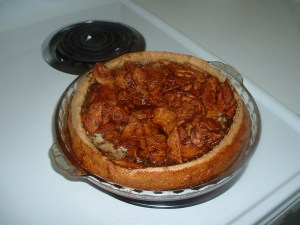
baked apple pancake

baked apple pancake

This exceptional souffle is a great entrée or breakfast meal for special occasions; beyond words, it pleases the sweet tooth of the child in each of us.  The directions are easy to follow; yet the outcome is a work of art, a display of love.

Our prized pancake weds together flavors, that strengthen and embellish each other.  Andrew Dornenburg and Karen Page inspired me with their helpful contribution concerning the enhancement of foods, one with another.  For instance, they list “food matches made in heaven” in Culinary Artistry.  This comprehensive list, with its apt name, includes superb parings for apples; my favorites are: bacon, cheese, currants, maple syrup, oatmeal, nuts, raisins, rosemary, sausages, sour cream, and yogurt.  1

Among Dornenburg and Page’s classic poetic unions for apples are: brown sugar, caramel, cinnamon, cream, custard, and vanilla.  Indeed, this dish is a testimony of the symphonic joining of these outstanding ingredients, for here they are baked together as one glorious whole.  2

This book teaches beautiful truths about how foods work in harmony, by employing either specific techniques or adding various ingredients.  Our authors write: “One flavor can overwhelm another, while in smaller quantity, as an accent, the same flavor has the power to bring out the other.”  We supplement sweetness with a pinch of salt when making fudge, while a touch of sugar is required to complete tart balsamic vinaigrette (see balsamic vinaigrette, 2016/08/22).  Such small additions intensify the main ingredient, giving relative prominence to it.  Too much of them, however, will destroy the finished food.  3

This principle of the harmonic blending of foods made me think of my acting days in community theatre, where I learned not to upstage my fellow actor, or steal away from his critical moment.  This truth transcends acting, however, for we all need to uphold each other’s performances daily, by downplaying our own.

Much like salt used in cooking, we can augment each other tastefully in our relationships-whether this be in holy matrimony or God-given friendships; thus, we grow together.  Let us regard our loved ones carefully by being salt and light to them.  Begin practicing this principle, by entertaining someone sumptuously this Valentine’s Day, with this triumphant apple pancake.

  1. Andrew Dornenburg and Karen Page, Culinary Artistry (Hoboken, N.J.: John Wiley & Sons, Inc., 1996), p. 88.
  2. Ibid.
  3. Ibid., p. 47.

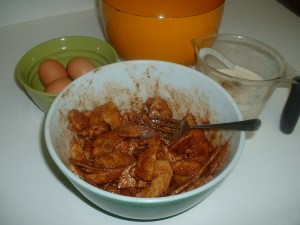
prepping ingredients for apple pancake

ingredients for apple pancake

Apple Pancake  Yields: 2-3 servings.  Total prep time: 1 hr & 10 min/  active prep time: 20 min/  baking time: 50 min.

Note: this is especially good served with Aidell’s natural, spicy-mango-with-jalapeno sausages, thus giving a beautiful hot, spicy contrast.  You may choose to double the recipe, providing you have 2 10-inch Pyrex pie plates, as cold left-overs are great with vanilla ice cream!)

10″ Pyrex pie plate

5 tbsp of butter

1/2 c whole wheat pastry flour  (If desired, grind 1/3 c organic soft winter white wheat berries to make 1/2 c flour.)

1/2 c unbleached white flour  (Bob’s Red Mill organic is my favorite; note you may choose to omit the whole wheat flour and use all unbleached white.)

1/2 tsp salt

5 lg eggs, beaten

1 c milk  (May use alternative milks, such as almond or hazelnut.)

1/2 tsp pure vanilla extract  (I use a high quality and terribly inexpensive Mexican vanilla, which I get through friends traveling to Mexico.)

1/2 c brown sugar  (Organic is best; may be found at Trader Joe’s and at times Costco.  May substitute 1 c healthier coconut sugar in place of 1/2 c brown and 1/2 c white sugars; for benefits of coconut sugar, see Zucchini Bread, 2017/07/24.)

1/2 c granulated sugar  (Organic is available in a 2-lb package at Trader’s, or in a more economical 10-lb bag at Costco.)

2 tbsp cinnamon   (A superb, organic Korintje cinnamon is available in bulk at our local Fred Meyer’s.)

2 granny smith apples, peeled, cored, and sliced very thin


  1. Preheat oven to 400 degrees.
  2. Grind flour, if you are using fresh-ground.
  3. Place butter in a 10-inch Pyrex pie plate.  Melt butter in oven.
  4. In a med/large bowl, mix together flour and salt; blend in eggs and milk; stir in vanilla.  Set aside.
  5. When butter is melted, pour batter in pie plate.  Place in oven and bake for 20-25 minutes, or until edges are puffed up and golden brown.
  6. Meanwhile prepare apples.  First, blend sugars and cinnamon in a med/large bowl; then, cut and add apple slices.  Mix well; sugars will get wet (see photo above).  Set aside.
  7. When pancake is puffed up after 20-25 minutes, quickly remove from oven and distribute apple mixture evenly in the hollow made by the edges.
  8. Return to oven as fast as possible and bake another 20-25 minutes, or until pancake is deep brown (see top photo).
  9. Serve immediately.  This is a heaven-sent treat!

1880’s Philadelphia Clam Chowder

mincing clams

mincing optional fresh razor clams

My great clam chowder is adapted from a recipe in the General Mill’s 20th century Special Silver Dollar City Edition of Miss Parloa’s New Cook Book; this reproduced cookbook was originally published in 1880, by Washburn Crosby Co., the makers of Gold Medal flour.  (This collection also includes my all-time favorite oatmeal/chocolate chip cookie, which I will share at a later date.)

I have enlarged upon this 19th century method of making this dish, by adding such flavor/texture enhancers as garlic, onion, celery, and unpeeled potatoes.  Miss Parloa calls her receipt Philadelphia clam chowder.  It introduces the technique of straining the clams, thus lending a delicate touch to the fish soup.  I am not a big fan of clam chowder, but I love this because of its mellowness, resulting from the removal of the clam juice.

There is much to be said about the distinctive flavors of shellfish and fish.  Harold McGee shares this apt science in his excellent treatise On Food and Cooking.  He teaches why ocean and freshwater creatures vary so greatly in taste, the former having a much stronger bite.

Ocean water is about 3% salt by weight, while the optimum level of all dissolved minerals inside of animal cells is less than 1%.  Consequently ocean creatures need to balance this substantial salt mineral, that they are breathing in and swallowing; they do this with amino acids, amines, and urea, which their bodies produce.  1

Behold, these substances have different flavors!  For example the amino acid glycine is sweet, while glutamic acid is savory; shellfish are especially rich in these and other amino acids.  Unlike shellfish, finfish rely heavily on the amine TMAO (trimethylamine oxide) for processing salt, which is largely tasteless.  Sharks, skates, and rays make ready the salt water with a slightly salty and bitter urea. However, this urea and the amine TMAO are converted into the stinky substance TMA (trimethylamine), by bacteria and fish enzymes in these dead, ocean-dwelling fish; thus, after they are killed, their meat tastes and smells powerfully bad with age, while that of their freshwater relatives doesn’t.  Note: our kitchen-cleanser ammonia is made from TMA.  2

Freshwater fish have a gentler effect on our taste buds, because the water they live in is actually less salty, than that of their cells; therefore, they do not need to accumulate these pungent amino acids, amines, or urea, which their ocean-dwelling cousins require to process the dissolved mineral salt.  3

You can see that different shellfish and fish supply our mouths with unique experiences.  Seawater varieties use a diversity of amino acids, amines, and urea to balance the salt in their cellular systems; these differing substances boast of a wide variety of powerful tastes.  Their freshwater counterparts, which don’t require these salt equalizers, are bland by comparison.

Miss Parloa counters the strong flavor of clam chowder by straining the clams, removing their excess liquid, which has an abundance of the above mentioned amino acids.  (For more history on Miss Parloa and 19th century American cuisine, see 1880’s Escalloped Salmon-2017/04/17, 1880’s Minced Cabbage-2017/04/24, and 1880’s Ozark Honey-Oatmeal Cookies-2017/10/30.)  I take this illustrious chef’s simple inspiration and provide an even richer experience, with additional textures and mouth-watering thrills.  You will like this delicious-yet mild-chowder!

References:

  1. Special Silver Dollar City Edition of Miss Parloa’s New Cook Book (Boston: Estes and Lauriat, 1880).  This reproduction of Marie Parloa’s cookbook was published by General Mills at an unknown date during the 20th century.
  2. Harold McGee, On Food and Cooking, (New York: Simon & Schuster, 1984, 2004), pp. 188.
  3. Ibid., p. 188.
  4. Ibid., p. 189.

Philadelphia Clam Chowder  Adapted from a recipe in General Mill’s 20th century Special Silver Dollar City Edition of Maria Parloa’s  Miss Parloa’s New Cook Book (Boston: Estes and Lauriat, 1880).

Yields: 8 servings.  Total prep time: 1 hr & 30 min/  active prep time: 30 min/  cooking time: 1 hr.

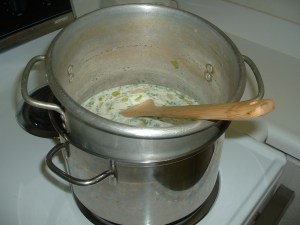
Note: if you don’t have large enough pots for the makeshift double boiler-see below photo and directions-just cook the soup over direct heat; this, however, may cause it to separate some, but this last option will reduce the cooking time.

1 tbsp oil  (Coconut or avocado oil is best; olive oil is carcinogenic at high temperatures.)

1 lg yellow onion, chopped

6 oz drained weight minced clams, or 3 strained 6.5 oz cans  (May use 6 oz fresh razor clams, chopped fine, see top photo.)

2 stalks celery, cut in 1/4″ dice

3 tbsp parsley, minced

1 lb potatoes, unpeeled, chopped in small 1/2″ pieces

5 lg cloves garlic, minced  (May use 3 cubes of frozen garlic from Trader Joe’s for easy prep.)

1 1/2 qt milk  (Whole milk is preferable, for both health and flavor.)

1 1/2 tsp salt, or to taste  (Himalayan, pink, or Real Salt is critical for optimum health; an inexpensive, fine grind, Himalayan salt is available at Costco.)

1/2 tsp white pepper, or to taste

3 tbsp butter

3 tbsp flour

  1. make-shift double boiler

    make-shift double boiler

    Heat oil, over medium heat, in a 4-quart pot that will sit inside a slightly larger pot to make a double boiler; see photo.  (If you don’t have two large pots, cook the chowder over direct heat; cooking will be faster with this last option, however, the cream soup may separate some.)

  2. When a small piece of onion sizzles in oil, add the rest of the onions and sweat, cook until translucent.  Remove from heat when done.
  3. Fill larger pot 2/5’s full of hot tap water, cover, and bring to a boil over med/high heat.
  4. Spray celery, parsley, and potatoes with a safe, inexpensive, effective produce spray: fill a spray bottle with a mixture of 97% distilled white vinegar and 3% hydrogen peroxide.  After spraying vegetables, let sit for 3 minutes, rinse really well.
  5. Drain canned clams in a colander.  If using fresh razor clams, drain and chop fine (see top photo).
  6. Chop all vegetables and garlic; add to pot of cooked onions.
  7. Add milk, clams, salt, and pepper to the pan of vegetables.  Fit this smaller pan into the larger pot, so it sits above the boiling water (see photo).  Watch water level while cooking to make sure water doesn’t boil dry.  Cook chowder until potatoes are soft, about 50 minutes.  Note: if preparing over direct heat, bring soup to a near-or slight-boil over medium heat; lower heat and simmer until potatoes are soft.  This option will lessen the cooking time.
  8. Meantime make roux, by melting butter in a small sauté pan over medium heat.  Add flour and stir constantly with a wire whisk.  Cook until light brown in color, about 2 minutes; set aside.
  9. When vegetables are soft, beat in roux with a big spoon; cook 5 more minutes, or until soup is thickened, stirring constantly.
  10. Adjust seasonings and serve.  May freeze leftovers; when you heat thawed chowder, however, it will be of a thinner consistency.  If desired, you may thicken with a small amount of roux-about 1 tbsp of melted butter cooked with an equal amount of flour-this amount will be adequate to thicken 4 leftover servings.
  11. I am passionate about this soup!

Gingered Bok Choy with Ground Turkey

gingered bok choy with ground turkey

gingered bok choy with ground turkey

Today’s recipe, with its Chinese flair, is easy to follow, though it takes some patient chopping of vegetables. (The process of this preparation flows, especially after the first time you make it.)  My dish is low in carbohydrates, vitamin-proficient, and has an inexpensive, high-quality protein. Abundant health and pleasure result!

The inspiration for it grew in me.  Recently I was influenced by Chef Susanna Foo. She Americanized her Chinese cuisine by substituting our everyday ingredients, for their Oriental counterparts, which were challenging to get in the 1990’s.  Foo discovered that these simple adjustments actually enhanced her cooking; thus I chose apple cider instead of rice vinegar and, for heat, jalapeno instead of Szechuan peppers.  1

My palette was also crying for orange juice in the mix.  I added to these surprises typical Chinese ingredients: ginger, garlic, soy sauce, sesame oil, coriander, and bok choy, which is a Chinese cabbage from Brassica rapa-the same species that gave us the turnip.  Note: the spice coriander is common to Chinese, Indian and Mexican cooking; its fresh leaves are known as cilantro-see Munazalla, 2018/03/12.  The glorious blending of these foods thrilled me!

My whole family acquired the cooking gene, a rich inheritance received from our parents. However the grander bequest was that of their love: Mom and Dad cherished one another in a steadfast, unspeakable way.  This security has always belonged to our entire family.  It has never weakened, no matter what, for even death has not separated my parents.

My father went to heaven on November 16, 2006, but I contend that my mother enjoys his presence even more now.  At 93, she sits in Buzzy-baby’s chair and eats ice cream with him.  She joyfully informs me, when I call, that he is letting her finish his share too, as he always did while he was alive.

My parents each possessed individual attributes that allowed for their earnest commitment: my father had a beautiful heart and my mother unshakable faith. Over the years, I have declared that my greatest heritage of all comprises of these two qualities.  These endowments, along with the cooking gene, set the stage for all I get to do in this world.  They have formed me, for I am a food historian in love with my God.

This legacy of devotion and faith is more precious than gold.  My inherited strong heart, powerful faith, and ability to cook, all three, propel me into this marvelous, God-given destiny.  Give me pots, pans, and ingredients and heaven-sent food results.  My meals excite all your senses.

Now I encourage you: look to your life; discover your unique inheritance (your intrinsic gifts); go forward with them.  Indeed your birthright was ordained before time began.  In the meantime try my recipe!

  1. Andrew Dornenburg and Karen Page, Culinary Artistry (Hoboken, N.J.: John Wiley & Sons, Inc., 1996), p. 211.

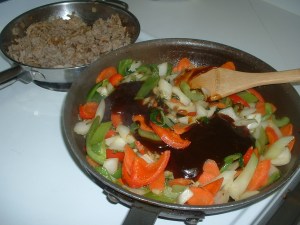
assembly of gingered bok choy

assembly of gingered bok choy with sauce

Gingered Bok Choy with Ground Turkey  Yields: 5-6 servings.  Total active prep time: 1 1/4 hour.

7 tsp oil  (Coconut or avocado oil is best for sauteing; olive oil produces carcinogens at high temperatures.)

1 med/lg yellow onion, halved at the root and cut in even 1/8″ slices

2 carrots  (Organic carrots are very inexpensive; find them in 1 lb packages at Trader Joe’s.)

2 stalks of celery

l lg red bell pepper  (It is important to use organic bell peppers, as this vegetable really absorbs pesticides.)

1 lb bok choy  (Organic bok choy comes in smaller heads; weigh before purchasing.)

1 lb ground turkey  (Natural is important; Foster Farms is reasonably priced and good.)

4 tbsp fresh ginger, peeled and chopped fine

1 lg jalapeno pepper, minced small  (May use more for a hotter dish.)

5 large cloves fresh garlic, or 3 cubes frozen garlic  (Frozen garlic is available at Trader Joe’s, it provides ease in cooking, especially excellent for this recipe.)

1/3  c organic tamari  (May substitute soy sauce, but not as healthy or flavorful; tamari is available in the health section at Fred Meyer’s, or at other national chains such as Whole Foods.)

1/3 c apple cider vinegar  (Raw is the best; inexpensive at Trader’s.)

1/3 c orange juice  (May squeeze your own, or use orange juice that is not from concentrate, such as Florida’s Natural or Tropicana’s.)

1/4 c water

1 tbsp sesame oil  (This is found at a good price at Trader’s.)

1/2 tsp ground coriander

1/4 cup corn starch, dissolved in 1/4 cup cold water

Steamed rice  (I personally prefer brown basmati.)

  1. Heat 1/2 tsp of oil in an large saute pan over medium heat.  Add a small piece of onion; when it sizzles, oil is ready.  Add remaining onions and caramelize, by stirring every several minutes, until color starts to form; then, stir every minutes, until dark brown.
  2. Meanwhile cook turkey in a extra large frying pan.  Place in a bowl.
  3. Clean all vegetables, except ginger, with an inexpensive effective spray (a mixture of  97% distilled white vinegar and 3% hydrogen peroxide); let sit for 3 minutes and rinse extra well.  Set aside.  While waiting for vegetables, start cooking rice.
  4. Peel and mince ginger in very small pieces, set aside.
  5. Chop garlic fine, if using fresh, set aside.  (Frozen garlic from Trader’s works better with this recipe.)
  6. When onions are caramelized, add cooked meat to them, and turn off heat.  Note: you will reuse this extra-large pan for cooking the vegetables.
  7. Dissolve corn starch in 1/4 cup cold water, set aside.  Next slowly heat garlic, tamari, vinegar, orange juice, water, sesame oil, and coriander in a small saucepan over med/low heat.  It will take about 15 minutes for light bubbles to rise in liquid.  Meanwhile go to next step.
  8. Prepare carrots by scraping with a knife and thinly slicing at a diagonal. (Scraping, rather than peeling, preserves vitamins just under the skin.)  Cut celery in 3/4″-wide diagonal pieces.  Place carrots and celery in a bowl, set aside.
  9. Chop pepper in 3/4″ x 2 1/2″-wide strips.  Place in another bowl with bok choy, which is chopped in strips the same size as the pepper, including greens.  Set all aside.
  10. Heat remaining 1 1/2 tbsp oil in the extra-large pan.  Place a small piece of carrot in oil, wait for it to sizzle.  Also turn heat on to med/low under pan of meat/onions.
  11. Add carrots, celery, and ginger to hot oil.  Stir well to coat vegetables with oil.  Cook 3 min, stirring occasionally.  Add bok choy and pepper strips, mix well with carrots.  Cook for about 7 minutes, or until vegetables are done, but still crisp.  Be sure to stir frequently.
  12. The liquid sauce should be forming light bubbles by now; add the cornstarch, which is thoroughly dissolved in water; beat constantly with a wire whisk.  It thickens quickly.  Remove from heat when thick and clear. (This takes only about 15 seconds.)  Set aside
  13. Mix together: hot meat, finished vegetables, and sauce.  Serve immediately with steamed rice.  This pleases the palate!