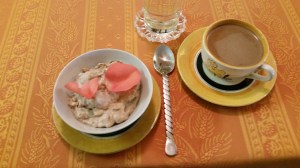
Serungdeng Kacang

serungdeng kacang

serungdeng kacang

The condiment serungdeng kacang first completed my varied dishes in the early 1980’s, when I was catering historical events in Billings, Montana.  In those days, I sought recipes that allowed me to offer thematic meals from diverse cultures and times. To my joy, I discovered a host of receipts from Indonesia; thus, I presented an Indonesian rijsttafel to my eager audiences.

A rijsttafel is a banquet of delicacies from this southeast Asian republic, formerly known at the Dutch East Indies.

Serungdeng kacang is a condiment for rice dishes in these ethnic feasts. My particular recipe comes from Java, one of the many islands in Indonesia. These coconut crumbs, spiced with onion and garlic, are spread liberally over the rice portions, in addition to a variety of other garnishes.

For me, serungdeng kacang has multiple, inventive benefits: it is compatible with Indian curries, acts as a delicious hors d’oeuvre, and-my favorite-provides the crowning touch to salads!

I always keep this enhancement to tossed greens on hand, by making a double batch and storing it in a sealed storage bag.  The beauty of this topping is it lasts a long time, if you are disciplined.

Prior to my doing this rijsttafel, I presented a gala event, a Moroccan affair, which was to  become one of my favorite memories in the history of my business; it best defines what my work entailed back then.

I loved to act in my youth and knew the Billings’ theatrical community well.  As an aside, actors often make a living in the restaurant business; they are adept at waiting tables.  Then my creative dinners needed both excellent service and improvisation.  An incredible fit was made with my Billings’ thespian friends; thus, I frequently employed them in my catered dramas.

My most treasured memory using this partnership was a fundraiser for the Billings’ Children’s Theatre, in which I presented an authentic Moroccan dinner, for a staged “Night at Rick’s Place”.  The five winning tickets, from those auctioned off-each with their three guests-were transported back to World War II in the theatre’s upstairs.

This large room had been converted into Rick’s Place, from the movie Casablanca.  It was furnished with a bar off to one side of the restaurant, while the dining room consisted of five tables of four, clothed with white linen.  The city’s leading actors peopled the bar scene. More of these, dressed in tuxedos, served the sumptuous meal to the unsuspecting partakers in this suspense.

Broadway arts resulted!  Numerous brawls took place in the bar; the Gestapo arrived; guests were pick-pocketed, and on and on.  Talk about fun.

My part was the researched African meal.  That afternoon, after weeks of cooking, I showed up for the final preparations in the theatre’s limited kitchen. Behold, the limits escalated upon my arrival, for the stove wasn’t working!

The true test of my creativity came.  Nevertheless, God’s grace broke through: makeshift occurred as a call went out and citizens brought in hot plates.  The event came off triumphantly, as I, in  Moroccan dress, told the innocent company the colorful history as each dish was served.

I repeated this dinner numerous times in my career, but this show never again reached the thrill of its original occurrence.  That night in “Casablanca” best exemplified what I did with my work then.

Now my food history presentations entertain larger audiences, but still guests participate in dinner theatre type events. They engage by eating authentic foods; I, dressed in period costume, narrate their careful stories.

Today my grand affairs mostly involve Northwest history, for which I was trained in graduate school.  However back in the 80’s and 90’s, I presented other cultures and times in my gala occasions.  Among these many thematic experiences was this Indonesian rijsttafel, from which today’s entry originated.

simple mincing of onion

simple mincing of onion

Serungdeng Kacang  Yields: 3 c.  Total prep time: 1 hr, plus 1 hr for cooling/ active prep time: 30 min/ cooking time: 30 min.

6 tbsp yellow onion, minced  (You will need a med/large onion; follow directions below for simple mincing-see photo.)

6 med/large garlic cloves, chopped fine

2 tbsp sugar  (Organic cane sugar is best; available at Trader Joe’s and Costco.)

1 tsp salt  (Himalayan, pink, or Real Salt is critical for optimum health; a fine grind Himalayan salt is available inexpensively at Costco.)

1 tbsp oil  (Coconut oil is the best for flavor and quality here.)

2 c unsweetened coconut chips  (Available in bulk at our local Winco, or in a 12-ounce Bob’s Red Mill package at local supermarkets.)

1 c roasted, unsalted peanuts  (Also available at low cost in bulk at our local Winco.)

  1. An easy way to mince onion is to peel it, leaving the root on; next, score it by cutting slices close together across the top one way, going 3/4 of way down into the onion; then, turn it and cut slices the other direction.  After onion is prepared thus, shave the minced pieces off the end of it with a sharp knife (see photo).
  2. Heat oil in a cast iron skillet over medium heat.
  3. Measure 6 tbsp of minced onion and place in a mortar; save rest of onion for other cooking.  With a pestle mash onions, garlic, sugar, and salt.  When this is a thick puree, set aside.  (See mortar and pestle in photo.)
  4. Place a piece of the coconut in oil; when it begins to turn brown, immediately lower temperature to med/low; oil is ready for cooking.  Meantime mix together coconut and onion mixture in a large bowl. Make sure coconut is completely coated.
  5. When oil is hot, add coconut mixture; mix well with spoon to evenly coat fruit with oil.
  6. Cook about 20 minutes (over med/low heat), or until golden brown in color and slightly wet, stirring every 5 minutes, so as not to burn.  Let it, however, cook for full 5-minute increments, without stirring; this allows for the coconut to brown.  As you stir it, carefully scrape bottom of pan with a spatula.
  7. When coconut is light golden brown, add the peanuts and cook for another 5 minutes; stir twice in this last 5-minute period.  Note: it will get a darker brown and drier, as it cooks more with the peanuts and then cools in the heat-retentive cast iron pan.
  8. Remove from heat and be sure to leave in skillet to cool; this completes the drying process.  (See top photo for finished product.)
  9. This lasts for months, kept in a sealed storage bag.

Sauteed Squash with Curried Yogurt Sauce

sauteed squash with curried yogurt sauce

sautéed squash with curried yogurt sauce

This history-which follows-came to me, when a beloved friend asked me to concoct this recipe for sautéed squash; she fell in love with its original at an excellent restaurant, while traveling.  Goldie longed to enjoy repeats of this masterpiece, without having to leave the Portland area; thus, she trusted my expertise to supply her this powerfully good recipe-thanks to another chef’s inspiration!

This whole process made me aware that we need each other’s expertise; thus, we lend our strengths to one another in order to break through circumstances-both in the kitchen and life. This exceptional combination started in the mind of an adept chef, but I built on it using my own approach.  In turn, I encourage you to take it to your worlds, by innovating yet further.

None of us wants to miss playing out our foreordained part!  I loved acting in community theatre in days past.  Here I learned that there are no small actors, just small parts.   The eye can’t say to the nose I have no part in you, or where would the sense of smell be in the body.  In this manner, we can’t fulfill our destinies without each other’s help, while always remembering that every “body part” is critical.  We don’t want to forfeit, even by default, any of our precious chances to give or receive support.  This way we discover our life-purposes.

James Trager has been all that for me in my writings.  With a mind like mine for detail, he offers a feast of food history information in The Food Chronology.  His work equips me with an abundance of needed facts, to effect my God-given calling.

For instance he has four entries on squash.  The first dates back to 1527, when conquistadors returned to Spain with facts about New World foods.  They reported that the Aztecs consumed squash and beans among numerous other delicacies, such as: white worms, eggs of water bugs, and domesticated guinea pigs.  These tamed animals were eaten with the skin on-the hair being removed as with a suckling pig.  (Note: while studying food in 1985, I was offered guinea pig in Peru, one of the lands the conquistadors conquered in the 16th century.)  1

Next, Trager takes us to Virginia in 1588.  Then English mathematician Thomas Hariot wrote that these Virginia fields were planted Indian-style with squash, maize, beans, and melons.  However he noted they yielded five times more than the same acre in England.  2

I take this chance to build on Trager’s house: this New World area, nearly two centuries before the forming of America, was called Virginia, a word from the Latin virgo (stem virgin).  The land was named after Queen Elizabeth I, who was queen of England and Ireland (1558-1603).  She was known as “the virgin queen”; thus, this virgin land became Virginia.

Finally, our illustrious historian Trager details the early public appearances of spaghetti and calabaza squash in the United States.  The first, resembling spaghetti, was introduced in 1962 by a specialty produce company in Los Angeles.  3  Then, when Miami’s Grand Bay Hotel opened in 1982, Jamaican-born Chef Katsuo Sugiura had a loin of lamb among his specialties.  He smoked this over oolong tea and hickory chips; Sugiura served it with calabaza squash, grilled Portobello mushrooms, and yuca.  4

I love to share the bread of life through my recipes and words.  As you can see, my act of creating is so dependent on the works of others.  Now may you expand this, my fire, in your lives-both inside and outside your kitchens.

  1. James Trager, The Food Chronology (New York: Henry Holt and Co., 1995), p. 88.
  2. Ibid., p. 104.
  3. Ibid., p. 569.
  4. Ibid., p. 660.
preparing squash

preparing squash

Sautéed Squash with Curried Yogurt Sauce Yields: 3-4 servings.  Total prep time: 3/4 hr.

3 tbsp butter

2 tsp fresh ginger, peeled and chopped fine  (I have also substituted 1/4 tsp dried ginger, but fresh is better.)

1/2 large apple, peeled and chopped in very small pieces  (I prefer granny smith apples here, but not necessary.)

1/4 tsp curry powder

2 tsp honey

1/2 cup plain yogurt  (Nancy’s Plain with Honey is good; Stoneyfield organic plain Greek yogurt is even better.)

1/4 tsp salt, or to taste  (Real Salt is important; available in health section of local supermarket.)

1 lb butternut squash, peeled and sliced in 1/4″-wide strips

Roasted almond slices for garnish, optional  (May roast nuts ahead of time at 350 degrees for 10 minutes.)

  1. Put a serving platter in a warm oven.
  2. Melt 1/2 tbsp of butter in a small saucepan over medium heat.  Add ginger, apple, curry powder, and honey; sauté until fruit is soft; stir frequently. Remove from heat, add yogurt immediately, season to taste with salt.  Set aside.
  3. Meanwhile peel squash with a sharp knife.  Remove any seeds.  Place flat side of halved squash on counter and cut in 1/4″-wide slices; cut these slices into equal sized strips.  (See above photo.)
  4. In large frying pan, heat 1 1/2 tbsp of butter over med/low heat, until a small piece of squash, which is placed in it, sizzles.  Sauté as many strips in hot butter as will fit in pan; cook for about 4 min per side, or until soft and golden brown. Remove cooked pieces to warm platter and keep in oven.  When this batch is finished, add another 1/2 tbsp of butter to pan and repeat this step, until all the squash is done.
  5. Pour yogurt sauce on hot squash, garnish with optional almond slices, and serve.  Be prepared for joy unspeakable!

Butternut Squash Soup

butternut squash soup

butternut squash soup

Someone once said that a meal at my home is like going to a spiritual spa; with God’s help, I nourish both body and soul.

My creative sister concocted this great soup and gave the recipe to me years ago.  It has frequently graced my table, where my guests experience much peace.

My vision for this blog is to sustain people with wholesome food through the written word; thus, they will build strong bodies.  However, I am fully aware that a vibrant physique isn’t enough to insure complete health-that of body, mind, emotions, relationships, and finances.

How clear it is: we miss the totality of this by lack of knowledge!  My desire is that vital truth, which sets people free, will be revealed here gradually, primarily through the intriguing discipline of preparing food.

My lavish meals in my home feed many, both physically and spiritually; my blog contacts a great number more.  My personal prayers, however, expand to Uganda, England, Germany, Peru, Kenya, India-to mention a few of the nations that constitute the cry of my heart.

Chief among my steadfast petitions is that my writings/recipes, which go around the entire globe, will eradicate our health deficiencies-first those in our bodies and then in every other area of our lives.  God bless our journey together in this!

As an aside, my favorite way to entertain is by having only one or two guests, for the conversation is most intimate then.  I always keep individual containers of soup-holding several servings-in my freezer; thus, delicious soup is easy to serve at my small dinner parties.

May I suggest you buy a three-and-a-half-pound squash?  Save one pound of it for next week’s recipe-sautéed squash with curried yogurt sauce.  Also if you have leftovers of the soup, freeze some for unexpected visitors.

pot of butternut squash soup

soup with soft squash before pureeing

Butternut Squash Soup  Yields: 8-10 servings.  Total preparation time: 1 1/2 hr/ active prep time: 30 min/ cooking time: 1 hr.

2 tbsp oil  (Coconut or avocado oil is best.)

1 extra lg or 2 med onions, chopped

2 1/2 lb butternut squash, unpeeled and cut in chunks  (I prefer organic; you may buy an extra pound to cover next week’s recipe.)

2 quarts broth, preferably bone broth  (See recipe for this power food at Tortellini Soup, 2016/10/10.)

2 c water

1 tbsp cinnamon

1 tsp dried ginger

1/3 tsp nutmeg  (Freshly ground nutmeg is best.)

1/4 tsp ground cloves

2 tbsp fresh ginger, peeled and chopped fine, optional

1 1/2 tsp salt, or to taste  (Himalayan, pink, or Real Salt is critical for optimum health; an inexpensive fine grind Himalayan salt is available at Costco.)

1/4 tsp white pepper, or to taste

Better Than Bouillon, chicken flavor, to taste

  1. Heat oil in a stock pot over medium heat.  Add a small piece of onion; when it sizzles, add the rest of the onions and sweat (cook until translucent).
  2. Meanwhile clean squash with a safe, inexpensive, effective vegetable spray (a mixture of 97% white distilled vinegar and 3% hydrogen peroxide): spray squash, let sit for 3 minutes, rinse extra well.
  3. Cut unpeeled squash in chunks.  Be sure to remove the seeds first.  Add to cooked onions.
  4. Pour broth and 2 c of water in pot. Add spices, fresh ginger, salt and pepper.
  5. Cover and bring to a boil, over med/high heat.  Reduce heat, uncover, and simmer for 40-50 minutes, or until squash is very soft (see above photo).  Check for flavor during cooking and adjust spices to taste.
  6. Remove from heat and puree with an immersion blender.  (This is also known as a blender-on-a-stick; available at Bed, Bath and Beyond at a moderate price.)
  7. Add water, if soup is too thick.  Stir in Better Than Bouillon, to taste, starting with a teaspoonful.
  8. Finally adjust salt and pepper.  Serve hot, freeze any leftovers.

Sweet Potato Pie

sweet potato pie

sweet potato pie

Sweet potato pie and Christmas go together.  “Ring those Christmas bells; light the Christmas tree!”  This familiar carol burst forth vitally for me first in 1994; then, I had just invited Jesus into my heart.  Incipient, living joy impacted me with this song, in my initial Sunday service, during that month of December.

For decades the Salvation Army has rung those Christmas bells every holiday season; they have invited us always to reach out to the less fortunate.

Last year a dear bell-ringer came into my life; George lite up the Fred Meyer’s grocery store, where I took my daily coffee.  During the holidays, this man reminisced about his mother’s sweet potato pie.  As he formed his words, my heart contrived an extraordinary surprise: I could develop a sweet potato pie for him.

Days later Christmas came alive for me much the same as in 1994: I delivered my newfound creation, this seasonal treat, to my cherished bell-ringer.

My heart leaped with joy, when George returned this year, for once more I got to give my sweet potato pie to him.  May you, too, shower your loved ones this holiday with this blessed recipe!

To learn more about the differences between sweet potatoes and yams go to African Nkyemire.  Also enjoy this tuber in my Sprouted Quinoa and Yam Salad, 2019/09/05.

  1. dscf0070Sweet Potato Pie  Yields 1-10″ pie.  Total prep time: 3 1/4 hr/  active prep time: 3/4 hr/  baking time: 1 hr (for sweet potatoes the day before) and 1 1/2 hr (for pie the day of).

2 c baked, peeled sweet potatoes, packed down in cup  (You will need 1 1/2 lbs or 2 medium sweet potatoes-note that yams are a variety of sweet potatoes in America.)

1 1/4 c half and half

1 c brown sugar, packed  (Organic is best; available at Trader Joe’s; coconut sugar is also excellent.)

3/4 tsp salt  (Himalayan, pink, or Real Salt is critical for optimum health; a fine grind Himalayan salt is available inexpensively at Costco.)

4 1/2 tsp cinnamon

1 tsp ginger

1/4 tsp ground cloves

1 tsp vanilla

4 lg eggs

  1. Preheat oven to 350 degrees.  Wash sweet potatoes, dry, and pierce with a fork.  Wrap potatoes in foil and place on a cookie sheet.  Bake in oven until soft, for about 1 hour, depending on size of potatoes.  Cool.  MAY BE DONE A DAY AHEAD.
  2. Note: if you don’t have a food processor, go to step 5 for doing this by hand.  If using a food processor, place 2 c peeled sweet potatoes in the processor.  Blend well.
  3. Place mashed sweet potatoes in a large bowl and add cream, milk, sugar, salt, spices, and vanilla; blend well with a wire whisk.
  4. Add eggs and beat again; set aside.  Proceed to pie crust.
  5. If doing this by hand, mash well peeled sweet potatoes, with a potato masher or large fork; follow steps 3 and 4.  Set aside when filling is complete.  Proceed to pie crust.

Pie Crust  Yields: 2  pie crusts.  (Note: this recipe requires 3/5’s of these 2 crusts; the rest may be baked into cinnamon sugar strips.)

1 1/4 c unbleached white flour  (Bob’s Red Mill organic is high quality.)

1 c whole wheat pastry flour  (I grind 2/3 c organic soft winter wheat berries, to make 1 c of whole wheat pastry flour.)

1 tsp salt

2/3 c oil  (Grapeseed or canola oil is best.)

1/3 c plus 1 tbsp boiling water

Wax paper  (This makes for a mess-free rolling out of the pie crust.)

  1. Preheat oven to 350 degrees.
  2. With a fork, blend flours and salt together in a medium bowl.
  3. Mix in oil and boiling water until all flour is incorporated.
  4. Form into two balls and cover in plastic wrap.  (One ball should be 3/5’s of the dough; the other smaller ball can be made into cinnamon strips and baked along with the pie.)  Place balls on top of hot oven to keep warm.
  5. Using a rolling-pin, roll out larger ball, between 2-18″ pieces of wax paper. Make a big, slightly oblong circle-12 1/2″ x 15″-with the dough (see above photo).  Peel off top piece of wax paper.  Turn upside down and gently place pie crust over a 10-inch pie plate, with the wax paper side up.  Very carefully peel the wax paper off.  With fingers, seal any cracks in crust and form a rim around the edge of plate with the dough; patch lean areas of the crust with excess from other areas.
  6. Pour the sweet potato puree in the pie crust.  Bake for 1 1/2 hr, or until a knife comes out clean, when inserted in center.
  7. This is good!

Curried Chicken/Cheese Ball

curry/chicken/cheese ball

curried chicken/cheese ball

This incredible hors d’ouvres dates back to the early 1980’s.  My mother’s best friend, in our small Rocky Mountain village, became my treasured ally. She and her husband moved to East Glacier Park, when he retired as a screenplay writer. Talbot Jennings was so famous that a prominent New York City television station featured his movies, such as The King and I, for a whole week, before he died.

This illustrious couple traveled the world during the production of these films; thus, Betsy schooled me in her prodigious cosmopolitan ways.  I thoroughly enjoyed sitting under her tutelage, as she prepared me for the lions at Trafalgar Square and exceeding more, prior to my moving to London.  I believe she was even more excited than I, about my valiant relocation to Tokyo half a decade later.

The voluminous New York Times brought the vast outside world to Betsy every weekend.  She was forever clipping articles to prepare me for my numerous sojourns.

With this same spirit, starting in 1982, she helped me to grow as a historical caterer. My creative mentor was always sending me gifts, which she ordered from the New York Times.  Ingenious gadgets were among a wide array of superlative food items. Many of these imaginative tools still grace my kitchen today.

While I was doing my early work in Billings, Montana, I journeyed to my hometown each year, where I catered multiple theme dinners per visit. The eight-hour drive across the wide expanse of the Big Sky Country thrilled my tender soul. How I delighted in approaching the backdrop of my beloved mountains, as I gazed across those colossal open prairies.

Once there, I spent many hours drinking in wisdom at Betsy’s feet.  During one of these relished trips, she offered this  delectable cheese ball to me.  I was enamored with it then and still am today.  Then it was a frequent hors d’oeuvre at my gala catered events;  today it is still my constant contribution to every holiday meal, at which I am a guest.

May you make this blessed appetizer a family tradition as well!

Curried Chicken/Cheese Ball  Yields: 2 1/2 c.  Total prep time: 3/4 hr/ active prep time: 30 min/ inactive prep time: 15 min.  Note: you may make this a day ahead.

8 oz cream cheese, softened

1 c slivered almonds

1/2 c unsweetened coconut, finely grated  (Available in bulk, at our local Winco and other stores.)

2 tbsp mayonnaise  (Best Foods excels all other mayonnaise.)

2-3 tbsp Major Grey’s Mango Chutney  (3 spoonfuls gives full-bodied sweetness.)

1 tbsp curry powder, or to taste

1/2 tsp salt  (Himalayan, pink, or Real Salt is critical for optimum health; a fine grind Himalayan salt is available inexpensively at Costco.)

3-4 frozen tenderloins  (Natural chicken is best; Trader Joe’s works well for quality and cost.)

1-9 oz box Original Wheat Thins

  1. Preheat oven to 350 degrees.  Roast almond slivers for 10 minutes.  Remove and cool on a plate.
  2. If you are using frozen tenderloins, thaw in warm water.  Cook chicken in salted boiling water.  When center is white, after inserting a knife, remove chicken from water and cool in refrigerator on a plate.  Do not overcook to avoid toughness.
  3. Mix all the above ingredients except the chicken and almonds.  Note: it works best to insert a regular teaspoon in the narrow jar of Major Grey’s Mango Chutney, when measuring it.  Be sure to use well-rounded teaspoons, as each approximates a tablespoon, for which the recipe calls.
  4. Chop roasted almonds with a sharp knife; add to cream cheese.
  5. Leave this cream cheese mixture out at room temperature, while waiting for the chicken to cool.  When meat is cool, cut it into small pieces; finally, mix chicken into cream cheese very gently, as not to shred it.
  6. Criss-cross two large pieces of plastic wrap; place chicken ball in the center of wrap.  Surround ball with this plastic covering and refrigerate on a small plate.
  7. Soften ball at room temperature before serving, to facilitate the spreading.
  8. Surround with crackers on a decorative serving plate.  This is a winner!

Thai Coconut/Lime Flounder

Salad with leftover Thai flounder

salad with leftover chilled Thai flounder

This delicious white fish dish resulted from a long-awaited-for marriage, which took place in my church in October.  A feast at my bountiful table was part of my wedding present to our venerated couple.

Our bride Dina was particularly interested in learning how to cook, with ease, for her new groom.  My bright idea was to begin my dinner gift in the kitchen with teaching her how to make the meal.  I prepared all the steps, just like you might see on a cooking show: the ingredients were set out in small individual dishes, along with the corresponding pans and utensils. All was in place for the lesson to flow naturally.

My priceless inheritance from my parents was a gene that “knows” food. Therefore I intuitively conceived this delicious dish, which was specifically geared for her husband’s dietary needs.  An exquisite, ultra simple recipe resulted.

Surprise and hesitancy occurred upon my friends’ arrival, as I informed Dina that she was going to make dinner, under my close direction.  She, being true to form, rolled up her sleeves with courage.  Her nervousness soon dissipated, for the facility of my simple instructions comforted her.  Joy unspeakable resulted: a chef was born! I have observed, as an aside, that this woman approaches all of life’s challenges with this same spirit.

Are you timid about stepping into the unknown, either in or out of the kitchen? May you receive encouragement to advance in faith; start by trying my recipes. They look lengthy at times, but are effortless!  The cause for this seeming protractedness is my inclusion of practical details, which make food preparation easy and enjoyable.  You’ll sense that you are in  cooking school, when you use my receipts, as I teach at every point.  Rest assured-I will educate you for the joy of cooking.

My favorite way to serve this smooth flounder, with its slight bite, is over a good pasta (however I used rice for my newly weds); either will bless the taste buds. Also, cold leftovers of this fish top off a salad superbly.

This feast pleased Dina and Dale; and me as well!

Thai coconut lime flounder dinner

Thai coconut/lime flounder dinner

Thai Coconut/Lime Flounder  Yields: 4 servings.  Total prep time: 40 minutes.

Note: flounders closely relate to soles; thus, you may substitute any sole here (also see Parmesan Dover Sole, 2017/03/27).

1 tsp coconut oil  (Other oils will do, but coconut is best for flavor and quality here.)

1 med yellow onion, halved at the core, and cut in even 1/8 inch slices

1 lime, juiced

7 oz Extra Thick Coconut Cream, or half of a 14 oz can  (This is available at Trader Joe’s.)

3/4 tsp dried, crushed red pepper  (Save spice jars and refill yearly with fresh, inexpensive “bulk’ spices.)

1/4 tsp salt

4 fillets of flounder, approximately 1 pound  (Wild-caught is best; may substitute a pound of sole, which is a close relative to flounder.)

Steamed rice or pasta, regular or gluten-free

  1. beginning stages of caramelization

    Start cooking rice, according to directions on package.  If using pasta, begin boiling water in a big pot; to which you add 2 tsp salt and 2 tbsp oil-any kind of oil will do.

  2. Place 4 individual dinner plates in oven; set the temperature on warm.
  3. Heat oil in a large sauté pan over med/low heat; stir in onions well; caramelize, by stirring every several minutes until they start to turn color (see photo); then, stir every minute until dark brown (see photo below); watch carefully while going to next steps.  (Do not crowd pan with onions, or they will sweat, taking much longer to cook.)
  4. Meanwhile roll lime on counter; press down hard with your hand, until the meat of the fruit is broken down and softened; juice lime; set aside.
  5. Place whole can of coconut oil in a small storage container; be sure first to gently stir milk and cream together thoroughly in can (this prevents a mess when emptying the can).
  6. Add half of the coconut cream (7 oz), lime, red pepper, and salt to caramelized onions.  Stir well and slowly bring to a soft boil over medium heat.  If preparing for guests, you may choose at this point, to set aside coconut/onion mixture and heat it 15 minutes before serving.  If you are waiting, be sure to have the plates warm, rice cooked, or water boiling when you start to cook the flounder.  (Note: you can freeze leftover coconut cream, or use within a week.)
  7. caramelized onions approaching finish

    Start cooking pasta in boiling water about 10 minutes before dinner time. Boil until it is al dente, about 7 minutes, do not over cook. Drain and place on heated dinner plates when done.

  8. Meanwhile add two fillets of flounder (more if using smaller sole) to hot coconut cream/onion mixture, which has been heated over medium temperature.  Poach briefly on each side, only until color in center is opaque.  Do not overcook.  Remove to heated dinner plates, on which you have placed pasta or rice.  Repeat this step with the remaining fillets.  Cover with sauce.
  9. Serve it forth!

Bolitos de Chocolat y Coco

Bolitos de chocolat y coco

bolitos de chocolat y coco

1985 was a big year for me, for I traveled to Peru-from whence this recipe is derived-that summer to study food, while later in September I went to Paris, with the intent of moving my business there. (Read more about my time in France in Balsamic Vinaigrette, 2016/08/22.)

My jocund days in Peru were filled with the warm blazing sun, but nights were very cold, as July brings winter to this nation in the southern hemisphere.

Machu Picchu met my love for mountains in a grand way.  The ancient trail leading to these ruins made for an arduous climb; we got off the train and labored, with copious sweat, for hours to complete its last leg.  What a memorable day!

My far-reaching, historical catering business was three years old during my time in South America, in the 1980’s, and my mind was a sponge for details about food. While there, every morsel that went into my mouth came out as a comment in my journal.  Most of this keen eating took place in inexpensive cafes, where chickens were always roasting on open hearths.  The better of these humble restaurants had guinea pig and Cebiche, raw white fish “cooked” in lemon juice.  Street vendors’ food also provided me with rich information, but my greatest joy was the private dinner invitations I received, to both rich and poor homes.  Note: there are only these two classes there.

Karen, my then neighbor in Billings, Montana, and her Peruvian boyfriend inspired me to make this colorful sojourn.  Indeed Chino’s family blessed my trip: I may not be alive today, but for them, as great trauma occurred for me in this country. Fortunately for me, his family was extremely influential; for instance, his second cousin was president during my visit.  (This man was ousted a number of days after I left; Chino’s brother-in-law was murdered by terrorists several months later.)

My trouble came when I and my traveling companion, a longtime friend from Paris, let down our guards.  We always covered each other’s backs in the marketplace, as robbery is ever-present in this poor nation; we, however, went our separate ways one day in Cusco.  On my own, I was mesmerized by the wide array of vendor’s goods: blankets on the ground displayed raw meats, brightly dressed women loudly announced their vibrant vegetables, modest pots and pans were set up elsewhere.  Stopping I indulged in a delicious, doughnut-like pastry; next, I reached for my funds to buy freshly squeezed orange juice.  My wallet was gone!

Absolutely everything of importance was in it: my passport, money, travelers’ checks, credit cards, and return ticket home.  This unseasoned traveler was without identity and provision in a volatile place.

God’s grace got me to my homeland safely through a multitude of miracles. The last of these happened just hours before my plane’s departure, for the president of Aero Peru, a friend of Chino’s family, reinstated my plane ticket at this critical moment.

Even before I experienced this culture, my repertoire of catered meals included a Peruvian dinner. The background for this authentic repast came from a cook book, from that country, shared by Chino’s girlfriend; nevertheless, this account was strictly for the upper class.  For hors d’ouvres at these events, I used the youth’s favored dish Ocopa-chunks of boiled, bland purple potatoes, topped with cheese, walnuts, mild chiles, and eggs. The main course boasted of Aji de Gallina, an incredible walnut chicken. Dessert was Suspiro Limeno, a light, airy custard; the feast ended with Bolitos de Chocolat y Coco.  To this day, these chocolate/coconut balls are the finishing touch at ever meal I host.

Chocolate has an interesting history.  Spanish explorer Hernando Cortez introduced cocao beans to Europe in 1528, when he returned from “New Spain”.  There the Aztecs mixed cocao paste with spices to make a thick drink.  In their convent at Oaxaca, creative Spanish nuns added sugar, which made this chocolate beverage even more palatable.  1

Chocolate was highly prized then and still is today; these superb, truffle-like candies-a rich man’s food in Peru-will please any chocolate lover.  This recipe is simple and foolproof; don’t miss this delectable treat.

  1. James Trager, The Food Chronology (New York: Henry Holt and Company, 1995), p. 89.
Making bolitos de chocolat y coco

chocolate after stirring in coconut

Bolitos de Chocolat y Coco (Peruvian chocolate/coconut balls)  Yields: about 6 dozen balls. Total prep time: 45 min.

12 oz unsweetened chocolate  (Baker’s works well.)

1-14 oz can sweetened condensed milk  (It’s important to use Borden’s Eagle Brand.)

2 tsp butter

2 c unsweetened fine-flake coconut  (Available in bulk at our local Winco and other supermarkets.)

  1. Break chocolate into pieces in a medium-size, heavy-bottom saucepan.
  2. Add butter, melt slowly over low heat.  Watch carefully, so as not to burn.
  3. Meanwhile open the can of milk and place 1/2 c of coconut in a measuring cup.  Set aside.
  4. When chocolate is completely melted, quickly add condensed milk.
  5. Stir over low heat for about 30 seconds; it will start forming a soft ball. Toward the end of the 30 seconds, stir in the coconut.  Do not overcook, or chocolate will be dry.  Immediately remove from heat after these 30 seconds; continue to stir vigorously until soft ball is formed all the way.  See photo.
  6. Cool just enough for handling.
  7. Place 1/2 c of coconut in a small bowl.  (You will add more coconut to the dish as needed.)  Form small balls of chocolate and roll in coconut, placing them in an 8×8 inch pan.
  8. Chill chocolate for several hours; then, transfer balls to a freezer-storage bag.  These will keep for a very long time, if you double the bag for long-term freezing.
  9. Excellent chocolate, so easy, absolutely foolproof.


Rosee, a Medieval Dish Flavored with Rose Petals

Rosee-a medieval dish flavored with rose petals

rosee, a dish flavored with rose petals

As I was envisioning this series on foods of the Middle Ages, I was told of a renaissance happening here in our city: we have been chosen as one of eight finalists in a national competition called America’s Best Communities.  Its goal is community revival in America.  This makes me aspire towards Tualatin leading the United States in the regeneration of its local people.

The best is always saved for last-dessert!  This medieval recipe, rosee, reproduces more of the excellent flavors of King Richard II’s court.  However there is a greater value in this post; here I share my vision for revival along with this delicious dish.

Some historians say the Renaissance, or birth of humanism, had its heritage in the beliefs and customs of the Middle Ages.  I discovered this truth in The Encyclopedia of the Renaissance.  This movement’s inheritance is defined there, for its patrons were often the medieval church and the papacy, while its artistic themes reflected the lives of the saints and stories from the Bible.  The questions of the Christian faith and morals were its issues, while the prayers and canons of the Mass constituted the texts for its music. Indeed the burgeoning of the Renaissance is founded in the spiritual and intellectual traditions of the medieval church. 1

A number of historians made this connection.  Likewise my series on 14th century, medieval foods gave me impetus for a proclamation: I see an awakening happening here in Tualatin, which began with prayer in my Abundant Life Family Church.  Indeed, we will lead our country in renewal, a renaissance.

Our town has already received $100,000, as a finalist in the above competition, to establish this vision.  Mobile Makerspaces, a well-equipped trailer, presently reaches certain schools.  It establishes a powerful birthright in our children, who are our future.  This happens with a bounty of traveling technical equipment, such as creative electronics and 3-D pens.  These ingenious tools give tomorrow’s citizens hands-on experience with big concepts in STEAM (an acronym for science, technology, engineering, arts, and mathematics).  Mobile Makerspaces is igniting our youth with passion for these disciplines.

Our city’s Mayor Lou Ogden, the Tualatin Chamber of Commerce, Mirror & Mask Community Theatre, Tualatin Public Library, and Tigard-Tualatin Public School District are all partnered together to implement our winning project.  Tualatin will grow as a result of this promotion of ‘on-fire learning’.  These powerful activities draw our excited youth into careers in these areas.  Much will be accomplished as a result of this.  Our own underemployed and unemployed will get jobs, while our local industries’ deep need for skilled workers will be met.

I clearly see us as winners; we will lead the nation in community revival.  Tualatin’s future is rosy, so is America’s!

  1.  Paul F. Grendler, ed., Encyclopedia of the Renaissance, 6 volumes (New York:  Charles Scribner’s Sons, 1999), Vol. 1, p.431-436.

Rosee, a Dish Flavored with Rose Petals  Yields: 4 servings.  Total active prep time: 1 hr, with an additional 1 1/2 hr for chilling.  This is adapted from a historical recipe in Lorna Sass’ To the King’s Taste (New York: Metropolitan Art Museum, 1975), pp. 100, 101, 116, 117.

5/8 c whole raw almonds

1 1/4 c boiling water

1 1/2  tbsp honey

dash salt, plus more for garnishing  (Himalayan, pink, or Real salt is critical for optimum health; an inexpensive fine grind Himalayan salt is available at Costco.)

1/4 c dried, crushed rose petals  (You may use the 1/2 c fresh petals that haven’t been sprayed; tear these into small pieces.)

1/4 tsp cinnamon

1/8 tsp dried ginger

1 tsp rice flour  (Rice flour is available in bulk at certain supermarkets, such as our local, upscale New Seasons.)

1/2 c dates, chopped fine

1 1/2 tbsp pine nuts

1/2 c heavy whipping cream

Fresh rose petals for garnish  (These are optional.)

  1. Chill a med/large bowl and beaters for an electric mixer in the freezer; this facilitates the whipping of the cream.
  2. Prepare almond milk: place almonds in a food processor and repeatedly press the pulse button, until nuts are finely ground.
  3. Boil water in a medium saucepan.  Dissolve honey and dash of salt in boiling water.  Stir in ground nuts.  Take off heat, let sit for 10 minutes, stir several times.
  4. Add rose petals to almond milk and let soak for 10 minutes more.
  5. Add cinnamon and ginger.  Cook for 5 minutes over low heat; stir occasionally.
  6. Sprinkle flour over milk mixture; continue cooking, while beating with a wire whisk until thickened.
  7. Add dates and pine nuts.  Mix well with a spoon.  Remove from heat, set aside, and cool to room temperature.  Do not cool in refrigerator.
  8. After custard is cool, easily beat the cream in the frozen bowl, until it forms soft peaks.
  9. Fold whipped cream into cooled custard.  Chill in individual serving dishes.
  10. Lightly salt each serving; garnish with 2 fresh rose petals, if desired.


Medieval White-Dish

White-dish

white-dish

Here is a bird’s eye view of a 14th century nobleman’s kitchen, as was common during the reign of King Richard II, as well as the foods in which they partook.

Their kitchen consisted of a large, separate structure with many fireplaces built along the walls, each with its own cooking area. At least one fireplace was large enough to roast a whole ox.  A raised, open hearth was situated in the center of the kitchen.

Bake metes (baked foods) were concocted in an oven, prepared first with a blazing fire, getting its brick walls red hot.  Cooks placed the pies, custards, and pastries in the hot oven, after they swept out the ashes.  These items baked, behind a closed door, until the oven was cool.

Bakers, however, made breads in separate buildings in larger kitchens, such as that of King Richard II.  The stoves in these bake houses were often 14 feet wide.

Our king was extravagant; he daily entertained over a thousand guests.  There is record of a very large shopping list for a banquet he gave on September 23, 1387. His overseer included 14 salted oxen, 2 fresh oxen, 120 sheep, 140 pigs, 120 gallons of milk, and 11,000 eggs, among taxing quantities of other items.

These feasts were held in the castle’s great hall.  Here the king and special guests sat on a raised platform, or high borde.  The lesser guests assembled at tables that paralleled the side walls.  The backless benches, on which they sat, were called banquettes; thus we got the name banquet for such affairs.

Cooks in many of these kitchens prepared white-dish, or blank-mang.  It was a popular dish in England, as well as on the Continent, during the Middle Ages. Chaucer’s chef made this receipt.  Our poet wrote in his “Prologue” to the Canterbury Tales (c.1386):  “For blancmange, that made he with the best.”

I am indebted to Lorna Sass for her documentation of this information in To the King’s Taste (New York: The Metropolitan Museum of Art, 1975).  Below is my version for her delicious, historical recipe.  Its preparation is easy with my introduction of 21st century appliances  Can’t encourage you enough to try this.  It’s a palate pleaser!

Next week I will be making the connection between these medieval foods and our “renaissance” happening right here in Tualatin, Oregon.

White-Dish is adapted from a recipe in Lorna Sass’ To the King’s Taste (New York: The Metropolitan Museum of Art, 1975).  Yields: 4-6 servings.

2 large chicken breasts

2 1/2 cups water

1 1/4 tsp salt  (Real Salt is best, available in health section of local supermarket.)

1/2 cup raw whole almonds

1 cup brown rice  (I like basmati rice, available at Trader Joe’s.)

3 tbsp butter

4 tsp brown sugar, packed down  (Sucanat  evaporated cane juice, may be substituted; this is close to what they used in the Middle Ages.)

3 tbsp anise seed

1/4 cup sliced almonds

  1. In a tightly covered medium-size saucepan, over medium heat, boil chicken in water, to which 1/4 tsp salt is added.   Boil for about 10-15 minutes.  Be careful to not overcook.  Check meat by cutting with a sharp knife; center should be slightly pink.  (Meat will be cooked more later on.) Remove chicken from broth; set aside both broth and meat.
  2. To make the almond milk, grind 1/2 cup whole raw almonds in a 11-cup, or larger, food processor. Pulse repeatedly until almonds are a fine powder.  (A blender or Vitamix will also work; add 2 tbsp of ice water to nuts, before grinding, if using either of these.)
  3. With food processor running, slowly add two cups of broth through the feeder tube on top of the processor.  (You may have to add water to make 2 cups of liquid; if perhaps you have extra broth, be sure to save this.)  Let sit for 10 minutes.  This makes almond milk.
  4. Put almond milk in the saucepan.  Add remaining 1 tsp salt, 1 tbsp butter, and sugar.  Bring to a boil over medium heat.  Add rice, cover,  and reduce heat to medium low.  Simmer gently for about 40 minutes, or until rice is soft.  Watch carefully so rice doesn’t cook dry; gently check bottom of pan with a fork, being careful to not stir rice.  Add more broth, or water, as needed.
  5. Meanwhile dice chicken into 1-inch cubes.  Set aside.
  6. In a small sauté pan, cook almond slices in remaining 2 tbsp of hot butter.  Watch carefully, sautéing only until light brown.  Salt them lightly and set aside.
  7. Crush anise seed using a mortar and pestle.  May also grind in a DRY food processor by pulsing lightly.  Set aside.
  8. Add chicken when rice is soft; stir, and cook about 5 more minutes, or until meat is hot.  Watch moisture in bottom of pan, so rice doesn’t burn, add water or broth as needed.
  9. Serve garnished with buttered almond slices and crushed anise seed.  SO GOOD!

Medieval Perrey of Peson Soup

Perrey of peson soup

perrey of peson soup

This heavenly soup is from the late 14th century manuscript collection titled the Forme of Cury (Manner of Cookery).  King Richard II, who reigned in England from 1377-99, requested the compilation of the methods of food preparation from his grand court. This record of 196 recipes resulted.  He was an extravagant king who daily dined with over 10,000 guests.  It took 300 cooks to prepare his extraordinary meals.  These manuscript receipts providentially allow us to replicate, in part, the flavor of his feasts.

Lorna Sass discovered two volumes published by the Early English Text Society, while she was researching at the Columbia University library in the early 1970’s. They were filled with medieval manuscript recipes; among them was the Forme of Cury. She published a number of these in To the King’s Taste in 1975.  Here she includes both the original version in Middle English and her translation of that. This is followed by her cooking instructions, which she developed based on a 70’s kitchen.  Her goal was to plainly duplicate these exceptional tastes as closely as possible.

I have simplified several of her recipes even further; my versions utilize our modernized conveniences nearly fifty years hence.  Perrey of peson, puree of pea soup, is my first inspiration.  The flavor here is much the same that our illustrious king experienced.  However I substituted dried peas for the shelling of fresh ones; thus, this distinctive soup is available year round.  Poetic license had me choose yellow peas instead of green.  Either will do.

The basic techniques for preparation in medieval times were much the same as today. There was paraboyling, bakying, stewying, scaldying, broyliying, tostying, fryeing, boilleing, and roosting.  However these manuscript recipes only document vague preparatory steps with the needed ingredients.  There were no quantities and not many details.  Below is an example: here you’ll find this soup’s receipt given in its entirety as taken from Sass’ book:

“Take peson and seeth hemsaft and cover hem til thei berst.  Thenne take up hem, and cole hem thorgh a cloth; take oynons, and mynce hem, and seeth hem in the same sew and oile therewith,; cast thereto sugar, salt, and saffron, and seeth hem wel thereafter, and serve hem forth.”

Indeed let us serve this forth!

A pot of perrey of peson soup

a pot of perrey of peson soup

Perry of Peson  Yields: 8 servings.  Total prep time: 1 hr & 20 min/  active prep time: 20 min/  cooking time: 1 hr.  This medieval puree of pea soup is adapted from a manuscript recipe from Lorna Sass’ To the King’s Taste (New York: The Metropolitan Museum of Art, 1975).

2 tbsp oil  (Coconut or avocado oil is best; olive oil at high temperatures produces carcinogens.)

1 lg yellow onion, chopped

2 c dried yellow peas  (Available in bulk at our local Winco; may substitute dried green peas; I choose these yellow peas, though the manuscript recipe calls for fresh peas.)

2 quarts bone broth or 2 liter-boxes chicken broth (See recipe under Tortellini Soup, 2016/10/10, for the easy, inexpensive preparation of bone broth.)

1 c water

scant 1/4 tsp saffron threads  (Spanish saffron available inexpensively at Trader Joe’s.)

2 tbsp brown sugar, packed down in spoon  (May also use sucanat, evaporated cane juice, which is close to what they used in the 14th century.)

Season with Better Than Bouillon, a healthy chicken base  (Most grocery stores carry this.)

White pepper and salt, to taste  (Himalayan, pink, or Real Salt is critical for optimum health; an inexpensive, fine grind Himalayan salt is available at Costco.)

  1. Heat oil in a stock pot, add onions, and sweat (cook until translucent).
  2. Add peas; stir to coat with oil.
  3. Add broth, water, and saffron; bring to a boil over med/high temperature; reduce heat and simmer at a low boil for 1 hour, or until peas are very soft, stirring occasionally.  DO NOT ADD SALT WHILE COOKING, AS PEAS WON’T SOFTEN.
  4. Add brown sugar when peas are soft.
  5. Next season with a small amount of Better Than Bouillon; taste and add more slowly.  Add white pepper and, finally, salt to taste.  Add these last three items slowly, adjusting as you go, until desired taste is achieved.
  6. Take off heat and puree with a stick blender, also known as an immersion blender, available at Bed, Bath, and Beyond.
  7. Check seasonings again, serve hot.  Freezes really well also.  Explodes with flavor!