Ropa Vieja (Omelette)

ropa vieja (omelette)

Here we examine the historical and botanical make-up of tomatoes, the importance of Africans in the forming of southern cuisine, and details about the publication of cook books in the American south.

America’s Food Heritage

Our typical American cuisine was inspired by the familiar recipes brought over by English, French, Spanish, and Dutch settlers, as well as those of Scotch-Irish and German colonists, who followed these early immigrants; all of this European influence merged with the available foods of the Native Americans present on this continent.  1

Southern Cuisine Developed by Africans

African slaves played a broad part in fashioning our distinctive southern cookery.  The mistresses of these slaves initially taught them-our people-receipts recalled from these mistresses’ individual heritages, as listed above; then, prized dishes were developed, with the Africans’ natural appreciation of and aptitude for cooking.  These foods were used in the strong social competition among the plantations.  Such delicacies, which in large part formed this region’s cuisine, were not initially compiled in books for the public, but rather closely safeguarded within each family, due to the rivalry among these established settlements.  Thus, there were no Southern cook books until the first quarter of the 19th century; a few recipes from this geographic area were preserved, however, in some American cook books, mostly those published in and around Philadelphia.  2

Mrs. Mary Randolph’s The Virginia Housewife, printed in 1824, in Washington D.C., is part of the advent of cook books specializing in foods from the South.  It also includes some Northern recipes, as well as a few Spanish dishes, of which our Ropa Vieja omelette is one.  This promising recipe boasts of only five ingredients, one of which is the garden tomato, and just a few succinct instructions; its simplicity makes it exceptional.  3

Botanical Make-up of Tomatoes Produces a Powerful Food

In On Food and Cooking, Harold McGee explains why this sweet-tart, botanical fruit tomato, which is used as a vegetable, has such great appeal.  He attributes this attractiveness to the unique flavor brought about by its low sugar content-3%; other great features are its large amount of savory glutamic acid-as much as 0.3% of its weight-and its ample quantities of aromatic sulfur compounds.  These two latter ingredients, present in ripe tomatoes, predispose them to complement the flavor of meats.  This is because these two substances exist more commonly in animal flesh than fruits; thus, their rich presence in tomatoes allows for added taste to meat dishes.  Savory glutamic acid and sulfur aromas likewise bring out great depth and complexity in sauces and other food combinations; therefore, this particular produce can even replace meat in flavoring vegan dishes.  4

American Origins of Tomatoes and their Slow Acceptance in Europe

Tomatoes originated in the west coast deserts of South America.  Extensive varieties existed in Mexico, by the time Hernando Cortez and his 400 Spaniards discovered this land in 1519.  The tomato was incorporated in American (and later European) cookery in various ways.  At the time of Cortez’ arrival, Mexicans used thin shavings of this green, unripe fruit in many dishes; they also mixed ripe tomatoes with chillis in a sauce to top cooked beans.  Subsequently, the Spaniards in Europe readily adopted this fruit in their cuisine.  5

When Francisco Pizarro began his bloody attacks in Peru in 1532, this South American land, with all its royal Incan wealth, was eating mostly a vegetarian diet of maize, potatoes (including sweet and manioc potatoes), squash, beans, peanuts, avocados, chillis, and our beloved tomato.  6

Some time later, the Italians were adding it to broths and soups, as noted by the Quaker merchant Peter Collinson in 1742.  Tomato sauce for pasta followed several decades hence.  7

Britain lagged behind Italy, in accepting this item, due to their long-held mistaken viewpoint, which had originated on the Continent, connecting it with a deadly nightingshade, being it was of this same family.   Not until the 20th century did the English acquired a taste for tomatoes, particularly canned tomato soup.  8

Popularity of Tomatoes Grew Slowly in the United States

North America was almost equally slow in receiving this fruit, probably due in part to these same European misconceptions; they considered it to be lacking in nourishment and substance, as well as a cause for gout.  9

During the late nineteenth and early twentieth centuries, the U.S began what was to become a wide acceptance of tomatoes, primarily due to the strong influence from the great Italian immigration then.   Nevertheless, their first appearance here was when Thomas President Thomas Jefferson brought back seedlings from a diplomatic trip to Paris.  There the Parisians had just accepted this “love apple”, believed to be an aphrodisiac; their acceptance directly resulted from the effect Italian cooking had on French troops during the French Revolution at the end of the 18th century (see Spicy Sausages with Tomatoes & Turnips).

It is interesting to note that our third president had an extensive garden of 170 varieties of fruits and 330 varieties of vegetables and herbs; his grand kitchen utilized most of this produce, even producing ketchup for our epicurean leader, who primarily chose a vegetarian diet.  Ketchup at this time, however, was a vinegar-based condiment made from such ingredients as walnuts and mushrooms, not tomatoes.  10

Be sure to access my other tomato recipes: Parmesan Dover Sole and Rosemary Eggs.

References:

  1. Esther B. Aresty, The Delectable Past (New York: Simon and Schuster, 1964), p. 181.
  2. Ibid., pp. 182, 183, 193.
  3. Ibid., p. 193.
  4. Harold McGee, On Food and Cooking (New York: Scribner, 1984, 2004), pp. 329, 330.
  5. On Food and Cooking (New York: Scribner, 1984, 2004), Reay Tannahill, Food in History (New York: The Three Rivers Press, 1988, 1973), p. 206.
  6. Ibid., p. 214.
  7. Ibid., p. 207.
  8. Ibid.
  9. Ibid.
  10. www.monticello.org/site/house-and-gardens/historic-gardens

ingredients for ropa vieja

Ropa Vieja (Omelette)  Yields: 2 servings.  Total prep time: 25 min.  Adapted from an 1824 southern recipe found in Esther B. Aresty’s The Delectable Past (New York: Simon and Schuster, Inc., 1964).

2 lg firm ripe tomatoes, cut in eighths, seeds and juice removed

2/3 c shredded leftover chicken, ham, or beef

4 lg eggs, beaten lightly  (May use 3 duck eggs, which are bigger than chicken eggs; for info on duck and chicken eggs, see Rosemary Eggs.)

2 tbsp butter

1 tbsp chopped parsley, optional

Salt, to taste  (Himalayan, pink, or Real Salt is critical for optimum health; an inexpensive fine grind Himalayan salt is available at Costco.)

Fresh ground pepper, to taste

  1. cooked tomatoes

    Spray the optional parsley with a safe, inexpensive, effective produce spray (mix 97% distilled white vinegar and 3% hydrogen peroxide); let sit 3 minutes: then, rinse well and chop fine.

  2. Cut the tomatoes in eighths, gently scoop out liquid and seeds with a spoon (it not necessary to peel the tomatoes), place in a bowl.
  3. Shred and measure the meat, set aside.
  4. Beat the eggs, only until whites and yolks are lightly blended.
  5. Over medium heat, melt 2 tablespoons butter in a non-stick skillet; mix in meat, heating for one minute.  Add tomatoes and cook for six minutes, or until mixture is hot and tomatoes are somewhat softened, stirring occasionally (see above photo).
  6. Reduce heat to med/low; sprinkle parsley over cooked tomatoes and meat; pour beaten eggs over this mixture, quickly distributing the meat and tomatoes evenly in eggs.
  7. finished product

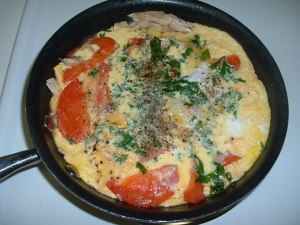
    Salt and pepper generously before covering; cover and cook slowly, until eggs are set on top (see photo).

  8. When done, you may remove any loose pieces of skin from tomatoes that appear on top of omelette; fold it over; cut in half to serve two people.

Spicy Sausage with Tomatoes and Turnips

spicy sausage with tomatoes and turnips

Nothing pleases the palate as much as tomatoes fresh from the garden; read below details concerning how they traveled from America to Europe to the whole world; then, experience this great tomato recipe.

How I love this time of year, as it explodes with their bounty.  Nevertheless, at times the question is what to do with them all.  When faced with this dilemma recently, I mixed this fruit with turnips and my favorite Aidells Spicy Mango with Jalapeno Chicken Sausages, both of which I had on hand; thus, this relatively quick and easy recipe evolved.  Enjoy.  (For another delicious Aidells sausage recipe, see Sausage with Zucchini and Eggplant .)

Where Tomatoes Originated

We think Italian cuisine, when tomatoes are mentioned, as we readily do with references to sweet and hot peppers, eggplant, potatoes, turkeys, and corn (in particular polenta).  None of these foods, however, were present as part of this country’s heritage, until after the discovery of America.  1

The tomato, Lycopersicon esculentum, along with its relatives the potato, chilli, and tobacco, are part of the nighingshade family; tomatoes were domesticated first in Mexico, long before Christopher Columbus’ arrival here.  2

Cortez Brought Tomatoes Back To Spain

In 1519, twenty-seven years after Columbus’ first voyage, this fruit was officially discovered in Mayan towns by Spanish adventurer Hernando Cortez.  In 1527, conquistadors brought it back to Spain, along with the avocado and papaya.  3

Tomatoes Spread Throughout Europe

Nearly three decades hence, in 1554, an Italian chronicle listed the first identifiable description of this yellow cherry tomato as pomo d’oro (golden apple).  By the end of the 16th century, both red and yellow tomatoes were present in European gardens, but only as exotic ornamental plants.  There was a long period in which great suspicion was attached to them throughout this continent, due to their close resemblance to a deadly nightingshade.  Circumstances of the French Revolution, at the end of the 18th century, however, established them as an acceptable food.  4

Italy Leads The Way In Eating Tomatoes

Outside of Mexico, Italy was first to heartily incorporate this fruit in its food preparation; inadvertently it became a leader in this adaptation.  The story unfolds with the French region Provence, whose cuisine was closely related to its Italian neighbor; these men from Provence formed the Marseillaise legion during the French Revolution.  Being richly exposed to Italian cooking, these soldiers had adopted the Italian “love apple”, as it was called, for it was considered an aphrodisiac.  In turn, this Marseillaise legion introduced this treasure to the Parisian troops, who took it back to their great city; thus, skepticism concerning tomatoes ceased in Paris.  Acceptance followed throughout Europe and subsequently the whole world.  5

The week after next, I will post a Spanish recipe Ropa Vieja, from a 19th century American cook book, with more information on the history of tomatoes.  This is an omelette using our prized fruit and leftover meat; it doesn’t get any simpler, but oh so taste-provoking!

References:

  1. Ilaria Gozzini Giacosa, A Taste of Ancient Rome (Chicago and London: The University of Chicago Press, 1994), p. 11.
  2. Harold McGee, On Food and Cooking (New York: Scribner, 1984, 2004), p.329.
  3. James Trager, The Food Chronology (New York: Henry Holt and Company, 1995), pp. 86, 88, 96, 97.
  4. Ibid.
  5. Esther B. Aresty, The Delectable Past (New York: Simon and Schuster, 1964), pp. 129-130.

Spicy Sausage with Tomatoes and Turnips  Yields 4-6 servings.  Total prep time: 1 hr.  Note: leftovers taste even better, as flavors meld.

5 1/2 tsp oil  (Coconut or avocado oil is best; olive oil is carcinogenic when heated to high temperatures.)

1 medium yellow onion, cut in even 1/8″ slices

12 oz Aidells Spicy Mango with Jalapeno Chicken Sausages  (May use any hot sausage of your choice, though this particular Aidells sausage is ideal; available at many supermarkets, including our local Winco and Fred Meyer-Kroger-stores.)

preparing turnips

1 lb turnips, cut in small 1/2″ dice

1 1/4 lb fresh tomatoes, chopped

3/4 tsp dried oregano  (Trader Joe’s has an excellent organic dried oregano for $1.99!)

1 tsp dried basil  (Also available reasonably at Trader’s.)

1 tsp salt  (Himalayan, pink, or Real Salt is critical for optimum health; a fine grind Himalayan salt is available at Costco for $4.95 for 5 lbs.)

1 tsp fresh ground pepper

cooking turnips

Avocado slices  (These are high in potassium and other powerful nutrients.)

  1. Spay vegetables with an effective, inexpensive spray (combine 97% distilled white vinegar and 3% hydrogen peroxide); let rest for 3 minutes; rinse really well.
  2. To caramelize onions, melt 1/2 tsp oil in a sauté pan over medium heat; when a piece of onion sizzles in pan, lower heat to med/low; add rest of onions (do not crowd or they will sweat, taking much longer to caramelize). Stir every several minutes, until they began to change color; then, stir every minute, until dark brown; set aside.  Watch carefully while proceeding to next steps.
  3. In another frying pan, heat 2 tsp oil over medium heat; when small piece of sausage sizzles in pan, add the rest; cook quickly until browned, watching closely so as not to burn; place in a bowl, carefully saving juices in pan.
  4. Deglaze hot pan with 2 or more tablespoons of water (scrape fond, cooked-on juices, off bottom); set pan aside.
  5. Peel turnips, dice in small 1/2″ cubes, place in a large bowl, see photo in list of ingredients.
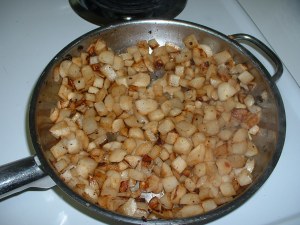
  6. Over medium heat, heat 1 tbsp more of oil in the above pan with juices. When a piece of turnip sizzles, stir in the rest, coating well with oils.  Cook covered until soft, about 10 minutes; stir every few minutes, deglazing pan each time you stir, by adding 2-4 tbsp of water; this additional water will steam the turnips; see above photo.  (Be sure to cover while cooking.)
  7. cooking tomatoes

    Meanwhile chop tomatoes; set aside in a bowl.

  8. Mix tomatoes into soft turnips; sauté uncovered, over medium heat, until they are cooked down-about 15 minutes-at which time a chunky sauce will be formed (see photo). When tomatoes initially begin cooking, stir in oregano, basil, salt, and pepper.  Be sure to cook this uncovered.
  9. Mix in sausage and onions after a somewhat-thick sauce has formed, having chunks of tomato in it; adjust seasonings (see photo).
  10. finished product

    Serve topped with avocado slices, for added health benefits.

Borscht (Beet Soup)

a bowl of borscht

This borscht recipe and its history have been with me since my catering days, during the early 1980’s in Billings, Montana.  Then I was preparing soups for a café in an art gallery; now it graces my table every summer.  A particular prayer partner claims my version is far better than that which she had in Russia.  Indeed, this chilled soup is a beautiful offering on a hot summer day!

This delicacy has been long popular in Eastern European countries under the following names: borscht, borsch, borshch, and bosht.  Over time it has spread from these nations to other continents, as their people emigrated.  In North America, it is commonly linked with the Jews and Mennonites that came from these European areas.  The common name borscht is derived from the Russian borsch meaning cow parsnip, which was an original recipe ingredient of the Slavs.

The most familiar American adaptation of this soup, which is made with beetroot, is of Ukrainian origin.  With its first record being in the 12th century, this dish subsequently emerged from a wide variety of sour-tasting soups present in the Eastern European section, such as rye-based white borscht, sorrel-based green borscht, and cabbage borscht.  Our well-known Ukrainian recipe was originally inspired by the addition of leftover beetroot pickling; thus, its brilliant color and tart flavor.

There are as many different preparations for this beet soup as there are homes in which it is consumed; they may include the additions of meat, fish, cabbage, carrots, tomatoes, and potatoes.

Spanish conquistadors brought potatoes and tomatoes from America to Europe in the 16th century; these vegetables, however, weren’t a common part of the Eastern European peasants’ diet until the 19th century, at which time they found their way into the Ukrainian and Russian borscht-food of both poor men and princes.  As a result of emigration, tomatoes and potatoes are a part of borscht recipes around the world, but my version has neither of these.

Still other variations occur with this renowned soup involving its garnishes and side dishes.  Smetana, or sour cream, is its most common topping; chopped herbs, hard-boiled eggs, bacon, and sausage may also be utilized.  There are plentiful side dishes; among them are pampushky (Ukrainian garlic rolls) and treasured pirozhki (individually sized pastries or dumplings filled with meat and onions).

You can see that despite its centuries-long-history there is no consistent receipt for this sustaining chilled delight, for even this latter characteristic may vary, and it may be served hot.  My borscht is a cold, meatless, summer soup adorned with sour cream and eggs; for the benefit of added protein make this recipe with bone broth (see its benefits and easy recipe at my post on Tortellini Soup, 2016/10/10).  This is a treat!

References:

https://en.wikipedia.org/wiki/Borscht

https://www.britannica.com/topic/borsch

www.dictionary.com/browse/borscht

easy mincing of onion

Borscht (Beet Soup)  Yields: 4-5 servings.  Total prep time: 1 hr/  active prep time:30 min/  cooking time: 30 min

1 tbsp oil  (Coconut or avocado oil is best; olive oil is carcinogenic when heated to high temperatures.)

1 med/lg yellow onion

3 lg purple beets, a little less than 2 lbs trimmed

1 qt broth  (Beef broth is good; I, however, prefer bone broth; for recipe and powerful health benefits, see Tortellini Soup, 2016/10/10.)

1 c water

2 small lemons, juiced  (Use half of this to start; then, adjust with more to taste.)

1 tbsp honey, or to taste  (Local raw honey is always best, for its localized bee pollen is known to relieve allergies naturally, through the concept of immunotherapy.)

1 tsp Better than Bouillon, or to taste

1/2 tsp salt, or to taste  (Himalayan, pink, or Real Salt is critical for optimum health; an inexpensive fine grind Himalayan salt is available at Costco.)

1/2 tsp freshly ground pepper, or to taste

sweating onions

Sour cream

3 eggs, hard-boiled and chopped  (I prefer duck eggs; see Rosemary Eggs, 2017/08/21, for their information.)

  1. Chop the onion in small pieces the easy way.  Peel it leaving the root on; next, score this by cutting slices close together across the top one way, going 3/4 of the way down into the onion; then, turn it and cut slices the opposite direction.  When onion is thus prepared, shave the small pieces off the end with a sharp knife (see photo in list of ingredients).  May discard root end; set aside chopped vegetable.
  2. Heat oil in a stock pot over medium heat; add piece of onion; when it sizzles, add remaining onion; sweat, cook only until translucent (see photo above).  Set aside, go to next step.
  3. Spray beets with an inexpensive, effective vegetable spray; mix 97% distilled white vinegar with 3% hydrogen peroxide in a spray bottle.  Let sit for 3 minutes and rinse well.
  4. Peel and cut beets in 1/4″ dice; add to cooked onions.
  5. Cover with broth and water; bring to a boil over med/high heat; reduce heat and simmer for about 30 minutes, or until beets are soft.
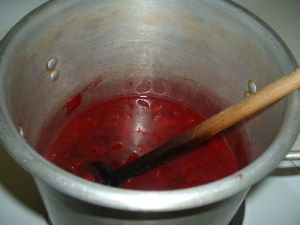
  6. borscht cooking in pot

    Add half the lemon juice and honey.

  7. Stir in Better than Bouillon; then, add salt and pepper.
  8. Adjust lemon juice, honey, Bouillon, salt, and pepper to taste.
  9. Chill for 4 hours or overnight.  Serve topped with sour cream and chopped hard-boiled eggs.
  10. This freezes well.  I love this summer soup!

1950’s Pear Pie

Fresh pear pie

fresh pear pie

The history of sugar is intriguing, spanning the continents.  Here we will examine the major turning points in the background of this substance.

My mother gave her children the choice of birthday cakes.  I was hard put to choose between banana cake-see 2016/08/08-and fresh pear pie.  My soul still thrills with the beautiful taste of baked pears, rich crumb topping, and the best of pie crusts.

I am so health conscious; thus I have experimented with using sugar alternatives here.  Coconut sugar or sucanat (evaporated cane juice) can not compete with cane sugar in this receipt. Only sugar insures the right texture and flavor in pear pie.

Sugar has been around for the longest time.  Saccharum officinarum, sugar cane, originated in the South Pacific’s New Guinea and was subsequently carried by human migration into Asia.  Sometime before 500 B.C., people in India were producing raw, unrefined sugar.  1

Its first known reference was in 325 B.C., when  Alexander the Great’s admiral Nearchus wrote of reeds in India that produce “honey” without any bees.  The word sugar began to appear frequently in Indian literature around 300 B.C.  This Sanskrit word sarkara, meaning gravel or pebble, became the Arabic sukhar, which finally came to be sugar.  2

The use of Indian sugar cane spread.  Around the 6th century after Christ, it was planted in the moist terrains of the Middle East, where the Persians made sugar a prized ingredient in their cooking.  After Islamic Arabs conquered Persia in the 7th century, they took the cane to northern Africa and Syria; it eventually made its way to Spain and Sicily.  3

Sugar in Europe was barely known until around 1100, and it remained a mere luxury until the 1700’s.  The western Europeans’ first encounter with sugar was during their Crusades to the Holy Lands in the 11th century.  Shortly thereafter Venice became the hub of Arabic sugar trade for western Europe, while the first known large shipment went to England in 1319.  4

At first the western Europeans treated it like other exotic imports-e.g., pepper and ginger-strictly as medicine and flavoring: it was produced in small medicinal morsels, as well as preserved fruits and flowers.  These sweets or candy first began being made by apothecaries, or druggists, which were making “confections” to balance the body’s principles.  The word confection is taken from Latin conficere. meaning “to put together” or “to prepare”.  5

The medieval years brought sugary nonconfections to Europe, such as candied almonds, as well as the use of this substance in recipes for French and English courts.  The chefs of royalty employed sugar in sauces for fish and fowl, for candying hams, and in desserts of various fruit and cream/egg combinations.  Around 1475, the Vatican librarian Platina wrote that sugar was now being produced in Crete and Sicily, as well as India and Arabia.  Columbus carried the cane to what is now Haiti and the Dominican Republic in 1493, on his second voyage.  6

By the 18th century, whole cook books were devoted to confectionery, which had become an art no longer associated with medicine.  During this century, sugar consumption exploded in Europe, with the rise of colonial rule in the West Indies and the enslavement of millions of Africans, resulting in the sugar industry becoming the major force behind slavery in the Americas (one estimate holds that fully two-thirds of the twenty million African slaves worked on sugar plantations).  This industry saw rapid decline later in the 1700’s, with the abolition movements, especially in Britain; the other European countries followed, one by one through the mid-19th century, in outlawing slavery in the colonies.  7

Sugar, however, had now become a world staple.  Presently 80% of its production comes from sugar cane, while most of the rest is derived from sugar beets.  8

Wisdom and moderation are needed with this substance.  Today our nation consumes sugar in unhealthy amounts.  Personally I hold fast to the adage of Mary Poppin’s:  “A spoonful of sugar helps the medicine go down.”  My standard is to substitute more beneficial sweeteners wherever possible.  However, there are times when only cane sugar will do.   My precious pear pie is one of them!

Enjoy this carefree, mess-free recipe.

References:

  1. Harold McGee, On Food and Cooking  (New York: Scribner, 1984, 2004), p. 648.
  2. James Trager, The Food Chronology  (New York: Henry Holt and Company, 1995), p. 19.
  3. Harold McGee, On Food and Cooking  (New York: Scribner, 1984, 2004), p. 648, 649.
  4.  Ibid., pp. 648, 649.
  5. Ibid., p. 649.
  6. Ibid., pp. 649, 650.
  7. Ibid., pp. 650, 651.
  8. https://en.wikipedia.org/wiki/Sugarcane
Pear pie, whipped cream, and freshly ground nutmeg

pear pie, whipped cream, and freshly ground nutmeg

Pear Pie with Hot Water Pastry Crust  Yields: 1-10″pie.  Total prep time: 1 1/4 hr/  active prep time: 30 min/  baking time: 45 min.

1 1/4 c unbleached white flour  (Bob’s Red Mill is high quality.)

1 1/3  c whole wheat pastry flour  (May grind 1 c soft white winter wheat berries for 1 1/2 c total fresh ground whole wheat pastry flour, carefully measuring needed amounts.)

1 tsp salt (Himalayan, pink, or Real Salt is critical for optimum health; a fine grind Himalayan salt is available very reasonably at Costco.)

2/3 c oil  (Grapeseed or avocado oil is best, available inexpensively at Trader Joe’s and Costco.)

1/3 c boiling water.

1 c sugar  (Organic cane sugar id preferable; available in 2 lb packages at Trader’s, but more economical  in 10 lb bags at Costco)

1/3 c butter, softened

5 lg Bartlett pears, ripened  (May use Anjou pears as well, but Bartletts are best, must be ripened.)

1 c heavy whipping cream  (Lightly sweeten this with powdered sugar.)

Nutmeg  (Freshly ground is superb!)

  1. Preheat oven to 450 degrees.
  2. Blend unbleached white flour, 1 c of whole wheat pastry flour, and salt in a large bowl.
  3. Add oil and boiling water; mix lightly with a fork.
  4. Divide into two balls, one much larger than the other; cover balls with plastic wrap and place on hot stove to keep warm.  (You will need to use 3/5’s of dough for this single crust for a 10″-pie plate; may bake leftover 2/5’s of dough in strips with butter and cinnamon sugar.)
  5. Roll out the large ball of dough between 2-18″ long pieces of wax paper. Form a very large, oblong circle which reaches to the sides of the paper.
  6. Gently peel off the top sheet of wax paper; turn over and place piece of rolled dough, wax paper side up, over a 10″-pie plate. Very carefully peel off the second piece of wax paper.
  7. Patch any holes in crust by pressing warm dough together with fingers. Form rim of crust on edge of pie plate by pressing dough together gently, using excess dough from heavier areas to make up for areas where dough is sparse.
  8. Mix 1/3 c of whole wheat pastry flour and sugar in same bowl in which you made the pie crust.  Blend in butter with a fork, until mealy in texture.
  9. Sprinkle 1/3 of this mixture in bottom of unbaked pie shell.
  10. Fill crust with peeled pear halves.  Fill in spaces with smaller pieces.
  11. Evenly spread remaining flour mixture on top of pears.
  12. Bake at 450 degrees for 15 minutes.  Reduce heat to 350 degrees and bake for 30 minutes more, or until crust is golden brown.
  13. Cool, serve with whipped cream and freshly grated nutmeg.  Mouthwatering!

Carrots au Beurre

Carrots-au-beurre

carrots au beurre

This three-part 19th century dinner, which started last week (see Chicken a l’Oignon and Lemon Meringues a la Ude), reflects the new Classic French cuisine.  This era in culinary history became popular as the Napoleonic age followed the French Revolution.  Then self-made men, following the example of Napoleon, rose in status and wealth.  They had to learn the ways of entertaining, or how to be amphitryons (hosts).

Cook books of the time reflected this non-aristocratic class’ needs, by giving such directions.  A forty-year lapse in the publication of cooking instructions, of any sort, existed prior to the beginning of this period.  One important recipe book, with the dawning of this new day, was Le Cuisinier, by A. Viard; it was published during the entire nineteenth century; its name, however, changed with each fresh political upheaval.

First printed in 1806, Le Cuisinier Imperial was named after the Emperor who loved classicism; Napoleon’s strong passion gave this new style of cooking its name Classic French cuisine.

The book’s title changed to Le Cuisinier Royal, when Louis XVIII became king in 1814.  Other name conversions reflected the politics of the century: it became Le Cuisinier National, at the time Louis Napoleon was elected President of the Republic; then, it went back to employing “Imperial”, when this man declared himself Emperor Napoleon III in 1852.  The cook book was known by Le Cuisinier National once again, when France became a republic in 1871; it has remained such; thus, this recipe for buttered carrots, taken from these pages, dates back two centuries.

In 1964, Esther Aresty documented the history of European and American cuisine in her account The Delectable Past, from which I got my above information. Here she improved on this delicious recipe from Le Cuisinier by pureeing this vegetable in a food mill.  I have augmented her outstanding method with easy, modernized, 21st century steps, utilizing a food processor.

You’ll be immensely pleased with this memorable dish; a comfort food of all comfort foods!

Carrots au Beurre  Adapted from a recipe in Esther B. Aresty’s  The Delectable Past (New York: Simon and Schuster, 1964).  Yields 4 servings.  Total prep time: 50 min./  active prep time: 20 min./  cooking time: 45 min.   Note: may make this the day before, as flavors are better the second day; double recipe for great leftovers.

½ cup pecan pieces

1 pound carrots  (Organic  carrots are very inexpensive.)

2 cups green beans  (Use either fresh or frozen;  excellent French-cut beans are available in Trader Joe’s freezer.)

1/4 cup whipping cream

2 tbsp butter

1 tsp fresh ground nutmeg, or to taste

1/2 tsp salt, or to taste  (Real Salt is best, available in health section of local supermarket.)

1/4 tsp pepper, or to taste

Butter or coconut spray  (Needed for oiling pan, if making ahead and refrigerating.)

  1. Preheat oven to 265 degrees. Roast pecans on a small cookie sheet for about 40 minutes, or until light brown, when piece is broken; set aside.
  2. Spray carrots with 97% distilled white vinegar mixed with 3% hydrogen peroxide, an inexpensive effective produce spray; let sit three minutes; rinse thoroughly; scrape with a sharp knife (scraping, as opposed to peeling, saves the vitamins which are just under the skin).  Cut into 1 inch pieces; if the carrot piece is thick, cut it in half.
  3. Cover cut vegetable with water in a medium saucepan, bring to a boil over medium/high heat, lower heat to medium, and cook until soft.
  4. Meantime steam green beans in a medium saucepan.  (If you are making carrots ahead, prepare green beans during last half hour of  the reheating of carrot dish in oven.)
  5. Place the hot, drained, soft carrots in a food processor; add cream, butter, nutmeg, salt, and pepper; blend until carrots are a smooth mixture, stopping once to scrape down sides.  Adjust seasonings to taste.  (IF preparing ahead, butter a baking dish large enough to hold recipe; then, place pureed vegetable in it; cover well with tin foil; refrigerate; reheat in 350 degree oven 1 1/2 hours before serving.)
  6. Place hot pureed carrots in the center of a vegetable platter, surround with green beans, and top with roasted pecans.