Turkey with Shallots, Cauliflower, and Bell Pepper

turkey with shallots, cauliflower, and bell pepper

It’s that time of year again for turkey,  Learn about the history of this bird and access a great recipe using either leftover roasted fowl or its ground version, which comes in one pound packages at any food market; the latter makes this dish accessible year-round.

Background of Turkey

Turkey is in the genus Meleagris, which is native to the Americas; the Mexicans domesticated it by 800 BC.  It was either introduced to Southwest U.S., or tamed here independently, by 200 BC; these indigenous people used its feathers for ceremonies, as well as in making robes and blankets; they didn’t, however, consume it as a meat until around 1100 AD.

Cortes Brought Turkey to Spain

This bird arrived in Europe in 1523-24, when the Spanish conquistador Hernando Cortes brought certain foods back from Mexico; in Spain, it was known as gallopavo (peacock).  There is some confusion concerning the exact derivation of its subsequent name turkey; most likely this was taken from our American bird’s mistaken resemblance to the African guinea fowl, which the Europeans knew as turkey fowl, as these were imported from Turkey.

England Adopted Turkey

Many believe that English navigator William Strickland introduced this food to England; indeed a tribute was made to him in 1550, in that he was granted a family coat of arms, including a “turkey-crop in his pride proper”; this coat of arms, with its turkey crest, is still in use today.

Christmas “Goose Clubs” Established in England

Until recent times, this bird was considered an extravagance in Europe, where native grouse and pheasant were cheaper alternatives.  In the 19th century, the English working class aspired to partake of goose for their holiday celebrations; Christmas “goose clubs” were established in England in the 1800’s, so these impoverished people could insure the necessary savings for their festive meal.

“The Christmas Carol” Goose Replaced by Turkey Today

One of the first mentions in literature, of turkey becoming this celebratory roast, is Charles Dickens’ vivid portrayal in A Chistmas Carol: a resultant, decadent Christmas dinner occurred, when the reformed Ebenezer Scrooge replaced Bob Crachit’s meager goose with a massive turkey.  Nevertheless, only since World War II, as growing conditions for turkey became less expensive, has this developed into the holiday fowl of choice in England.

Turkey Would Have Been a Better National Bird

In U.S. history, Benjamin Franklin was disappointed when turkey was not selected for our national bird; he argued that it is a true original native, whereas the eagle can be found in all countries.

“Heritage” Birds

With our present heightened fascination in high cuisine, “heritage” birds are gaining in popularity.  These are traditional breeds, much like Strickland and Dickens encountered, which can trace their ancestry to the earliest domesticated animals.  They have a ratio of dark to white meat of about 50/50.

Broad Breasted Whites have been sold predominantly in grocery stores for decades; these were bred to have a ratio of 65% white meat to 35% dark, while weighing up to 50 pounds; the maximum weight of a wild turkey is 25 pounds, which is also the upper weight of the traditional heritage birds.  These latter come with such colorful names as Bourbon Red, Royal Palm, and Midget White; even with their gamy taste, people are willing to pay $9, or more, per pound to partake of this delicacy, while Broad Breasted Whites are often given away free, as promotional deals, at local supermarkets nowadays.

You may call me penurious, but I made this dish with all-natural Foster Farms ground turkey, which is close to $3 a pound; my recipe, however, is great for Thanksgiving leftovers, whether they be of a Broad Breasted White or a heritage breed.

References:

  1. James Trager, The Food Chronology (New York: Henry Holt and Company, Inc., 1995), pp. 86, 87, 180.
  2. http://www.history.com/news/hungry-history/turkey-talk-the-story-behind-your-thanksgiving-bird
  3. http://www.historyextra.com/article/premium/turkeys
  4. https://en.wikipedia.org/wiki/Turkey_(bird)

flavorful onions caramelized with vinegar

Turkey with Shallots, Cauliflower and Green Pepper  Yields: 5-6 servings.  Total prep time: 50-60 min.

5 tsp oil  (Coconut or avocado oil is best for health; olive oil is carcinogenic, when heated to high temperatures.)

1 med yellow onion, cut in even 1/8” slices

4 oz shallots, chopped in 1” pieces

1 tbsp butter

1 lb natural ground turkey  (May use leftover roasted turkey, broken in bite-size pieces.)

Salt to taste  (Real Salt is critical for good health; available in nutrition center at local supermarket.)

Fresh ground pepper to taste

2 lb cauliflower  (Yellow or orange cauliflower is sometimes available, in the organic section, at our local Fred Meyer-Kroger-stores.)

1 lg bell pepper  (In particular, it is important that peppers be organic, as they readily absorb pesticides.)

3-4 tbsp flavored vinegar  (I used elderberry vinegar, which I purchased in Montana.)

  1. For caramelizing, peel and cut onion in even 1/8” slices.  Heat 1 tsp oil in a large sauté pan over medium heat; when a small piece sizzles in oil, reduce heat to medium/low; add rest of onions and slowly cook, stirring every 2 minutes, until color begins to form.  (It is important to not crowd pan, or add too much oil, as

    cutting shallots in 1″ pieces

    this will slow down the cooking process.)  When a light golden color is beginning to form, start stirring every minute, until dark brown.  Deglaze pan of onions-scrape fond, browned, cooked-on-juices, off bottom of pan with a spatula-by adding 1-2 tbsp of the vinegar (see above photo of caramelized onions with vinegar).  Go to the next steps, while onions are cooking.

  2. Spray cauliflower and pepper with an inexpensive, effective produce spray (combine 97% distilled white vinegar with 3% hydrogen peroxide in a spray bottle); let sit for 3 minutes; rinse well.
  3. Peel shallots, cut large ones in 1” pieces, and set aside (see photo above).
  4. In another frying pan, melt butter; add shallots; and cook over medium heat, until they are translucent.  Add raw turkey, salt and pepper generously, cook until pink is gone-see photo below.  (If your turkey was previously frozen, there will be lots of juices, but if cooking fresh-ground, you may need to deglaze hot pan with 1-2 tbsp of vinegar; if using roasted turkey pieces, just stir these into shallots-do not cook.)  Set turkey/shallots aside in a large bowl.
  5. cooked turkey and shallots

    Cut peppers into 1” x 3” strips, set aside.

  6. For ease in dividing the cauliflower into bite-size florettes, first break chunks of cauliflower off the head; next, cut off all excess stalk from these bigger sections; then, make small knife-cuts in the stems of these pieces, gently pulling apart small florettes with fingers; set aside separately in a bowl.
  7. Heat 1 tsp of oil over medium heat in the above, empty meat pan; when a  piece sizzles in hot oil, add the remaining peppers; cook until somewhat soft, but still crisp.  Deglaze hot pan, with a tbsp of vinegar-may have to deglaze with water instead, for only a total of 3-4 tbsp of vinegar should be used for all deglazing, in entire recipe; vinegar adds delightful flavor, but too much is overpowering.  Put peppers in with bowl of meat.
  8. When onions are done, mix together thoroughly with meat/shallots/peppers.  Heat last tbsp of oil in this pan, over medium heat; after a small piece sizzles in hot oil, add rest of cauliflower; salt and pepper florettes, distributing oil evenly among them.  Add 1/4 c water, cover pan, and cook until soft, stirring occasionally.
  9. finished product

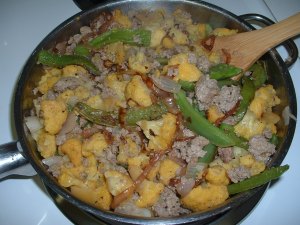
    Blend turkey and vegetables into soft cauliflower, adjust seasonings, and heat thoroughly (see photo).  Serve with anticipation!

1880’s Ozark Honey-Oatmeal Cookies

Ozark honey-oatmeal cookies

Here we will look at the detailed history of shortening and the background of early cook books in America, including Miss Parloa’s New Cook Book, 1880; this cook book gives us these delicious Ozark honey-oatmeal cookies.

Early American Cook Books

My library holds many old cook books, some copyrighted in the 1800’s; I also have a number of facsimiles, exact reproductions of the originals.  These latter aren’t considered costly with collectors, but are highly valuable to me, with their precise historical evidence required for my work.

A number of these republications help me with my need for early U.S.A. food history.  For instance one illuminates the 18th century: American Cookery, by Amelia Simmons; this was the first truly U.S. cook book, with such strictly American dishes as Indian pudding, Indian slapjack (pancakes), and johnnycake (flat corn cakes).  1

All early cook books, that were published on our soil, prior to this 1796 publication, were actually reprints of English cook books, none of which contained American ingredients such as: cranberries, clams, cornmeal, shad (fish of the genus Alosa), terrapin (turtles), etc.  2

Interestingly, recipe books were not in demand in our young country, where rivaling colonial plantations jealously guarded their family’s treasured receipts, and rich city dwellers adhered to their individual Old World cooking traditions.  (See Ropa Vieja, for more on the development of American cuisine.)  3

Washburn-Crosby Co. Publishes Miss Parloa’s New Cook Book

In a recent cooking class, I taught Ozark Honey-Oatmeal Cookies from one of my facsimiles: the Silver Dollar City Edition of Miss Parloa’s New Cook Book, which Washburn-Crosby Co. published in Boston originally, in 1880.  Its facsimile was issued at an unknown date during the 20th century, by General Mills, the successor to Washburn-Crosby Co.  Access the fascinating history of Maria Parloa and her cook books, these two flour mills, and this period cuisine at my following entries: 1800’s Escalloped Salmon1880’s Minced Cabbage, and 1880’s Philadelphia Clam Chowder.  4

The History of Shortening

These cookies call for shortening; its definition is fat used in cooking, made from animal, vegetable, or compound manufactured substances.  Examples of the latter are margarine, discovered in France in 1869, and Crisco, which is a hydrogenated vegetable oil, created in America in 1911; Crisco usually comes to mind when shortening is mentioned today.  5

The term shortening, however, first surfaced in the early half of 18th century; it is considered to be American.  As far as cook books are concerned, it appeared in several of Amelia Simmons’ recipes in American Cookery, 1796, such as johnnycake and “another plain cake”, though she doesn’t define the word shortening, which for her purposes probably meant butter or lard.  6

In the April 6, 1892 edition, the New York Times promoted Cottolene, as a “New Shortening…a vegetable product far superior to anything else for shortening and frying purposes”.  This, the first hydrogenated vegetable oil, was primarily used as a cooking medium, in some households.  7

In June of 1911, Procter and Gamble began selling hydrogenated cottonseed oil, as Crisco (short for “crystallized cottonseed oil”); they discovered this shortening in their quest to generate a raw material for soap, through a technique that had its origins in 1897 France.  8

Because of an intense promotional campaign, it became the first popular national shortening product of its kind (this ingredient is extremely prevalent in 20th century recipes).  To this day, Crisco remains the best known brand for this item in the U.S.; there are other well-known brands in a number of other countries.  9

Healthy Ingredients in Ozark Honey-Oatmeal Cookies

These Ozark Honey-Oatmeal Cookies allow for a healthy means to satisfy our sweet tooth, for they are made with such powerful foods as: organic oats, semi-sweet chocolate chips, organic raisins, unsweetened coconut flakes, pumpkin seeds, nuts, raw honey, etc.  In place of required refined sugar, I use the healthy alternative coconut sugar.

The recipe, from this 1880’s cook book, calls for shortening, which probably referred to either butter or lard initially, though those baking from its facsimile, in the 20th century, would have used then popular Crisco.  I leave this choice up to you.

This recipe is easy to make and is extremely good!  Enjoy.

References:

  1. Facsimile of Amelia Simmons, American Cookery, 1796 (Grand Rapids, MI: William B. Eerdmans Publishing Co., 1965), pp. 57, 58.
  2. Esther B. Aresty, The Delectable Past (New York: Simon and Schuster, 1964), pp. 183-186.
  3. Ibid.
  4. Silver Dollar City Edition of Maria Parloa, Miss Parloa’s New Cook Book (Minneapolis: Washburn-Crosby Co., 1880); this facsimile was reproduced by General Mills at an unknown date  in the 20th century.
  5. http://www.foodtimeline.org/shortening.html and https://en.wikipedia.org/wiki/Shortening
  6. Ibid.
  7. Ibid.
  8. Ibid.
  9. Ibid.

mixing oatmeal into dough in stages

1880’s Ozark Honey-Oatmeal Cookies  Adapted from a recipe in General Mills’ 20th century Special Silver Dollar City Edition of Miss Parloa’s New Cook Book, originally published in 1880.  Yields: 4 1/2 dozen.  Total prep time: 1 hr.

1 3/4 cup flour  (May grind 1 1/3 cups organic hard red spring wheat berries, a berry with a high protein content; this makes 2 cups of flour.  (BE SURE to remove 1/4 cup of flour, after it is ground, for the required 1 3/4 cup.)

1/2 c butter, or shortening

1 1/4 c sugar  (Coconut sugar has the most health benefits; see The Best Zucchini Bread for details.)

2 lg eggs

1/3 c honey

1 tsp baking soda

1 tsp salt  (Himalayan, pink, or Real Salt is critical for optimum health; an inexpensive fine grind Himalayan salt is available at Costco for $4.95/5 lbs.)

2 c oats  (Organic is only slightly more expensive; so much healthier.)

1/3 c unsweetened coconut flakes  (Available inexpensively in bulk at our local Winco.)

1/3 c pumpkin seeds

1/3 c nuts, chopped

1/3 c raisins  (Organic is important; available reasonably at Trader Joe’s.)

1/2 c chocolate chips  (High quality, semi-sweet chocolate chips are available at Trader’s.)

Parchment paper, wax paper, and 2 cookie sheets

  1. Preheat oven to 375 degrees.
  2. If grinding your own flour, begin to do so now.
  3. In a large bowl, cream butter and sugar with a fork; beat in eggs, one at a time; blend in honey.
  4. shaping dough in rough rounds

    Stir salt and baking soda into flour, in another large bowl.  (Instead, may place these ingredients in a sealed gallon-size storage bag and shake vigorously.)

  5. Mix this flour mixture into the shortening/sugar/eggs; do not over beat the dough, as this makes cookies tough.
  6. Stir coconut, pumpkin seeds, nuts, chocolate chips, and raisins into this mixture, distributing evenly.
  7. Mix half the oats into this dough gently; then, add other half (see photo at top of recipe); stir with a large rubber spatula or spoon, just until blended.
  8. Using a teaspoon, drop dough 2 inches apart on parchment-paper-covered cookie sheet, shaping rounds roughly with fingers, as you go (see above photo).
  9. Place pan in preheated oven for about 9-10 minutes, or until golden brown.
  10. Meanwhile, start shaping dough-rounds on a second parchment-lined pan.
  11. When first pan is done, immediately start baking this second pan.
  12. cookies baked to perfection

    Cool baked cookies on cookie sheet for 2 minutes (see photo).   Remove and place them on a large piece of wax paper.

  13. Using a new piece of parchment paper, prepare the third pan of cookies, to be ready for the oven as soon as second batch is done (pans should be cool before spooning dough on them-may place them in the refrigerator).  Repeat until all the dough is used.
  14. These freeze well, to have on hand for healthy snacks.

Ropa Vieja (Omelette)

ropa vieja (omelette)

Here we examine the historical and botanical make-up of tomatoes, the importance of Africans in the forming of southern cuisine, and details about the publication of cook books in the American south.

America’s Food Heritage

Our typical American cuisine was inspired by the familiar recipes brought over by English, French, Spanish, and Dutch settlers, as well as those of Scotch-Irish and German colonists, who followed these early immigrants; all of this European influence merged with the available foods of the Native Americans present on this continent.  1

Southern Cuisine Developed by Africans

African slaves played a broad part in fashioning our distinctive southern cookery.  The mistresses of these slaves initially taught them-our people-receipts recalled from these mistresses’ individual heritages, as listed above; then, prized dishes were developed, with the Africans’ natural appreciation of and aptitude for cooking.  These foods were used in the strong social competition among the plantations.  Such delicacies, which in large part formed this region’s cuisine, were not initially compiled in books for the public, but rather closely safeguarded within each family, due to the rivalry among these established settlements.  Thus, there were no Southern cook books until the first quarter of the 19th century; a few recipes from this geographic area were preserved, however, in some American cook books, mostly those published in and around Philadelphia.  2

Mrs. Mary Randolph’s The Virginia Housewife, printed in 1824, in Washington D.C., is part of the advent of cook books specializing in foods from the South.  It also includes some Northern recipes, as well as a few Spanish dishes, of which our Ropa Vieja omelette is one.  This promising recipe boasts of only five ingredients, one of which is the garden tomato, and just a few succinct instructions; its simplicity makes it exceptional.  3

Botanical Make-up of Tomatoes Produces a Powerful Food

In On Food and Cooking, Harold McGee explains why this sweet-tart, botanical fruit tomato, which is used as a vegetable, has such great appeal.  He attributes this attractiveness to the unique flavor brought about by its low sugar content-3%; other great features are its large amount of savory glutamic acid-as much as 0.3% of its weight-and its ample quantities of aromatic sulfur compounds.  These two latter ingredients, present in ripe tomatoes, predispose them to complement the flavor of meats.  This is because these two substances exist more commonly in animal flesh than fruits; thus, their rich presence in tomatoes allows for added taste to meat dishes.  Savory glutamic acid and sulfur aromas likewise bring out great depth and complexity in sauces and other food combinations; therefore, this particular produce can even replace meat in flavoring vegan dishes.  4

American Origins of Tomatoes and their Slow Acceptance in Europe

Tomatoes originated in the west coast deserts of South America.  Extensive varieties existed in Mexico, by the time Hernando Cortez and his 400 Spaniards discovered this land in 1519.  The tomato was incorporated in American (and later European) cookery in various ways.  At the time of Cortez’ arrival, Mexicans used thin shavings of this green, unripe fruit in many dishes; they also mixed ripe tomatoes with chillis in a sauce to top cooked beans.  Subsequently, the Spaniards in Europe readily adopted this fruit in their cuisine.  5

When Francisco Pizarro began his bloody attacks in Peru in 1532, this South American land, with all its royal Incan wealth, was eating mostly a vegetarian diet of maize, potatoes (including sweet and manioc potatoes), squash, beans, peanuts, avocados, chillis, and our beloved tomato.  6

Some time later, the Italians were adding it to broths and soups, as noted by the Quaker merchant Peter Collinson in 1742.  Tomato sauce for pasta followed several decades hence.  7

Britain lagged behind Italy, in accepting this item, due to their long-held mistaken viewpoint, which had originated on the Continent, connecting it with a deadly nightingshade, being it was of this same family.   Not until the 20th century did the English acquired a taste for tomatoes, particularly canned tomato soup.  8

Popularity of Tomatoes Grew Slowly in the United States

North America was almost equally slow in receiving this fruit, probably due in part to these same European misconceptions; they considered it to be lacking in nourishment and substance, as well as a cause for gout.  9

During the late nineteenth and early twentieth centuries, the U.S began what was to become a wide acceptance of tomatoes, primarily due to the strong influence from the great Italian immigration then.   Nevertheless, their first appearance here was when Thomas President Thomas Jefferson brought back seedlings from a diplomatic trip to Paris.  There the Parisians had just accepted this “love apple”, believed to be an aphrodisiac; their acceptance directly resulted from the effect Italian cooking had on French troops during the French Revolution at the end of the 18th century (see Spicy Sausages with Tomatoes & Turnips).

It is interesting to note that our third president had an extensive garden of 170 varieties of fruits and 330 varieties of vegetables and herbs; his grand kitchen utilized most of this produce, even producing ketchup for our epicurean leader, who primarily chose a vegetarian diet.  Ketchup at this time, however, was a vinegar-based condiment made from such ingredients as walnuts and mushrooms, not tomatoes.  10

Be sure to access my other tomato recipes: Parmesan Dover Sole and Rosemary Eggs.

References:

  1. Esther B. Aresty, The Delectable Past (New York: Simon and Schuster, 1964), p. 181.
  2. Ibid., pp. 182, 183, 193.
  3. Ibid., p. 193.
  4. Harold McGee, On Food and Cooking (New York: Scribner, 1984, 2004), pp. 329, 330.
  5. On Food and Cooking (New York: Scribner, 1984, 2004), Reay Tannahill, Food in History (New York: The Three Rivers Press, 1988, 1973), p. 206.
  6. Ibid., p. 214.
  7. Ibid., p. 207.
  8. Ibid.
  9. Ibid.
  10. www.monticello.org/site/house-and-gardens/historic-gardens

ingredients for ropa vieja

Ropa Vieja (Omelette)  Yields: 2 servings.  Total prep time: 25 min.  Adapted from an 1824 southern recipe found in Esther B. Aresty’s The Delectable Past (New York: Simon and Schuster, Inc., 1964).

2 lg firm ripe tomatoes, cut in eighths, seeds and juice removed

2/3 c shredded leftover chicken, ham, or beef

4 lg eggs, beaten lightly  (May use 3 duck eggs, which are bigger than chicken eggs; for info on duck and chicken eggs, see Rosemary Eggs.)

2 tbsp butter

1 tbsp chopped parsley, optional

Salt, to taste  (Himalayan, pink, or Real Salt is critical for optimum health; an inexpensive fine grind Himalayan salt is available at Costco.)

Fresh ground pepper, to taste

  1. cooked tomatoes

    Spray the optional parsley with a safe, inexpensive, effective produce spray (mix 97% distilled white vinegar and 3% hydrogen peroxide); let sit 3 minutes: then, rinse well and chop fine.

  2. Cut the tomatoes in eighths, gently scoop out liquid and seeds with a spoon (it not necessary to peel the tomatoes), place in a bowl.
  3. Shred and measure the meat, set aside.
  4. Beat the eggs, only until whites and yolks are lightly blended.
  5. Over medium heat, melt 2 tablespoons butter in a non-stick skillet; mix in meat, heating for one minute.  Add tomatoes and cook for six minutes, or until mixture is hot and tomatoes are somewhat softened, stirring occasionally (see above photo).
  6. Reduce heat to med/low; sprinkle parsley over cooked tomatoes and meat; pour beaten eggs over this mixture, quickly distributing the meat and tomatoes evenly in eggs.
  7. finished product

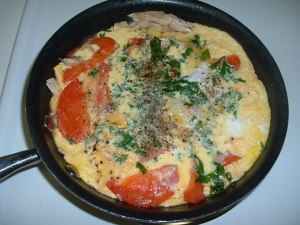
    Salt and pepper generously before covering; cover and cook slowly, until eggs are set on top (see photo).

  8. When done, you may remove any loose pieces of skin from tomatoes that appear on top of omelette; fold it over; cut in half to serve two people.

Avocado, Bean, and Corn Salad

avocado, bean, and corn salad

My church celebrated its 22nd anniversary this past summer with our annual picnic, which we always associate with incredible food; there are two men in our congregation that smoke tri-tip for this gala.  (They stay up all night smoking our Thanksgiving turkeys as well, which is by far the best turkey I have ever experienced.)  This year our outdoor celebration also boasted of fried chicken, not to be outdone by everyone’s glorious side-dish contributions.

Church gatherings are famous for their magnificent spreads; our congregation is no exception, for we have a host of great cooks, even though our body is small.  Indeed, we eat well!

I always make the following bean salad for our anniversary; it is not only quick, but keeps well in the sun.  May you find this a great dish for potlucks also.

Normally I don’t use many canned goods in my food preparations; they, however, facilitate the ease of this excellent recipe.  The history of canning is of great interest to me.  It began with a Nicolas Appert, a creative Frenchman with ordained skills-promised attributes we all get to exercise.

Our genius started out as a brewer; then, became a steward for the aristocracy; finally, he ended up as a confectioner during the Napoleonic era.  When France and Britain were at war in 1795, Napoleon, seeking a way to best preserve food for his army, offered 12,000 francs to the winner of a contest for such a discovery.  As a confectioner, Appert’s mind had already been developing such a solution, for he had been pursuing the foremost means in lengthening the shelf-life of fruits, by improving on the traditional candying and drying processes.  This formal opportunity brought his ideas to fullness; thus, he won the prize with his method in which he preserved fruits, vegetables, meats, eggs, partridges, chestnuts, grape must, even the vegetable truffles.  Our originator partially cooked the foods, before placing them in wide-mouth bottles; then, by corking and boiling the bottles in a water bath, he expelled the damaging air.  This technique of food preservation has remained in tact throughout the centuries.  1

Nevertheless, this hero unfortunately died a pauper, for by accepting the prize he lost the chance to patent his design.  (As an aside, I speak with the authority given me, in Jesus Christ’s name: “Enemy of our souls, you can steal none of our rewards!”)  2

In 1810, Appert published a book detailing his canning procedure, which the award had prohibited him from patenting; just months later, a patent using his method for preserving foods surfaced in England.  There, however, his corked glass container became a more durable, tin-coated iron canister, which came with instructions for opening with a chisel and hammer.  3

By 1849, this technology for food preservation improved with machine-made, can tops and bottoms.  Prior to this, two skilled workers produced 120 cans a day; now two people could daily make 1500 cans, and these machine-operators were unskilled at that.  4

These tin cans inspired what was the slow advent of can openers, an invention that remained quite unsatisfactory from its first appearance in 1855, until our modern device appeared in the 1980’s; this latter, a side-opening implement, uses two wheels in tandem, one rotating, the other serrated, removing the lid, while leaving no sharp edges.  These days we take this relatively new, inexpensive tool for granted; as a result of the sped of modern technology, often even this is not required, for now many cans come with pop-tops.  5

Today can-making is a major economic force; in the United States alone, more than 130 billion cans are generated yearly, making this an eight billion dollar industry.  6  The majority-about four times more-of these canned goods are fizzy drinks, such as sodas and beer, rather than food.  7

Hardcore cooks can soak and boil dried beans for my salad; nevertheless most of us choose to thank Nicolas Appert, for his obedience to press in with his quick mind.  As a result, we have canned beans and corn for this blessed recipe.

  1. Bee Wilson, Consider the Fork (New York: Basic Books, 2012), pp. 219-221.
  2. Ibid., p. 220.
  3. Ibid., p. 221.
  4. James Trager, The Food Chronology (New York: Henry Holt and Company, Inc., 1995), p. 242
  5. Bee Wilson, Consider the Fork (New York: Basic Books, 2012), pp. 221, 221.
  6. www.cancentral.com/can-stats/history-of-the-can
  7. Bee Wilson, Consider the Fork (New York: Basic Books, 2012) , p. 223.

assembling salad using garlic peeler

Avocado, Bean, and Corn Salad  Yields: about 1 1/2 quarts.  Total prep time: 25 min.  Note: this salad is spicy; for a milder version,  use less garlic and Jalapeno peppers; spiciness always lessens in intensity after a day of refrigeration; it is best to make this ahead for flavors to meld.

2-15 ounce cans of beans, drained  (Simple Truth Organic Tri-Bean Blend is ideal; available inexpensively at our local Fred Meyer-Kroger-stores.)

1-15 ounce can of sweet corn  (Trader Joe’s brand is excellent.)

1/2 cup chopped red or sweet onion  (For easy chopping, see step 2.)

5 large cloves of fresh garlic, or to taste, minced coarsely  (This amount provides a fair amount of bite; adjust for desired garlic flavor.)

chopping onion the easy way

2 Jalapeno peppers, or to taste, minced

1/2 cup salsa  (Trader Joe’s Salsa Autentica is ideal.)

1 tsp salt, or to taste  (Real Salt is important for health; available in health section at local supermarket.)

1/2 tsp fresh ground pepper, or to taste

2 small avocados, chopped

  1. Drain beans and corn in a colander, while proceeding to next step.
  2. For easy chopping, with root in tact, score a large onion with slices across top, cutting 2/3’s of the way down into it; turn onion and cut slices in opposite direction; shave pieces off end (see above photo); place in a large bowl.
  3. coarse grind of garlic

    For exceptional efficiency, peel garlic with a green, rubber garlic peeler from Bed, Bath, and Beyond (see this in photo at beginning of recipe).  May chop cloves coarsely with a sharp knife, or for quick preparation, place in a food processor, pressing pulse button repeatedly; stop and scrape down sides once; do not over chop, as a coarse grind adds bite to salad (see photo); place in bowl with onions.

  4. Cut Jalapeno peppers in half length-wise, scoop out seeds with a spoon, mince fine, and add to bowl (see photo below).  When finished, be sure to wash hands thoroughly before touching eyes.
  5. Stir salsa, salt, and pepper into onions/Jalapeno peppers.
  6. Gently blend beans and corn into this mixture; do not over mix, as this will make the beans mushy.  If making ahead, refrigerate at this point.
  7. mincing Jalapeno peppers

    Before serving, chop avocados, and carefully fold into bean mixture.  Serve with pleasure.

Quick and Delicious Leek Soup

bowl of leek soup

The history of leeks is colorful. They have been cultivated both in Europe and Central Asia for thousands of years; they are considered to be native to Central Asia and the Mediterranean, though historical texts from other areas mention them as well.

There are Biblical accounts of their presence in Egypt-in northeastern Africa-during early world history.  When times got tough in the wilderness, the children of Israel longed for this delicacy, to the point that they were willing to return to their captivity under Pharaoh; archaeological digs support the presence of leeks in the Egyptian diet for the past 4 millennia.

Shortly after Christ’s presence on earth, during the first century A.D., the Roman Emperor Nero consumed them daily, for he adhered to their healing power in strengthening one’s singing voice.  Greek philosopher Aristotle concurred with this commonly accepted belief in ancient times, for he attributed the clear voice of the partridge to its diet consisting of this vegetable.

As the Roman Empire spread, its soldiers allegedly brought this choice food to the tables of the United Kingdom, where its popularity grew greatly.  According to legend as far back as the 6th century A.D., Welsh soldiers were wearing a leek in their helmets for identification purposes-a tradition that was carried on in subsequent centuries.  Shakespeare, whom I studied in London in 1974, refers to this Welsh passion in Henry V.  Such enthusiasm continues in Wales in present times, for this member of the onion family is now its national emblem, along with the daffodil.

My first encounter with this Allium occurred in the 1980’s in Billings, Montana, when an Irish friend taught me how to make leek soup, as part of a complete Irish meal.  I had need to know how to cook this national cuisine authentically, for I had contributed a catered St. Patrick’s Day dinner to a fundraiser’s auction, which the local radio station had promoted well; thus, I had ten eager winners expecting the best.  My friend, whose roots were in Ireland, put his heart into equipping me for this fun event; he even made a huge Irish flag, which I still possess.

Leek soup is prevalent in many different nationalities; I serve a Potage Bonne Femme, a potato and leek soup, in a 19th century French banquet, from my repertoire of historical meals.  This present version, however, is superior.  For more recipes and information on leeks, go to  Zucchini Chicken with Leeks and Shallots and Kale, Leeks, and Chicken.

Enjoy this fast soup recipe both now and for years to come; it is that good.

References:

https://draxe.com/leeks/

http://foodfacts.mercola.com/leeks.html

http://www.historic-uk.com/HistoryUK/Historyof Wales/TheLeek-National-emblem-of-the-Welsh

www.wales-calling.com/culture/leeks-and-daffodil.htm

trimming leeks

Leek Soup  Yields: 2 qts.  Total prep time: 1 hr.

3 leeks, white and light green part, 2/3 lb trimmed

1 med/lg yellow onion, chopped small

2 celery ribs, in small dice  (If desired, may omit the celery and double the potatoes, or vice versa double the celery, omitting the potatoes, to be diabetic friendly.)

5 tbsp butter, preferably Kerry butter (If using only celery, 7 tbsp butter will be needed.)

2 small Yukon potatoes, 2/3 lb, peeled and chopped in 1/2″-cubes  (May substitute sweet potatoes, which have a low glycemic index; these add great flavor to soup.)

4 c chicken broth  (Bone broth is best for food value;  for easy recipe, see Tortellini Soup.)

1/2 c water

1 bay leaf

1 tsp salt, or to taste  (Himalayan, pink, or Real Salt is critical for optimum health; a fine grind Himalayan salt is available at Costco for $4.95 for 5 lbs.)

1/2 tsp white pepper, or to taste

1/4 tsp nutmeg, or to taste  (Fresh ground is best.)

1/2 bunch, or 1/2 c chopped, Italian flat parsley  (Organic is only slightly more expensive and much healthier.)

2 tbsp flour, 2 tbsp butter, for roux

1 c whipping cream

1 tsp Better than Bouillon soup base, or to taste  (Chicken flavor is best, but vegetable flavor will also do.)

  1. Spray all vegetables, including parsley, with a vegetable spray (a mixture of 97% distilled white vinegar and 3% hydrogen peroxide is effective and inexpensive).  Let sit for 3 minutes; rinse well.
  2. rinsing chopped leeks

    Remove dark green top off leeks, leaving the white and light green part.  With the root in tact, cut leek in half lengthwise (see above photo); fan out under running water to remove dirt.  Holding the two halves together, cut each leek in 1/4″-thick-slices; place pieces in a large container.  Rinse well with water, stirring with hand (see photo); drain in a colander.

  3. Chop onion and celery, set aside.
  4. Melt 1/4 c butter in a large stock pot over medium heat; chop the celery in small 1/4″-dice.  Watch butter so as not to burn.  (Use 6 tablespoons of butter, if doubling the celery, by omitting the potatoes.)
  5. Add leeks, onion, and celery to melted butter, distributing it well throughout vegetables; cook covered for about 8-10 minutes, stirring several times (this will sweat the onions and leeks, or turn them translucent).
  6. Peel and cut potatoes in small 1/2″-pieces, placing them in a bowl of water to keep them from turning color.
  7. When leeks and onions are translucent, add drained potatoes, broth, 1/2 c water, bay leaf, salt, pepper, and nutmeg to pot.
  8. making roux

    Cover and bring to a boil over med/high heat; lower heat and simmer, partially covered, for about 20 minutes, or until potatoes are soft.  Stir occasionally

  9. Wash parsley, remove stems, chop, and set aside
  10. Make a roux by melting 2 tbsp butter in a small saucepan over medium heat; blend in 2 tbsp of flour with a wire whisk.  Cook until golden brown, mixing continuously.
  11. When potatoes are soft, whisk 1 c of the hot soup broth into pan of roux; add a second c of broth, blending thoroughly-this mixture will be quite thick-then, add this back into the soup.
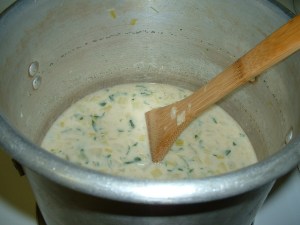
  12. Mix parsley, cream, and roux into soup in stock pot; add a tsp of Better than Bouillon, to heighten taste.  Adjust seasonings and simmer for another five minutes (see photo of finished product).
  13. finished product

    Serve hot and enjoy!  (Flavors meld best after sitting for a day.)

Spicy Cold Noodles made w/ Ezekeil 4:9 Sprouted Grain Pasta

spicy cold noodles

This is one of my all-time favorite recipes, which I have been making every summer for 35 years.  It first blessed me, when I taught it to my students in Billings, Montana, during one of my plentiful cooking classes in the 1980’s.

I don’t exactly remember where I got it, but believe it came in a newspaper clipping sent by my mother, for she was good at supplying me with quaint receipts from the media, during my early catering/teaching career.  Many choice dishes were thus provided, which still grace my table today.  This specific one highly pleases the palate, though it deviates slightly from its authentic roots.

Korean vs Chinese Spicy Cold Noodles

There are both Korean and Chinese spicy cold noodles; both nationalities use sesame and chili oils, soy sauce, vinegar, garlic, and sugar in their mixes.  The Korean variation includes gochujang, a spicy pepper paste.  The Chinese sauce differs in that it calls for sesame paste and peanut butter, giving it an emulsified effect; it is tart, fiery, and slightly sweet.

My particular 1980’s account is from China, though it is Americanized with red wine vinegar instead of rice vinegar, which wasn’t readily available in Montana during the 1980’s.  This version doesn’t have the ever-present peanut butter and chili oil, but is still spicy hot with an abundance of garlic.  It is a memorable burst of flavors.

Spicy Cold Noodles from Szechuan

China is a vast land of varying cuisines.  Just before I left Billings, one of my students, a travel agent, was engaging me to teach these regional culinary truths, while accompanying her on a tour of a number of China’s leading provinces.  My sudden move to Portland, Oregon, in February of 1986, interrupted those plans to go abroad; nevertheless that early research still rests with me.  One of the provinces, which I was studying, was Szechuan-the home of this post’s recipe.

Various Types of Noodles throughout China

Noodles are common throughout this vast country; among the many variations are Chongquing hot noodles, Wuhan hot and dry noodles, Henan stewed noodles, and Beijing style Zhajiang noodles.  The latter dish reaches far beyond the Hebei Province; it is made with pork gravy, which varies greatly from southern to northern China.

The cuisine of Szechuan, also known as Chuan or Sichuan, not only produces these spicy cold noodles, but is famous for dandanmian-dandan-noodles as well; they too have a spicy sauce, and also contain preserved vegetables.  Both these dishes are street foods in Sichuan; they are served everywhere, even in small food stands on the street.

Low Glycemic Ezekiel 4:9 Sprouted Grain Pasta

I used poetic license, in that I chose pasta that is a complete protein and a natural, low glycemic food; thus, these delicious noodles are diabetic friendly.  This brand “Ezekiel 4:9 Sprouted Grain Pasta” contains the six grains and legumes, which are mentioned in this Old Testament scripture.  As published on their box, these half-dozen organic foods are germinated in pure filtered water; therefore, beneficial enzymes are activated, causing sprouting and releasing powerful nutrients, which otherwise would lay dormant.  Diabetics who can’t tolerate carbohydrates have reported good luck with this pasta, which makes this rich repast possible for them (be sure to consult with your doctor).

Join me on a trip to China with this select, health-promoting receipt!

ingredients for spicy cold noodles

Spicy Cold Noodles  Yields: 4-5 servings.  Total prep time: 30 minutes, plus several hours for chilling.  Note: may omit the chicken for a vegan recipe.

1 1b chicken, or 5 tenderloins, thawed  (All natural is best; available reasonably at Trader Joe’s.)

10 oz dry pasta  (Ezekiel 4:9 Sprouted Grain Fettuccine is a complete protein pasta, which is low glycemic, diabetic friendly, and high in fiber; may choose to use a spaghetti pasta.)

1 1/3 tbsp sesame oil

2 tbsp garlic, chopped

1/4 c sesame paste, or tahini  (Trader Joe’s makes a good organic one.)

3 tbsp hot brewed tea

3 tbsp soy sauce  (Organic tamari is best for your body.)

3 tbsp red wine vinegar  (May also use rice vinegar.)

2 tsp sugar

Salt to taste  (Himalayan, pink, or Real Salt is critical for optimum health; an inexpensive fine grind Himalayan salt is available at Costco.)

  1. Thaw chicken in a bowl of warm water.  Fill a stock pot with 4 quarts of water; bring to a boil over med/high heat.
  2. Meanwhile peel garlic cloves; cut cloves in halves or thirds; measure 2 tablespoons worth of pieces.  (This amount gives a lot of

    emulsifying tahini and tea

    bite, may use more or less to taste.)  Place garlic in a food processor and press the pulse button repeatedly, to form a med/coarse grind; stop and scrape down sides once; set aside.  (May also chop with a sharp knife, if you don’t have a processor.)

  3. Place tenderloins in boiling water; turn down heat to medium; do not add salt.  Cook for about 4 minutes, or just until pink is gone; do not overcook.  Remove from water when done and place on a plate in refrigerator.  SAVE BROTH.
  4. Brew tea.  Place sesame butter in a large bowl, add hot tea, stir until emulsified, or smooth and creamy (see photo).  Blend in garlic, soy sauce, vinegar, and sugar; set aside.  (If chicken is finished cooking while you are preparing sauce, proceed to step 5, and then come back to sauce.)
  5. Bring broth-to which you have added 1 tsp of sesame oil-to a rapid boil over med/high heat in the stock pot.  Add pasta and turn down heat to medium (do not add salt, as this toughens the noodles).  Stirring occasionally, cook for approximately 6-7 minutes, or until al dente-slightly chewy.  Drain pasta and immediately submerge in cold water to stop cooking process, set aside.
  6. Cut chicken in bite-size pieces, add to sauce, and season with salt.  Toss together with pasta.
  7. Serve chilled.  Yum!


Creative Caesar Salads

creative Caesar salad topped with serungdeng kacang

When I was growing up, we lived in the small resort town of East Glacier Park, Montana, which is the east entrance to Glacier National Park; there were only 250 residents at the foot of these glorious Rocky Mountains.  Because of our town’s minuscule size, it was necessary to travel to larger cities to take care of our major shopping needs, such as school clothes every late summer.  Usually we traveled within our State, 150 miles east to Great Falls; on special occasions, we ventured as far away as Spokane, Washington.  I can still feel the thrill as we prepared, in the early morning dark, to leave on these revered journeys.

Memories of Ridpath Hotel in  Spokane, WA during  the 1950’s

During the extra special trips to Spokane, the Ridpath Hotel captivated me; we ate many dinners in its plush dining room, often partaking in their Caesar salad, which came with the pomp and flair of table-side service.  My young heart was even then preparing for my career in food history, for I was fascinated by the coddling of the egg, with the torch used for that purpose; in like manner, I rhapsodized over the delight of the powerful garlic on my tender tongue.

To this day I love Caesar salad; I share a recipe here that lives up to this enduring mental monument.  Be prepared to enjoy.

Origins of Caesar Salad

There are several accounts of how this famous dish began.  After much research, I chose to attribute its origin to the Italian chef Caesar Cardini (1896-1956), who created this American classic at his well-known restaurant in Tijuana, Mexico.  There in 1924, he was serving an unusual number of Californian visitors, escaping for the Fourth of July weekend during prohibition.  This original production was served table side, without anchovies, and included whole lettuce leaves, which were eaten by the stems, using one’s fingers.

Caesar salad enhanced with beans

Are Coddled Eggs Safe?

There are numerous opposing views on the safety of coddled eggs.  Some profess that they are not a threat: it is adequate to place the eggs in rapidly boiling water, remove the pan from the heat, and then allow the eggs to cook for 60 seconds; indeed, this technique provides the best taste.

Others propound that holding eggs at 140 degrees F (60 degrees C) for five minutes kills potential contaminants, such as salmonella; this can also be achieved instantly by heating them to 160 degrees F (71 degrees C).

Still others declare that uncooked and under-cooked eggs are not safe at all; they rigidly promote the use of either hard-boiled or pasteurized eggs; the latter are available in some grocery stores.  Note: it is important to use caution in highly susceptible populations, such as small children, pregnant women, the elderly, and those with health problems.

Two Resolutions to Problem

Here I cover this dilemma with two good solutions: my favorite version of this dressing is made with coddled eggs, which have been cooked for 60 seconds; nonetheless, for times when extra special care is needed, I provide a method of heating the prepared dressing to 160 degrees; this last procedure, however, thickens our treasured concoction quite a lot.  With both of these two options, the powerful recollected taste from my youth is maintained, which is heightened even further with strong combinations of foods in my creative Caesar salads.

References:

https://whatscookingamerica.net/CaesarSalad.htm

www.reluctantgourmet.com/caesar-salad/

www.foodandwine.com/fwx/food/we-can-thank-tijuana-and-prohibition-caesar-salad

www.ochef.com/447.htm

https://en.wikipedia.org/wiki/coddled_egg

www.safeeggs.com/blog/will-the-real-safe-caesar-salad-recipe-please-stand-up/

finished Caesar dressing (feeder tube in lid at right side)

Caesar Salad Dressing  Yields: about 1 1/2 cups.  Total prep time: 30 min.  If cooking the dressing, total prep time is 45 min.

3 fresh, free-range eggs, at room temperature  (Place in warm water for 10-15 minutes.)

2 tbsp fresh garlic

1 tbsp cider vinegar  (Raw is best; available inexpensively at Trader Joe’s.)

1 scant tbsp Dijon mustard  (Aioli Garlic Mustard from Trader’s is also excellent.)

2 small lemons, juiced

3 dashes of Tabasco

3 dashes of Worcestershire

1/4 c grated Parmesan cheese

1 anchovy, optional

3/4 tsp salt, or to taste  (Himalayan, pink, or Real Salt is critical for optimum health; an inexpensive fine grind Himalayan salt is available available at Costco for $4.95 for 5 lbs..)

1/2 tsp freshly ground pepper, or to taste

3/4 c olive oil  (Personally I prefer a light olive oil for flavor; Trader Joe’s brand, fruity Extra Virgin Olive Oil or Bel’Olio, from Costco, are both great.)

  1. Use room temperature eggs, by placing them in warm water for 10-15 minutes.  For health reasons, it is important that they are washed, free-range, and fresh.  I feel comfortable with coddled eggs, which makes the best dressing.  If, however,  you are sensitive to them (or storing this dressing for more than 4-5 days), take the extra precaution of cooking it as described in step 6, or better yet use pasteurized eggs, which are available in some grocery stores.
  2. coddling eggs

    For coddled eggs, bring a small pan of water to a boil over high heat; prepare an ice bath, using a bowl of cold water with ice cubes.  Place eggs in rapidly boiling water; quickly remove from heat; let them sit for 60 seconds; then, immediately transfer to the ice bath, to the stop cooking process.  Crack them on side of bowl, scooping coddled egg out of shell with a spoon, set aside (see photo).

  3. Meanwhile mince 2 tbsp of garlic: peel cloves, cut in halves; then, chop this in a food processor by repeatedly pressing pulse button; measure 2 tbsp of chopped garlic and place this back in processor.  Set aside.  (TO MAKE DRESSING BY HAND: chop the garlic with a sharp knife; mix all ingredients, except the oil, in a med/small bowl; then, beat in the oil SLOWLY, to emulsify the dressing.  May also make this in a VitaMix or blender.)
  4. Juice the lemons, set aside.
  5. Add all ingredients, except the oil, to the garlic in the processor.  Turn on machine and blend; place oil in the feeder, which is located on the top (see this feeder in above photo of finished product); thus, oil will drip in slowly for an emulsified dressing.  Adjust seasonings.  This will keep in the refrigerator for 4-5 days; for longer storage, go to the next step.  Serve on the creative salads given lastly.
  6. For cooked dressing, prepare an ice bath, using a large bowl with a smaller one inserted in center (see photo).  Prepare Caesar dressing as described in steps 2-

    cooked dressing cooling in ice bath

    5; transfer this mixture to a small, heavy-bottomed saucepan; cook dressing over low heat, stirring constantly, until this egg mixture reaches 160 degrees F (71 degrees C); immediately place in the ice bath to cool, adding more ice as needed.  Note: the dressing will thicken as it cooks. Serve on salads described below.

  7. I like to be creative with my Caesar salads; here are two suggestions for using foods that highly complement this excellent dressing.  First: mix greens, sweet onion, avocado, Parmesan cheese, and homemade croutons (2016/08/15); then, top this with serungdeng kacang, which is crispy coconut chips and peanuts sautéed with a garlic/onion puree (2017/01/09).  Second: mix greens, Parmesan cheese, homemade croutons, and beans; legumes really accentuate the flavor of this dressing!  Enjoy.

1880’s Minced Cabbage

cooked minced cabbage

Gold Medal Flour, Betty Crocker and Miss Parloa all had their beginnings in Washburn-Crosby Co.  Along with last week’s post on escalloped salmon, I discovered this elegant minced cabbage in Miss Parloa’s New Cook Book, which was originally published in 1880 by Washburn-Crosby Co.

Its successor General Mills reprinted this same worthy account in the twentieth century.  This latter company, however, is better known for publishing recipe books under the pseudonym Betty Crocker, who never existed, unlike our illustrious 19th century writer Maria Parloa.

In 1921, before the above transfer of title, Washburn-Crosby was first to use the name “Betty Crocker”.  This came as a result of their being inundated with 30,000 entries, in a contest promoting their Gold Medal flour.

Many of these participants asked questions concerning baking.  Washburn-Crosby discerned that the replies would hold more influence if signed by a woman; thus, the inspiration for this sham Betty Crocker, which was derived from the surname of a retired company director.

General Mills continued in this tradition, after it was created in 1928, when it began merging Washburn-Crosby with 26 other U.S. flour-milling companies.  This, then the world’s largest flour mill, initially portrayed this fictitious authority photographically, in 1936, as a gray-haired home-maker.  Her image was frequently revised throughout the last century, as Betty Crocker was used as a major brand name for their various products.  (See more history at my 1880’s Clam Chowder-2017/01/30-1880’s Escalloped Salmon-2017/04/17-and 1880’s Ozark Honey-Oatmeal Cookies-2017/10/30.)

It is jarring when we learn the falsehood of long accepted traditions, like the authenticity of this established person, for truth is fundamental to our stability.  We implicitly search for verity in all things, cooking included.

Rejoicing occurs when a good source for teaching the basics is found, such as those required for food preparation, as well as the execution of life; I hope you will discover these fundamentals present in my writings.

May you come to rely on my receipts, preparing them with the ease with which they are intended.  They may look lengthy at times; this is because I spell out shortcuts with care, for in a sense my blog is like going to cooking school.  Quickly you learn my simple, creative techniques, thus gaining the ability to follow my recipes adeptly.

This effortless minced cabbage comes with the height of freedom.  Enjoy!

References:

  1. Silver Dollar City Edition of Maria Parloa’s Miss Parloa’s New Cook Book (Boston: Estes and Laurait, 1880); this facsimile was published at an unknown date during the 20th century.
  2. James Trager, The Food Chronology (New York: Henry Holt and Company, 1995), pp. 434, 456, 488.
  3. http://www.pbs.org/food/the-history-kitchen/who-was-betty-crocker/
  4. https://foodimentary.com/2012/03/24/a-history-of-betty-crocker-the-woman-who-never-was/
  5. http://www.fundinguniverse.com/company-histories/general-mills-inc-history/

chopping cabbage in a food processor

1880’s Minced Cabbage  Yields: 4 servings.  Total prep time: 25 min.  This is adapted from a recipe in General Mills’ Special Silver Dollar City Edition (copyright date unknown) of Maria Parloa’s Miss Parloa’s New Cook Book, (Boston: Estes and Laurait, 1880).

Note: this can be made ahead and reheated just before serving.

1 1/2 lb green cabbage

2 tbsp oil  (Coconut oil is ideal for quality and flavor here; avocado oil is also good; olive oil is carcinogenic when heated to high temperatures.)

2 tbsp butter

2 tbsp flour

1 tsp salt, or to taste  (I prefer a coarse salt here, such as a kosher salt or Trader Joe’s coarse sea salt. )

  1. Chop cabbage either by hand, or more quickly, by using the slicing attachment to a food processor.  If using a food processor, cut cabbage in pieces that will fit in its feeder tube (see above photo).  Set aside.
  2. Heat oil over medium heat in a large sauté pan, in which you have placed a small piece of cabbage.  When it sizzles, add rest of cabbage, and stir well to evenly distribute oil; cook until vegetable is limp, stirring frequently.  Meanwhile go to next step.
  3. cooking roux

    Make roux in a small sauté pan: melt butter over medium heat, add flour, and stir with a wire whisk.  Cook  until mixture is a light brown, about 2 minutes; remove from heat and set aside (see photo).

  4. When cabbage is soft, add salt, and stir well.
  5. Blend roux into vegetable, cook until consistency of cabbage is somewhat thickened, stir continually.
  6. When done, remove from heat.  May serve immediately, or better yet, make ahead, and reheat just before serving.  When it sits, cabbage juices form in pan; as you reheat it, stir in juices and loosened fond, which is obtained by scraping these caramelized pan drippings and browned bits off bottom of pan, using a wooden or plastic cooking spatula.  This adds great flavor!  (See top photo for finished product.)