Red Sauce for Pasta or Spaghetti Squash

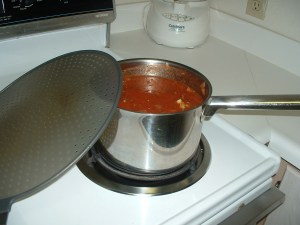
simmering red sauce with splash shield

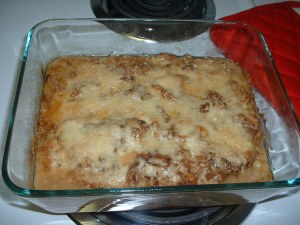
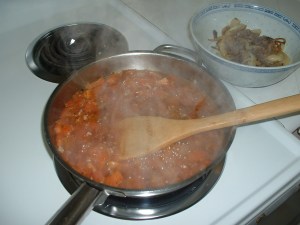
A beloved friend gave me a Valentine’s present of heart-shaped pasta; immediately I created this red sauce so I could enjoy my new treasure, resulting in this excellent covering for either pasta or spaghetti squash.

Follow these easy instructions for substituting the squash, if your dietary needs call for a vegetable rather than a starch with this piquant accompaniment.

Gifts promote well-being in both the giver and receiver.  My mother’s favorite language of love was that of gift giving; thus, I learned at an early age the power of contributions from the heart.  As a result I love to shower favor upon others, as well as graciously receive their inspired kindnesses.

This same act of generous sacrifice plays a lively part in my relationship with my Father in heaven, for I constantly seek to offer myself to him.  In doing so, it is important to slow down, move forward cautiously, relax, and especially, trust the process.  In this way, we proffer our lives to our Maker moment by moment.  However this process often brings tension, for resistance arises.

We see an explicit example of this opposition in our practice of eating: here polarity is experienced between a desire to quietly absorb pleasure and a friction arising out of our need to resolve storms present in our beings.

Taut emotions can result as we struggle to calm overactive minds, so we can enjoy our food; this dichotomy in our bodies can be countered with prayer.  Great grace is needed, however, if heightened feelings cause us even to miss the opening blessing over our nutriments.

When the above happens to me while eating, I immediately search my heart for honest moves of gratitude, which usually include my two favorite gifts from God: I have vibrant health, with my acquired ability to eat sanely, and an immense supply of resources, including the highest quality of food.

These two endowments were not always present with me, for I knew excessive physical and financial poverty in the past.  At one point I had a 226 pound body, that couldn’t stop eating compulsively; now it is clothed better than Solomon in size petite.

All devouring of my economic supply has likewise ended.  An apt example of this is the recent demolition of my computer, at which juncture I stood, looked out my window at the river below, and spoke the word: all things come together for good for those that love God and are called according to his purpose.  Joyful faith rose in me, I was convinced that increase was on its way.

Indeed it was!  For after waiting patiently six weeks, I now publish my blog with the fastest of computers, an I-7 laptop equipped with a new wireless keyboard, mouse, printer, and monitor setup.

In addition to the outstanding quality of these, I have a fiber optic internet connection-instead of DSL-with 90 times more power and a monthly fee that is slightly less!

This unheard of upgrade-a sign of the Father’s immense love-was further outdone by the monetary provision for this loss.  First, great deals gave me $700 worth of equipment for $280.  Next, three separate parties were moved to help me with this.  This was outdone even further, however, with this full amount being exceeded by half again as much, or $140 was left over in gift monies!

This is just one simple example of how my needs are always met today.  God, who owns the cattle on a 1000 hills, indeed showers us with blessings, if we but believe.

He loves each and every one of us!  Right now, his heart is reaching out, to set us free from all wounds that hinder his glory from manifesting in our lives.  He is only about goodness, as my testimony proves.  Let’s receive his blessings; begin by enjoying this red sauce recipe.

sweating onions

Simple Red Sauce for Pasta or Spaghetti Squash  Yields: 2 qt.  Total prep time: 1 hour/  active prep time: 30 minutes/  cooking time: 30 minutes.   (Spaghetti squash requires approximately 1 1/2 hr to bake.)

4 tbsp oil  (Coconut oil is best for flavor and quality here; avocado oil will also do; olive oil is carcinogenic, when heated to high temperatures.)

1 med/lg yellow onion, chopped

1 lb ground beef

1 lb romanesco or 3/4 lb mushrooms  (I like to use romanesco for variety’s sake; it is a green variant of cauliflower, which is available in the organic section at better supermarkets; may also use a combination of both.)

3 tbsp butter, if using mushrooms

2-15-oz cans of tomato sauce  (Hunt’s and Simple Truth-at our local Fred Meyer’s-make inexpensive organic tomato sauces.)

1-15-oz can of water

2 tsp dried oregano  (Trader Joe’s carries a superb, organic dried oregano for $1.99!)

1 tbsp dried basil  (Also available inexpensively at Trader’s.)

1 tsp sugar  (I prefer organic; available at Trader’s and also in a more economical 10 lb bag at Costco.)

2 1/2 tsp salt, more to taste  (Real Salt is important for optimum health, available in nutrition section at local supermarket.)

1/2 tsp fresh ground pepper, more to taste

5 extra-large garlic cloves, minced  (3 cubes of Trader’s frozen garlic is better here.)

1/4 c tomato paste  (Open a 6-oz can and freeze individual 1/4 cup servings in small plastic bags, to be thawed as needed.)

Pasta or 4.5 lbs spaghetti squash  (This spaghetti squash yields 4-6 servings.)

Parmesan cheese, grated or shaved

  1. If using spaghetti squash, preheat oven to 375 degrees; pierce squash with a fork multiple times; place on side on foil-covered cookie sheet, and bake for approximately 1 1/2 hour, turning halfway through, at 3/4 hour.  Cool for at least 10 minutes before handling, cut lengthwise, take out seeds, and scrape out “noodles” with a fork, when ready to serve.
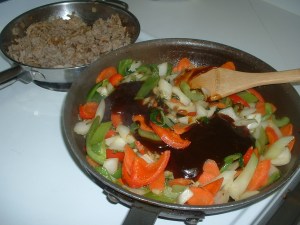
  2. Heat 2 tbsp oil in a 3-quart saucepan over medium heat; add a small piece of onion; when it sizzles, add rest of onions and sweat (cook until translucent); see photo.
  3. Fry beef in sauté pan; salt and pepper generously before cooking; drain fat if there is a great deal of excess, when finished.  Proceed to next step, while meat is cooking.
  4. If using romanesco, clean and cut into very small pieces, add to translucent onions, and cook until somewhat soft, about 4-5 minutes, stirring frequently.
  5. Add the cooked beef to onion mixture, along with tomato sauce, water, herbs, sugar, 1/2 tsp salt, pepper, and garlic.  Blend well.  Set aside sauté pan.
  6. Cover saucepan with a splash shield, which is available at Bed, Bath, and Beyond (see top photo); bring to a boil over medium heat; reduce heat to med/low and simmer for 30 minutes.  Go to next step.
  7. If you are using mushrooms instead of the romanesco, clean them by brushing off dirt with a mushroom brush, cut into small chunks.  Heat butter in the sauté pan, cook mushrooms in hot butter for several minutes, until slightly limp, stirring constantly.  Add mushrooms and juices to sauce.
  8. Meanwhile if serving with pasta, boil a large pot of water, to which 2 tbsp oil and 2 tsp salt are added.
  9. When sauce has simmered for 30 minutes, blend in tomato paste; cook for several minutes, or until thickened, stirring constantly.
  10. Adjust seasonings to taste.
  11. Boil pasta 10 minutes before serving, or if using spaghetti squash, split baked squash in half lengthwise, take out seeds, and scoop out noodle-like membrane with a fork.
  12. Pour hot sauce over noodles and top with Parmesan cheese.  Serve immediately.
  13. Note: may freeze small individual containers of leftover sauce, to be conveniently thawed for future use.  This is dynamite!

Onion Bread

the grinding of flour, with an attachment for a Kitchen Aid mixer

Bread is proverbially known as the staff of life.  Indeed, my onion bread promotes vitality in body and soul; how it nourishes.

Words, as well as bread, establish the life force in each of us.  As my blog unfolds each week, I passionately look up even the simplest definitions; thus, I am able to best express my vision to you.

I see maxims, succinct formulations of principles or rules of conduct, in cooking which subsequently transfer over to our everyday existence.  My specific choice of terms defining food preparation displays concise truth that releases liberty to our total person.

Each written expression must have the precise force to propel that which is being born in my thoughts.  My broad scope for this website is to set captives free from all hindrances to receiving healthy nutriments.  My salutary insights first change our natural physiques; then, invigorate our minds; last, heal our emotions and spirits.

It has been spoken that the word of God is the bread of life.  We find freedom with it, as it produces needed change, which sheds light on the hidden fractures in our being.  May you be rejuvenated in God’s word, my life-sustaining English meanings, and this good onion loaf.

To gain this we must rise to action by taking courage; one must purpose to step into the unknown.  Read on, to grasp how the fundamentals of bread baking transfer to indefatigable living.

Let’s start with the practical first: may I encourage us to take a leap of faith by nimbly making bread with a food processor?  Blessings follow immediately with the remarkable ease which replaces this otherwise messy/time-consuming work.  Quickly we master making homemade bread using my simple, detailed directions; these comprehensive steps will circumvent all mistakes.  Let us allow ourselves the luxury of a little practice, which guarantees ultimate perfection.

There will always be new horizons, with greater challenges to overcome, as we walk through life.  Our proper attitude about this allows us to approach necessary growth with unspeakable joy and confidence.  It is critical, however, to learn the power of patience-needed in times of trouble-and equally important, the calm endurance required, while quietly waiting for our promised good.

Faith is critical in learning this great process of baking bread, as well as achieving tireless living; take my pledge that simple, better bread is fool-proof, if you honor my comfortable instructions.  Likewise effortless patterns of existence are more readily obtainable, as we draw upon the maxims found between cooking and living.  We dare to reach out for superlatives.

Now for the final stretch: when the time is right, invest in a wheat grinder for optimum health-giving bread, with a long shelf life.  Grinding our own wheat is a quick, one-step process: merely place the mixing bowl under the wheat grinding attachment on a Kitchen Aid, turn the machine on, and  the purest of flours is produced minutes later. (See top photo.)  If you don’t have a Kitchen Aid, it is possible to buy less expensive appliances that grind grains.  Trust, you won’t be sorry that you made this investment!

easy mincing of onion

Onion Bread Yields: 1 loaf.  Total prep time: 3 1/4 hr/  active prep time: 45 min/  inactive prep time: 2 hr/  baking time: 30 min.  Note: these steps are detailed, making this process easy to learn.  Also see Cocoa Bread (2016/05/30), Rosemary Bread (2017/10/16), and “Cuban” Holiday Rolls (2017/11/20).

1 1/4-1 1/2 c tepid water, 105 to 115 degrees

1  individual packet of yeast  (May use 3 tsp of Red Star Active Dry Yeast from an inexpensive 2-lb package, available at Costco, which may be frozen in a sealed container for long-term use.)

2 tbsp plus 1/4 tsp sugar

1 c unbleached white flour  (Bob’s Red Mill is high quality.)

3 c whole wheat flour  (Optional: grind 2 2/3 c organic hard red spring wheat berries to make the total 4 c of flour.)

1 1/4 tsp salt  (Himalayan, pink, or Real Salt is important for optimum health; a fine grind Himalayan salt is available at Costco for $4.95/5 lbs.)

1 c yellow onion, minced  (1 med/large yellow onion needed, refer to step 3 and above photo for easy mincing.)

4 tbsp dried chopped onion  (Available in bulk and in jars in the spice section; save all jars and refill yearly with fresh, inexpensive bulk spices-place adhesive tape, with date of purchase on each jar.)

1-13-gallon plastic bag

3-4 tbsp oil  (Any kind will do for oiling the bag.)

Spray oil  (Coconut spray oil is best; PAM is available at most stores; our local Winco brand, however, is far cheaper.)

  1. If grinding your own flour, begin to do so now (see top photo).
  2. Place 1/4 c lukewarm water in a small bowl; stir in yeast and 1/4 tsp sugar.  Let rest in a warm place for about 10 min, or until it becomes creamy, foams, and is nearly doubled in size.  (When using yeast directly from the freezer, it will take a little longer to proof.)
  3. Meantime mince the onion the easy way (see photo).  Peel it, leaving the root on; next, score this by cutting slices close together across the top one way, going three quarters of the way down into the onion; then, turn it and cut slices the opposite direction.  When onion is prepared thus, shave the minced pieces off the end with a sharp knife.  Measure and set aside chopped onion; save leftovers for other cooking.
  4. In an 11-cup (or larger) food processor blend well: flour, 2 tbsp sugar, salt, minced fresh onion, and dried onion.
  5. When yeast mixture is doubled, add it and 1 1/4 c of water to flour mixture in food processor (only 1 c will be needed for fresh-ground flour, which has a coarser grind, not absorbing water as readily).
  6. Knead for 35 seconds; let cool by resting for 4 minutes; be aware that processing heats dough, which kills the yeast, if cooling is not allowed.
  7. After dough has cooled, knead again for 35 seconds; let rest for 4 minutes; take out and knead by hand for 5 minutes.  As you start kneading, it will feel somewhat moist to the touch-a lot of moisture is absorbed with kneading by hand.  (This is especially true when you grind your own flour.)  Refer to next step.
  8. Lightly flour hands and counter top IF needed, while kneading dough.  (When it sticks to hands, it helps to regularly wash and dry them.)  Dough should be firm, not sticky, and rather smooth, with the exception of the onion bumps, when finished.  Though highly unlikely, if dough becomes too stiff to knead easily, place back in food processor, kneading in 1 tbsp of water. Repeat if necessary, until severe stiffness is gone, it is flexible, and kneading by hand is facile, carefully resting dough so as not to overheat.  Again, dough will be firm, not sticky, elastic, and smooth to the touch (minus the onion bumps) when kneading is complete.
  9. Place in a 13-gallon plastic bag, in which you have evenly distributed 3-4 tbsp of oil.  Let rise in a warm place for 50-60 minutes, or until doubled.  (Only with freshly ground flour, will dough need to be punched down at this point and be allowed to rise for an additional 30 minutes.)
  10. Punch dough down, form it into a loaf, place in a bread pan sprayed with oil.  Also spray a piece of plastic wrap with oil; drape this loosely in and around the loaf.  Let rise for 50-60 minutes, or until doubled.
  11. 30 minutes into this last proofing time, be sure to preheat the oven to 400 degrees; this insures oven is ready when dough has risen.
  12. Remove plastic wrap when loaf is doubled; bake 27-30 minutes, or until it sounds hallow when tapped on bottom with fingers.  (Temperatures vary slightly from oven to oven-my oven takes 27 minutes.)
  13. Cool thoroughly on rack.  This keeps well in refrigerator, when wrapped in paper towel and sealed in a storage bag.  This process becomes extremely easy and quick with practice!  Enjoy.

Parmesan Dover Sole

pan of baked Dover sole

Joy found in my gift of hospitality and fine food exploded when I was celebrating a belated Christmas get-together with Carol, a friend of 31 years.  Our time in each other’s company is always rich; my desire for our merrymaking was that my food would give honor, blessing our long-term bond.  This delicious dish answered this ambition beyond my expectations.  I share it here for your use with those close to you.

Friendship and food are both treasured gifts.  When we mix the two together, life pours forth.  I always endeavor to meet my guests’ particular needs, thus making each dinner engagement unique and exceptional.

For instance Carol doesn’t like hors d’ouvres, as they were never served in her family of origin; for her they take away from an acute appetite for the main meal.  Consequently, we just partake in tea and conversation for the first half hour of our gathering.

This sensible person has a heightened awareness of taste.  She knows good food and eats with purpose, maximally enjoying each bite.  This takes concentration; my friend allows herself this luxury; thus, we spend much of our repast in silence, focusing on gastronomic pleasures.

This discipline was first displayed to me when I was 20 years old, while waiting on table in my father’s restaurant.  (Joy unspeakable happened to me then, as I served the public with our exceptional ailments.)

My About Page on this website notes that which is true for each of us: it details the unfolding of my destiny, which has been happening throughout my entire life-I was born a food historian.  An excellent example of this destiny-making process is what I learned about the gift of hospitality, while serving the public in my youth; during that instructive time, a young couple showed me what a treasure stillness brings to eating.

Tourists peopled my family’s eatery in Glacier National Park and this unique pair was probably there on their honeymoon.  I initially approached their table with rousing emotion, my usual display of a genuine heartfelt welcome.  My spirit, however, was quickly corrected.  This excitable enthusiasm, which was normally highly pleasing to those on holiday, was not appropriate in their presence, for there was a holy reverence about them.  My sensitive response was an immediate change of demeanor.

Throughout their lengthy feast, I watched them with awe, as they indulged in each other’s company and our kitchen’s delights, in their unparalleled way.  I intuitively knew how to respect them with a quiet spirit.  This, however, was so foreign to me that I felt like I was walking on egg shells.  But oh the glory of it all!

Since then, God has given me a friend with whom I can practice what these two taught me, forty odd years ago.  Carol and I uphold veracity in all of life’s dealings; thus, even our eating is veracious.  Because of the honesty in our souls, we engage in veneration to God as we consume food; therefore, you can see my need for a dish that would rise to our integrity, which I knew would be present at this gathering.

My heart’s desire was met in this Parmesan Dover Sole recipe; how facile and pleasing it is beyond words.

sauce cooking

Parmesan Dover Sole   Total prep time: 1 1/3 hr/  active prep time: 50 min/  baking time: 30 min.  Yields: 3-4 servings.  Note: you may double this recipe, leftovers are great, however fish only keeps for 3 days.

1/2 tsp oil  (Coconut oil is best here for flavor and quality; you may also use avocado oil; olive oil is carcinogenic, when heated to high temperatures.)

1 med yellow onion, halved at the root and cut in even 1/8 inch slices

5 med cloves garlic, minced  (May substitute 2 cubes frozen garlic from Trader Joe’s for easy prep.)

1 lb Roma tomatoes, chopped small  (Organic is best; the organic Roma variety is not that much more expensive than regular tomatoes.)

1/2 tsp sugar, optional  (This brings out the flavor in the tomatoes.)

1/2 tsp salt, or to taste  (Himalayan, pink, or Real Salt is critical for optimum health; a fine grind Himalayan salt is available at Costco for $4.95/5 lb.)

1/4 tsp fresh ground pepper, or to taste

1/2 tsp Better Than Bouillon  (This soup base, in either chicken or vegetable flavor, will do; available at most grocery stores.)

3/4 c boiling water

Spray oil  (Pam coconut spray oil is ideal, available more reasonably in our local Winco brand.)

1 lb Dover sole fillets, or other type of whitefish, such as flounder  (Dover sole is a type of sole that has very thin fillets, which is ideal for absorbing sauces; see Thai Coconut/Lime Flounder, 2016/12/05.)

1 c Parmesan cheese, grated or shaved

Rice, steamed according to directions on package

  1. Preheat oven to 350 degrees.  (If you prepare dish ahead of time, do steps 2 through 9 before hand; then, begin preheating oven 1 hour before serving.)
  2. beginning stages of caramelization

    Heat oil in a large sauté pan over med/low heat; add onions and caramelize, by stirring every several minutes until color starts to form (see photo); then, stir every minute until dark brown (see photo below). Do not crowd onions in pan, or they will sweat, taking much longer to cook.

  3. If using fresh garlic, chop and set aside.  Spray tomatoes with an inexpensive, effective vegetable spray, a mixture of 97% distilled white vinegar and 3% hydrogen peroxide; let sit for 3 minutes; rinse well.
  4. Meantime dissolve Better Than Bouillon in the hot water, set aside.
  5. Chop tomatoes in small pieces and place in another frying pan; add garlic, bouillon mixture, sugar, salt, and pepper, stirring well.  Bring to a boil over medium heat; then, turn heat down to med/low; simmer gently for about 20 minutes, or until a sauce is formed, with the tomatoes somewhat chunky (see above photo).  Adjust seasoning when sauce is complete. (For tips about cooking properly with garlic, see Tomato/Feta Chicken, 2016/07/25.)
  6. onions nearing finish

    Begin steaming the rice while tomatoes are cooking.  (If you are preparing this ahead of time, start this starch when you put cold fish dish in preheated oven, 50 minutes before serving.)

  7. For a single recipe, spray with oil a 9 1/2″ x 7 1/2″ x 3″ pan or 2 1/2-quart baking dish (for a double recipe, use a 9 1/2″ x 13″ x 2″ pan).  Place fish fillets in bottom of pan.
  8. Pour prepared sauce over raw fish and sprinkle with Parmesan cheese, see top photo.  (If preparing this ahead, refrigerate fish dish at this point.)
  9. Bake in preheated 350 degree oven for 30 to 50 minutes-time varies if fish is cold from the refrigerator.  Fish is done when its center is opaque and it flakes with a fork.
  10. Enjoy this incredibly good dish!  Leftovers are also delicious.

Gingered Bok Choy with Ground Turkey

gingered bok choy with ground turkey

gingered bok choy with ground turkey

Today’s recipe, with its Chinese flair, is easy to follow, though it takes some patient chopping of vegetables. (The process of this preparation flows, especially after the first time you make it.)  My dish is low in carbohydrates, vitamin-proficient, and has an inexpensive, high-quality protein. Abundant health and pleasure result!

The inspiration for it grew in me.  Recently I was influenced by Chef Susanna Foo. She Americanized her Chinese cuisine by substituting our everyday ingredients, for their Oriental counterparts, which were challenging to get in the 1990’s.  Foo discovered that these simple adjustments actually enhanced her cooking; thus I chose apple cider instead of rice vinegar and, for heat, jalapeno instead of Szechuan peppers.  1

My palette was also crying for orange juice in the mix.  I added to these surprises typical Chinese ingredients: ginger, garlic, soy sauce, sesame oil, coriander, and bok choy, which is a Chinese cabbage from Brassica rapa-the same species that gave us the turnip.  Note: the spice coriander is common to Chinese, Indian and Mexican cooking; its fresh leaves are known as cilantro-see Munazalla, 2018/03/12.  The glorious blending of these foods thrilled me!

My whole family acquired the cooking gene, a rich inheritance received from our parents. However the grander bequest was that of their love: Mom and Dad cherished one another in a steadfast, unspeakable way.  This security has always belonged to our entire family.  It has never weakened, no matter what, for even death has not separated my parents.

My father went to heaven on November 16, 2006, but I contend that my mother enjoys his presence even more now.  At 93, she sits in Buzzy-baby’s chair and eats ice cream with him.  She joyfully informs me, when I call, that he is letting her finish his share too, as he always did while he was alive.

My parents each possessed individual attributes that allowed for their earnest commitment: my father had a beautiful heart and my mother unshakable faith. Over the years, I have declared that my greatest heritage of all comprises of these two qualities.  These endowments, along with the cooking gene, set the stage for all I get to do in this world.  They have formed me, for I am a food historian in love with my God.

This legacy of devotion and faith is more precious than gold.  My inherited strong heart, powerful faith, and ability to cook, all three, propel me into this marvelous, God-given destiny.  Give me pots, pans, and ingredients and heaven-sent food results.  My meals excite all your senses.

Now I encourage you: look to your life; discover your unique inheritance (your intrinsic gifts); go forward with them.  Indeed your birthright was ordained before time began.  In the meantime try my recipe!

  1. Andrew Dornenburg and Karen Page, Culinary Artistry (Hoboken, N.J.: John Wiley & Sons, Inc., 1996), p. 211.
assembly of gingered bok choy

assembly of gingered bok choy with sauce

Gingered Bok Choy with Ground Turkey  Yields: 5-6 servings.  Total active prep time: 1 1/4 hour.

7 tsp oil  (Coconut or avocado oil is best for sauteing; olive oil produces carcinogens at high temperatures.)

1 med/lg yellow onion, halved at the root and cut in even 1/8″ slices

2 carrots  (Organic carrots are very inexpensive; find them in 1 lb packages at Trader Joe’s.)

2 stalks of celery

l lg red bell pepper  (It is important to use organic bell peppers, as this vegetable really absorbs pesticides.)

1 lb bok choy  (Organic bok choy comes in smaller heads; weigh before purchasing.)

1 lb ground turkey  (Natural is important; Foster Farms is reasonably priced and good.)

4 tbsp fresh ginger, peeled and chopped fine

1 lg jalapeno pepper, minced small  (May use more for a hotter dish.)

5 large cloves fresh garlic, or 3 cubes frozen garlic  (Frozen garlic is available at Trader Joe’s, it provides ease in cooking, especially excellent for this recipe.)

1/3  c organic tamari  (May substitute soy sauce, but not as healthy or flavorful; tamari is available in the health section at Fred Meyer’s, or at other national chains such as Whole Foods.)

1/3 c apple cider vinegar  (Raw is the best; inexpensive at Trader’s.)

1/3 c orange juice  (May squeeze your own, or use orange juice that is not from concentrate, such as Florida’s Natural or Tropicana’s.)

1/4 c water

1 tbsp sesame oil  (This is found at a good price at Trader’s.)

1/2 tsp ground coriander

1/4 cup corn starch, dissolved in 1/4 cup cold water

Steamed rice  (I personally prefer brown basmati.)

  1. Heat 1/2 tsp of oil in an large saute pan over medium heat.  Add a small piece of onion; when it sizzles, oil is ready.  Add remaining onions and caramelize, by stirring every several minutes, until color starts to form; then, stir every minutes, until dark brown.
  2. Meanwhile cook turkey in a extra large frying pan.  Place in a bowl.
  3. Clean all vegetables, except ginger, with an inexpensive effective spray (a mixture of  97% distilled white vinegar and 3% hydrogen peroxide); let sit for 3 minutes and rinse extra well.  Set aside.  While waiting for vegetables, start cooking rice.
  4. Peel and mince ginger in very small pieces, set aside.
  5. Chop garlic fine, if using fresh, set aside.  (Frozen garlic from Trader’s works better with this recipe.)
  6. When onions are caramelized, add cooked meat to them, and turn off heat.  Note: you will reuse this extra-large pan for cooking the vegetables.
  7. Dissolve corn starch in 1/4 cup cold water, set aside.  Next slowly heat garlic, tamari, vinegar, orange juice, water, sesame oil, and coriander in a small saucepan over med/low heat.  It will take about 15 minutes for light bubbles to rise in liquid.  Meanwhile go to next step.
  8. Prepare carrots by scraping with a knife and thinly slicing at a diagonal. (Scraping, rather than peeling, preserves vitamins just under the skin.)  Cut celery in 3/4″-wide diagonal pieces.  Place carrots and celery in a bowl, set aside.
  9. Chop pepper in 3/4″ x 2 1/2″-wide strips.  Place in another bowl with bok choy, which is chopped in strips the same size as the pepper, including greens.  Set all aside.
  10. Heat remaining 1 1/2 tbsp oil in the extra-large pan.  Place a small piece of carrot in oil, wait for it to sizzle.  Also turn heat on to med/low under pan of meat/onions.
  11. Add carrots, celery, and ginger to hot oil.  Stir well to coat vegetables with oil.  Cook 3 min, stirring occasionally.  Add bok choy and pepper strips, mix well with carrots.  Cook for about 7 minutes, or until vegetables are done, but still crisp.  Be sure to stir frequently.
  12. The liquid sauce should be forming light bubbles by now; add the cornstarch, which is thoroughly dissolved in water; beat constantly with a wire whisk.  It thickens quickly.  Remove from heat when thick and clear. (This takes only about 15 seconds.)  Set aside
  13. Mix together: hot meat, finished vegetables, and sauce.  Serve immediately with steamed rice.  This pleases the palate!

Serungdeng Kacang

serungdeng kacang

serungdeng kacang

The condiment serungdeng kacang first completed my varied dishes in the early 1980’s, when I was catering historical events in Billings, Montana.  In those days, I sought recipes that allowed me to offer thematic meals from diverse cultures and times. To my joy, I discovered a host of receipts from Indonesia; thus, I presented an Indonesian rijsttafel to my eager audiences.

A rijsttafel is a banquet of delicacies from this southeast Asian republic, formerly known at the Dutch East Indies.

Serungdeng kacang is a condiment for rice dishes in these ethnic feasts. My particular recipe comes from Java, one of the many islands in Indonesia. These coconut crumbs, spiced with onion and garlic, are spread liberally over the rice portions, in addition to a variety of other garnishes.

For me, serungdeng kacang has multiple, inventive benefits: it is compatible with Indian curries, acts as a delicious hors d’oeuvre, and-my favorite-provides the crowning touch to salads!

I always keep this enhancement to tossed greens on hand, by making a double batch and storing it in a sealed storage bag.  The beauty of this topping is it lasts a long time, if you are disciplined.

Prior to my doing this rijsttafel, I presented a gala event, a Moroccan affair, which was to  become one of my favorite memories in the history of my business; it best defines what my work entailed back then.

I loved to act in my youth and knew the Billings’ theatrical community well.  As an aside, actors often make a living in the restaurant business; they are adept at waiting tables.  Then my creative dinners needed both excellent service and improvisation.  An incredible fit was made with my Billings’ thespian friends; thus, I frequently employed them in my catered dramas.

My most treasured memory using this partnership was a fundraiser for the Billings’ Children’s Theatre, in which I presented an authentic Moroccan dinner, for a staged “Night at Rick’s Place”.  The five winning tickets, from those auctioned off-each with their three guests-were transported back to World War II in the theatre’s upstairs.

This large room had been converted into Rick’s Place, from the movie Casablanca.  It was furnished with a bar off to one side of the restaurant, while the dining room consisted of five tables of four, clothed with white linen.  The city’s leading actors peopled the bar scene. More of these, dressed in tuxedos, served the sumptuous meal to the unsuspecting partakers in this suspense.

Broadway arts resulted!  Numerous brawls took place in the bar; the Gestapo arrived; guests were pick-pocketed, and on and on.  Talk about fun.

My part was the researched African meal.  That afternoon, after weeks of cooking, I showed up for the final preparations in the theatre’s limited kitchen. Behold, the limits escalated upon my arrival, for the stove wasn’t working!

The true test of my creativity came.  Nevertheless, God’s grace broke through: makeshift occurred as a call went out and citizens brought in hot plates.  The event came off triumphantly, as I, in  Moroccan dress, told the innocent company the colorful history as each dish was served.

I repeated this dinner numerous times in my career, but this show never again reached the thrill of its original occurrence.  That night in “Casablanca” best exemplified what I did with my work then.

Now my food history presentations entertain larger audiences, but still guests participate in dinner theatre type events. They engage by eating authentic foods; I, dressed in period costume, narrate their careful stories.

Today my grand affairs mostly involve Northwest history, for which I was trained in graduate school.  However back in the 80’s and 90’s, I presented other cultures and times in my gala occasions.  Among these many thematic experiences was this Indonesian rijsttafel, from which today’s entry originated.

simple mincing of onion

simple mincing of onion

Serungdeng Kacang  Yields: 3 c.  Total prep time: 1 hr, plus 1 hr for cooling/ active prep time: 30 min/ cooking time: 30 min.

6 tbsp yellow onion, minced  (You will need a med/large onion; follow directions below for simple mincing-see photo.)

6 med/large garlic cloves, chopped fine

2 tbsp sugar  (Organic cane sugar is best; available at Trader Joe’s and Costco.)

1 tsp salt  (Himalayan, pink, or Real Salt is critical for optimum health; a fine grind Himalayan salt is available inexpensively at Costco.)

1 tbsp oil  (Coconut oil is the best for flavor and quality here.)

2 c unsweetened coconut chips  (Available in bulk at our local Winco, or in a 12-ounce Bob’s Red Mill package at local supermarkets.)

1 c roasted, unsalted peanuts  (Also available at low cost in bulk at our local Winco.)

  1. An easy way to mince onion is to peel it, leaving the root on; next, score it by cutting slices close together across the top one way, going 3/4 of way down into the onion; then, turn it and cut slices the other direction.  After onion is prepared thus, shave the minced pieces off the end of it with a sharp knife (see photo).
  2. Heat oil in a cast iron skillet over medium heat.
  3. Measure 6 tbsp of minced onion and place in a mortar; save rest of onion for other cooking.  With a pestle mash onions, garlic, sugar, and salt.  When this is a thick puree, set aside.  (See mortar and pestle in photo.)
  4. Place a piece of the coconut in oil; when it begins to turn brown, immediately lower temperature to med/low; oil is ready for cooking.  Meantime mix together coconut and onion mixture in a large bowl. Make sure coconut is completely coated.
  5. When oil is hot, add coconut mixture; mix well with spoon to evenly coat fruit with oil.
  6. Cook about 20 minutes (over med/low heat), or until golden brown in color and slightly wet, stirring every 5 minutes, so as not to burn.  Let it, however, cook for full 5-minute increments, without stirring; this allows for the coconut to brown.  As you stir it, carefully scrape bottom of pan with a spatula.
  7. When coconut is light golden brown, add the peanuts and cook for another 5 minutes; stir twice in this last 5-minute period.  Note: it will get a darker brown and drier, as it cooks more with the peanuts and then cools in the heat-retentive cast iron pan.
  8. Remove from heat and be sure to leave in skillet to cool; this completes the drying process.  (See top photo for finished product.)
  9. This lasts for months, kept in a sealed storage bag.

Sauteed Squash with Curried Yogurt Sauce

sauteed squash with curried yogurt sauce

sautéed squash with curried yogurt sauce

This history-which follows-came to me, when a beloved friend asked me to concoct this recipe for sautéed squash; she fell in love with its original at an excellent restaurant, while traveling.  Goldie longed to enjoy repeats of this masterpiece, without having to leave the Portland area; thus, she trusted my expertise to supply her this powerfully good recipe-thanks to another chef’s inspiration!

This whole process made me aware that we need each other’s expertise; thus, we lend our strengths to one another in order to break through circumstances-both in the kitchen and life. This exceptional combination started in the mind of an adept chef, but I built on it using my own approach.  In turn, I encourage you to take it to your worlds, by innovating yet further.

None of us wants to miss playing out our foreordained part!  I loved acting in community theatre in days past.  Here I learned that there are no small actors, just small parts.   The eye can’t say to the nose I have no part in you, or where would the sense of smell be in the body.  In this manner, we can’t fulfill our destinies without each other’s help, while always remembering that every “body part” is critical.  We don’t want to forfeit, even by default, any of our precious chances to give or receive support.  This way we discover our life-purposes.

James Trager has been all that for me in my writings.  With a mind like mine for detail, he offers a feast of food history information in The Food Chronology.  His work equips me with an abundance of needed facts, to effect my God-given calling.

For instance he has four entries on squash.  The first dates back to 1527, when conquistadors returned to Spain with facts about New World foods.  They reported that the Aztecs consumed squash and beans among numerous other delicacies, such as: white worms, eggs of water bugs, and domesticated guinea pigs.  These tamed animals were eaten with the skin on-the hair being removed as with a suckling pig.  (Note: while studying food in 1985, I was offered guinea pig in Peru, one of the lands the conquistadors conquered in the 16th century.)  1

Next, Trager takes us to Virginia in 1588.  Then English mathematician Thomas Hariot wrote that these Virginia fields were planted Indian-style with squash, maize, beans, and melons.  However he noted they yielded five times more than the same acre in England.  2

I take this chance to build on Trager’s house: this New World area, nearly two centuries before the forming of America, was called Virginia, a word from the Latin virgo (stem virgin).  The land was named after Queen Elizabeth I, who was queen of England and Ireland (1558-1603).  She was known as “the virgin queen”; thus, this virgin land became Virginia.

Finally, our illustrious historian Trager details the early public appearances of spaghetti and calabaza squash in the United States.  The first, resembling spaghetti, was introduced in 1962 by a specialty produce company in Los Angeles.  3  Then, when Miami’s Grand Bay Hotel opened in 1982, Jamaican-born Chef Katsuo Sugiura had a loin of lamb among his specialties.  He smoked this over oolong tea and hickory chips; Sugiura served it with calabaza squash, grilled Portobello mushrooms, and yuca.  4

I love to share the bread of life through my recipes and words.  As you can see, my act of creating is so dependent on the works of others.  Now may you expand this, my fire, in your lives-both inside and outside your kitchens.

  1. James Trager, The Food Chronology (New York: Henry Holt and Co., 1995), p. 88.
  2. Ibid., p. 104.
  3. Ibid., p. 569.
  4. Ibid., p. 660.
preparing squash

preparing squash

Sautéed Squash with Curried Yogurt Sauce Yields: 3-4 servings.  Total prep time: 3/4 hr.

3 tbsp butter

2 tsp fresh ginger, peeled and chopped fine  (I have also substituted 1/4 tsp dried ginger, but fresh is better.)

1/2 large apple, peeled and chopped in very small pieces  (I prefer granny smith apples here, but not necessary.)

1/4 tsp curry powder

2 tsp honey

1/2 cup plain yogurt  (Nancy’s Plain with Honey is good; Stoneyfield organic plain Greek yogurt is even better.)

1/4 tsp salt, or to taste  (Real Salt is important; available in health section of local supermarket.)

1 lb butternut squash, peeled and sliced in 1/4″-wide strips

Roasted almond slices for garnish, optional  (May roast nuts ahead of time at 350 degrees for 10 minutes.)

  1. Put a serving platter in a warm oven.
  2. Melt 1/2 tbsp of butter in a small saucepan over medium heat.  Add ginger, apple, curry powder, and honey; sauté until fruit is soft; stir frequently. Remove from heat, add yogurt immediately, season to taste with salt.  Set aside.
  3. Meanwhile peel squash with a sharp knife.  Remove any seeds.  Place flat side of halved squash on counter and cut in 1/4″-wide slices; cut these slices into equal sized strips.  (See above photo.)
  4. In large frying pan, heat 1 1/2 tbsp of butter over med/low heat, until a small piece of squash, which is placed in it, sizzles.  Sauté as many strips in hot butter as will fit in pan; cook for about 4 min per side, or until soft and golden brown. Remove cooked pieces to warm platter and keep in oven.  When this batch is finished, add another 1/2 tbsp of butter to pan and repeat this step, until all the squash is done.
  5. Pour yogurt sauce on hot squash, garnish with optional almond slices, and serve.  Be prepared for joy unspeakable!

Butternut Squash Soup

butternut squash soup

butternut squash soup

Someone once said that a meal at my home is like going to a spiritual spa; with God’s help, I nourish both body and soul.

My creative sister concocted this great soup and gave the recipe to me years ago.  It has frequently graced my table, where my guests experience much peace.

My vision for this blog is to sustain people with wholesome food through the written word; thus, they will build strong bodies.  However, I am fully aware that a vibrant physique isn’t enough to insure complete health-that of body, mind, emotions, relationships, and finances.

How clear it is: we miss the totality of this by lack of knowledge!  My desire is that vital truth, which sets people free, will be revealed here gradually, primarily through the intriguing discipline of preparing food.

My lavish meals in my home feed many, both physically and spiritually; my blog contacts a great number more.  My personal prayers, however, expand to Uganda, England, Germany, Peru, Kenya, India-to mention a few of the nations that constitute the cry of my heart.

Chief among my steadfast petitions is that my writings/recipes, which go around the entire globe, will eradicate our health deficiencies-first those in our bodies and then in every other area of our lives.  God bless our journey together in this!

As an aside, my favorite way to entertain is by having only one or two guests, for the conversation is most intimate then.  I always keep individual containers of soup-holding several servings-in my freezer; thus, delicious soup is easy to serve at my small dinner parties.

May I suggest you buy a three-and-a-half-pound squash?  Save one pound of it for next week’s recipe-sautéed squash with curried yogurt sauce.  Also if you have leftovers of the soup, freeze some for unexpected visitors.

pot of butternut squash soup

soup with soft squash before pureeing

Butternut Squash Soup  Yields: 8-10 servings.  Total preparation time: 1 1/2 hr/ active prep time: 30 min/ cooking time: 1 hr.

2 tbsp oil  (Coconut or avocado oil is best.)

1 extra lg or 2 med onions, chopped

2 1/2 lb butternut squash, unpeeled and cut in chunks  (I prefer organic; you may buy an extra pound to cover next week’s recipe.)

2 quarts broth, preferably bone broth  (See recipe for this power food at Tortellini Soup, 2016/10/10.)

2 c water

1 tbsp cinnamon

1 tsp dried ginger

1/3 tsp nutmeg  (Freshly ground nutmeg is best.)

1/4 tsp ground cloves

2 tbsp fresh ginger, peeled and chopped fine, optional

1 1/2 tsp salt, or to taste  (Himalayan, pink, or Real Salt is critical for optimum health; an inexpensive fine grind Himalayan salt is available at Costco.)

1/4 tsp white pepper, or to taste

Better Than Bouillon, chicken flavor, to taste

  1. Heat oil in a stock pot over medium heat.  Add a small piece of onion; when it sizzles, add the rest of the onions and sweat (cook until translucent).
  2. Meanwhile clean squash with a safe, inexpensive, effective vegetable spray (a mixture of 97% white distilled vinegar and 3% hydrogen peroxide): spray squash, let sit for 3 minutes, rinse extra well.
  3. Cut unpeeled squash in chunks.  Be sure to remove the seeds first.  Add to cooked onions.
  4. Pour broth and 2 c of water in pot. Add spices, fresh ginger, salt and pepper.
  5. Cover and bring to a boil, over med/high heat.  Reduce heat, uncover, and simmer for 40-50 minutes, or until squash is very soft (see above photo).  Check for flavor during cooking and adjust spices to taste.
  6. Remove from heat and puree with an immersion blender.  (This is also known as a blender-on-a-stick; available at Bed, Bath and Beyond at a moderate price.)
  7. Add water, if soup is too thick.  Stir in Better Than Bouillon, to taste, starting with a teaspoonful.
  8. Finally adjust salt and pepper.  Serve hot, freeze any leftovers.

Thai Coconut/Lime Flounder

Salad with leftover Thai flounder

salad with leftover chilled Thai flounder

This delicious white fish dish resulted from a long-awaited-for marriage, which took place in my church in October.  A feast at my bountiful table was part of my wedding present to our venerated couple.

Our bride Dina was particularly interested in learning how to cook, with ease, for her new groom.  My bright idea was to begin my dinner gift in the kitchen with teaching her how to make the meal.  I prepared all the steps, just like you might see on a cooking show: the ingredients were set out in small individual dishes, along with the corresponding pans and utensils. All was in place for the lesson to flow naturally.

My priceless inheritance from my parents was a gene that “knows” food. Therefore I intuitively conceived this delicious dish, which was specifically geared for her husband’s dietary needs.  An exquisite, ultra simple recipe resulted.

Surprise and hesitancy occurred upon my friends’ arrival, as I informed Dina that she was going to make dinner, under my close direction.  She, being true to form, rolled up her sleeves with courage.  Her nervousness soon dissipated, for the facility of my simple instructions comforted her.  Joy unspeakable resulted: a chef was born! I have observed, as an aside, that this woman approaches all of life’s challenges with this same spirit.

Are you timid about stepping into the unknown, either in or out of the kitchen? May you receive encouragement to advance in faith; start by trying my recipes. They look lengthy at times, but are effortless!  The cause for this seeming protractedness is my inclusion of practical details, which make food preparation easy and enjoyable.  You’ll sense that you are in  cooking school, when you use my receipts, as I teach at every point.  Rest assured-I will educate you for the joy of cooking.

My favorite way to serve this smooth flounder, with its slight bite, is over a good pasta (however I used rice for my newly weds); either will bless the taste buds. Also, cold leftovers of this fish top off a salad superbly.

This feast pleased Dina and Dale; and me as well!

Thai coconut lime flounder dinner

Thai coconut/lime flounder dinner

Thai Coconut/Lime Flounder  Yields: 4 servings.  Total prep time: 40 minutes.

Note: flounders closely relate to soles; thus, you may substitute any sole here (also see Parmesan Dover Sole, 2017/03/27).

1 tsp coconut oil  (Other oils will do, but coconut is best for flavor and quality here.)

1 med yellow onion, halved at the core, and cut in even 1/8 inch slices

1 lime, juiced

7 oz Extra Thick Coconut Cream, or half of a 14 oz can  (This is available at Trader Joe’s.)

3/4 tsp dried, crushed red pepper  (Save spice jars and refill yearly with fresh, inexpensive “bulk’ spices.)

1/4 tsp salt

4 fillets of flounder, approximately 1 pound  (Wild-caught is best; may substitute a pound of sole, which is a close relative to flounder.)

Steamed rice or pasta, regular or gluten-free

  1. beginning stages of caramelization

    Start cooking rice, according to directions on package.  If using pasta, begin boiling water in a big pot; to which you add 2 tsp salt and 2 tbsp oil-any kind of oil will do.

  2. Place 4 individual dinner plates in oven; set the temperature on warm.
  3. Heat oil in a large sauté pan over med/low heat; stir in onions well; caramelize, by stirring every several minutes until they start to turn color (see photo); then, stir every minute until dark brown (see photo below); watch carefully while going to next steps.  (Do not crowd pan with onions, or they will sweat, taking much longer to cook.)
  4. Meanwhile roll lime on counter; press down hard with your hand, until the meat of the fruit is broken down and softened; juice lime; set aside.
  5. Place whole can of coconut oil in a small storage container; be sure first to gently stir milk and cream together thoroughly in can (this prevents a mess when emptying the can).
  6. Add half of the coconut cream (7 oz), lime, red pepper, and salt to caramelized onions.  Stir well and slowly bring to a soft boil over medium heat.  If preparing for guests, you may choose at this point, to set aside coconut/onion mixture and heat it 15 minutes before serving.  If you are waiting, be sure to have the plates warm, rice cooked, or water boiling when you start to cook the flounder.  (Note: you can freeze leftover coconut cream, or use within a week.)
  7. caramelized onions approaching finish

    Start cooking pasta in boiling water about 10 minutes before dinner time. Boil until it is al dente, about 7 minutes, do not over cook. Drain and place on heated dinner plates when done.

  8. Meanwhile add two fillets of flounder (more if using smaller sole) to hot coconut cream/onion mixture, which has been heated over medium temperature.  Poach briefly on each side, only until color in center is opaque.  Do not overcook.  Remove to heated dinner plates, on which you have placed pasta or rice.  Repeat this step with the remaining fillets.  Cover with sauce.
  9. Serve it forth!

Medieval Perrey of Peson Soup

Perrey of peson soup

perrey of peson soup

This heavenly soup is from the late 14th century manuscript collection titled the Forme of Cury (Manner of Cookery).  King Richard II, who reigned in England from 1377-99, requested the compilation of the methods of food preparation from his grand court. This record of 196 recipes resulted.  He was an extravagant king who daily dined with over 10,000 guests.  It took 300 cooks to prepare his extraordinary meals.  These manuscript receipts providentially allow us to replicate, in part, the flavor of his feasts.

Lorna Sass discovered two volumes published by the Early English Text Society, while she was researching at the Columbia University library in the early 1970’s. They were filled with medieval manuscript recipes; among them was the Forme of Cury. She published a number of these in To the King’s Taste in 1975.  Here she includes both the original version in Middle English and her translation of that. This is followed by her cooking instructions, which she developed based on a 70’s kitchen.  Her goal was to plainly duplicate these exceptional tastes as closely as possible.

I have simplified several of her recipes even further; my versions utilize our modernized conveniences nearly fifty years hence.  Perrey of peson, puree of pea soup, is my first inspiration.  The flavor here is much the same that our illustrious king experienced.  However I substituted dried peas for the shelling of fresh ones; thus, this distinctive soup is available year round.  Poetic license had me choose yellow peas instead of green.  Either will do.

The basic techniques for preparation in medieval times were much the same as today. There was paraboyling, bakying, stewying, scaldying, broyliying, tostying, fryeing, boilleing, and roosting.  However these manuscript recipes only document vague preparatory steps with the needed ingredients.  There were no quantities and not many details.  Below is an example: here you’ll find this soup’s receipt given in its entirety as taken from Sass’ book:

“Take peson and seeth hemsaft and cover hem til thei berst.  Thenne take up hem, and cole hem thorgh a cloth; take oynons, and mynce hem, and seeth hem in the same sew and oile therewith,; cast thereto sugar, salt, and saffron, and seeth hem wel thereafter, and serve hem forth.”

Indeed let us serve this forth!

A pot of perrey of peson soup

a pot of perrey of peson soup

Perry of Peson  Yields: 8 servings.  Total prep time: 1 hr & 20 min/  active prep time: 20 min/  cooking time: 1 hr.  This medieval puree of pea soup is adapted from a manuscript recipe from Lorna Sass’ To the King’s Taste (New York: The Metropolitan Museum of Art, 1975).

2 tbsp oil  (Coconut or avocado oil is best; olive oil at high temperatures produces carcinogens.)

1 lg yellow onion, chopped

2 c dried yellow peas  (Available in bulk at our local Winco; may substitute dried green peas; I choose these yellow peas, though the manuscript recipe calls for fresh peas.)

2 quarts bone broth or 2 liter-boxes chicken broth (See recipe under Tortellini Soup, 2016/10/10, for the easy, inexpensive preparation of bone broth.)

1 c water

scant 1/4 tsp saffron threads  (Spanish saffron available inexpensively at Trader Joe’s.)

2 tbsp brown sugar, packed down in spoon  (May also use sucanat, evaporated cane juice, which is close to what they used in the 14th century.)

Season with Better Than Bouillon, a healthy chicken base  (Most grocery stores carry this.)

White pepper and salt, to taste  (Himalayan, pink, or Real Salt is critical for optimum health; an inexpensive, fine grind Himalayan salt is available at Costco.)

  1. Heat oil in a stock pot, add onions, and sweat (cook until translucent).
  2. Add peas; stir to coat with oil.
  3. Add broth, water, and saffron; bring to a boil over med/high temperature; reduce heat and simmer at a low boil for 1 hour, or until peas are very soft, stirring occasionally.  DO NOT ADD SALT WHILE COOKING, AS PEAS WON’T SOFTEN.
  4. Add brown sugar when peas are soft.
  5. Next season with a small amount of Better Than Bouillon; taste and add more slowly.  Add white pepper and, finally, salt to taste.  Add these last three items slowly, adjusting as you go, until desired taste is achieved.
  6. Take off heat and puree with a stick blender, also known as an immersion blender, available at Bed, Bath, and Beyond.
  7. Check seasonings again, serve hot.  Freezes really well also.  Explodes with flavor!

Tortellini Sausage Soup and Bone Broth

pot of tortellini soup

I first had this soup in the pleasing home of a beloved friend six years ago. Her husband was dying of cancer; I was there ministering to them and they to me, for she was letting me do my laundry, while I helped to cook and clean.  We also had a time of deep prayer, as we cried out for healing grace.

My friend showed me how to make this tortellini soup amidst cleaning and laundry; it nourished our bodies and souls then especially, because of the trauma.  Here I have elaborated on this recipe, bringing yet more vitality, with the most important change being homemade bone broth. How it generates length of days!

Bone broth is a power food.  Eight ounces of chicken stock has only one gram of protein, while bone broth has nine grams per cup!  Further, it impacts our health in numerous ways.  Dr. Axe in Food is Medicine, lists its benefits as: aiding digestion, overcoming food intolerances, boosting the immune system, improving joint pain, and reducing cellulite.  1

I encourage you to take advantage of leftover bones; freeze chicken carcasses, until you have three; then, make this super stock with the easy guidelines listed below.

This friend’s other-half died shortly after this.  His funeral was a celebration of goodness and life; it was my favorite funeral ever, for God’s love was there.  I, however, experienced a mingling of confusion admits the joy: why death?

I have since learned the answer to this.  It is never our Father’s will that anyone die before fullness of age.  The Bible teaches us precisely how to avoid all ruin; it warns us that we are destroyed by lack of knowledge.  Its careful directions educate us on how to avoid destruction, with exacting instructions for receiving abundant life, as well.

Back then, my friends and I didn’t have enough wisdom to overcome death’s fierce attack.  Today I can say that I have the knowledge to overcome anything, in Jesus Christ’s name; this is solely because of the truth I have learned from the word of God.  Now I am strong and can stand in the face of all adversity, and I do just that!

My most prized wedding took place months after this favored funeral.  The size of this celebration of matrimony was extremely small, just a handful of attenders, but God was present!  The Spirit spoke to my heart in every fine detail of this ceremony: the vows spoken, the songs sung, the exquisite food, the fond fellowship were all an expression of vibrant blessing.

I experienced jubilee this day, for at the time, I thought there is redemption of the loss of my friend with this wealthy wedding, which followed the holy funeral.  Nevertheless this recovery was in mere seed-form then, as all truth starts.

Now there is fullness of this hope, for I know that we no longer have to be victims of destruction, as we have authority over the enemy of our souls.  This I learned at Abundant Life Family Church; I invite you to listen to teachings at alfc.net.

Bon appetit!

References:

  1. https://draxe.com/the-healing-power-of-bone-broth-for-digestion-arthritis-and-cellulite/
Tortellini soup

tortellini soup

Tortellini Sausage Soup  Yields: 2 qt.  Total prep time for soup, if bone broth is prepared ahead: 1 hr/ active prep time: 30 min/ cooking time: 30 min.  Note: may substitute packaged chicken broth.

1 tbsp oil  (Coconut or avocado oil is best; olive oil is carcinogenic when heated to high temperatures.)

1 med/large onion, chopped

1 lg carrot, cut diagonally in 1/4″ slices

1 stalk celery, sliced at a diagonal in small pieces

10-14 oz natural sausage, sliced diagonally  (A spicy sausage is preferable.)

scant 1/2 tsp Chinese Five Spice

scant 1/2 tsp dried crushed red pepper, or to taste

1 1/2 qt bone broth, recipe below  (You may substitute 1-liter box of chicken broth plus 1-15 oz can.)

6 oz frozen spinach or kale  (Organic frozen kale is available in health section at our local Fred Meyer-Kroger-store.)

1-15 oz can  kidney beans, or beans of your choice  (Organic beans are only slightly more expensive.)

1 c dried cheese or pesto-filled tortellini  (Available at Trader Joe’s.)

1 tsp salt, or to taste  (Himalayan, pink, or Real Salt is critical for optimum health; an inexpensive fine grind Himalayan salt is available at Costco.)

1 1/2 tsp Better Than Bouillon-chicken flavor-or to taste

1 c grated or shaved Parmesan cheese

  1. sweating onions

    Heat oil in a stock pot over medium heat; when a piece of onion sizzles in hot oil, add the rest and sweat, or cook until translucent (see photo).

  2. Add carrot, celery, and sausage; cook covered for a total of 10 minutes, stirring occasionally.
  3. Blend in Chinese Five Spice and red pepper; cover and cook 2-3 more minutes, stirring once midway.
  4. Stir in broth (see recipe below), cover, and bring to a boil over med/high heat.
  5. Mix in spinach or kale, tortellini, and drained beans; cover and bring to a second boil.
  6. Lower heat to medium, uncover, and cook for 10-15 minutes, or until greens are limp and pasta is soft.
  7. Add salt and Better Than Bouillon; adjust seasonings to taste.
  8. Serve topped with Parmesan cheese.

Bone Broth  Yields: about 3 qt.  Total prep time: your choice of 13-25 hrs/ active prep time: 15min/ inactive prep time: 30 min/  cooking time: 12-24 hrs, longer cooking extracts more nutrients.  (Note: may be made ahead and frozen in quart-size containers.)

1/2 c raw apple cider vinegar (Raw cider vinegar is most cost efficient at Trader Joe’s.)

3 leftover chicken carcasses, or 1 lg turkey carcass, broken in pieces  (May freeze individual carcasses until ready to use.)

2 lg yellow onions, quartered

4 celery ribs with leaves, cleaned and chopped in 2″ pieces

4 lg carrots, cleaned, skin scraped off, and chopped in chunks

8 lg cloves of garlic

  1. Fill an oven-proof stock pot one-third full of water, stir in vinegar, place poultry carcasses in water-break the bones to fit compactly in pot.  Add more water to cover carcasses and stir well.  Let sit 30 minutes (the vinegar draws out the nutrients from the bone marrow).
  2. Spray vegetables, except garlic and onions, with a safe, inexpensive, effective vegetable spray made by combining 97% distilled white vinegar with 3% hydrogen peroxide.  Let sit for 3 minutes; then, rinse well.  Scrape carrots and cut all vegetables; set aside.
  3. Preheat oven to 350 degrees.
  4. After 30 minutes, add vegetables to pot (be sure all is covered with water) and place it in oven.  Bake 1 hour at 350 degrees.
  5. Turn temperature down to 300 degrees; cook for a total of 12 to 24 hours-longer periods produce more nutrition, though 12 hours is still quite good.
  6. Add more water periodically, if needed; don’t, however, add any water the last 12 hours of cooking-this will aid in reducing broth, for freezing compactly.
  7. Strain when done.  Note: you may reduce to 2 qt liquid, for freezing compactly in quart-size containers, adding 1/2 qt of water to each, to restore to 1 1/2 qt of bone broth, for use in this tortellini soup recipe.