Ahi Tuna with Black Bean & Eggplant Dish

When I require a firm fish for creating recipes, I prefer ahi tuna over halibut, as the later tends to be drier.  I discovered in Culinary Artistry, by Andrew Dornenburg and Karen Page, that the excellence of tuna steaks is enhanced by both eggplant and black beans; lemon and garlic also compliment ahi.  It took courage for me to experiment with blending all the above together in a dish needed for a special occasion, during which I honored the Lomilos from Uganda.  1

Cooking takes risks, as life does; nothing comes automatically.  A patient, pressing-in is required to foster creative mastery.

I learned an important lesson in my early thirties when I moved to Portland, for then I was struggling to overcome an addiction to alcohol.  In the process of sobering up, I was taught to trust in the history of old-timers in areas that I didn’t yet have enough victory of my own.  As a result, I listened carefully to my elders’ testimonies, holding fast to their professed truths.  The pay-off was great, for I haven’t had a drink since 02/06/86.

In like manner, I have reached out to experts in the culinary field over the years; thus, amplifying my own inherent strengths.  The outcome is an acquired proficiency in successfully combining foods, as exemplified here.

I see parallels between skills gained in cooking and those procured in living.  Continuing with these teachings in my blog holds promise that ability, in both these areas, will be attained.

I can’t stress enough that patience and trust are essential elements, as we walk in the light each of us has, taking baby steps of courage to rise to our next level.

True to form, I sought help from experts in writing this recipe and its history.  For instance, I needed to know more about not overcooking tuna.  Harold McGee teaches about the meat-red-color of certain tunas in On Food and Cooking; it is caused by the oxygen-storing pigment myoglobin, which is needed for this fish’s nonstop, high-velocity life.  This deep red color is lost, if this fish is not frozen well below minus 22 degrees F, which helps explain the brownish color of some frozen tunas.  When cooked, it looses this blood red color at about the same temperature that beef does, between 140-160 degrees F.  2

It is best to under cook this food, or dryness will result.  If you like your meat rare, you will probably also like rare tuna; thus, be careful to check for color during its preparation.

Let’s humbly learn from the masters, purposing to keep all seeds of knowledge protected in fertile soil.

Eat hearty, this is a delicious fish!

  1. Andrew Dorenburg and Karen Page, Culinary Artistry (Hoboken, N.J.: John Wiley & Sons, Inc., 1996), pp. 187, 273.
  2. Harold McGee, On Food and Cooking (New York: Scribner, 1984, 2004), p. 194.

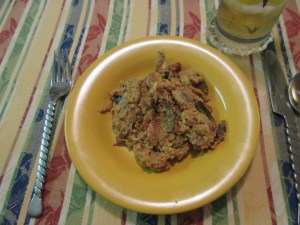
finished black beans and eggplant

Ahi Tuna with Black Beans and Eggplant Dish  Yields: 4 servings.  Total active prep time: 1 1/4 hr.

6 tbsp oil  (Avocado oil is best, coconut oil will do; olive oil produces carcinogens when heated to high temperatures.)

1 med yellow onion, halved and cut in 1/8 inch slices

1 lb eggplant

1/4 c water

3 tbsp lemon juice, fresh squeezed  (2 small lemons needed.)

4 tsp salt, or to taste  (Himalayan, pink, or Real Salt is critical for optimum health; a fine grind Himalayan salt is available at Costco for $4.95 for 5 lbs.)

2 tsp fresh ground pepper, or to taste

5 lg cloves of garlic, minced  (3 frozen cubes of garlic from Trader Joe’s makes preparation easier.)

1-15 oz can of black beans  (Organic is best; Simple Truth brand at our local Fred Meyer’s is very economical.)

2 tsp crushed dried red pepper

2 tsp garlic powder

2 tsp dried ginger

2 tsp dried oregano  (Organic is available for $1.99 at Trader’s!)

4 ahi tuna steaks, or about 1 1/3 lb

1 tsp sesame oil

  1. fond on bottom of pan of eggplant

    For caramelizing onions, halve onion and cut into even 1/8″ slices.  Heat 1/2 tsp oil in a large sauté pan over medium heat; place a small piece of onion in oil; when it sizzles, add rest of onion and turn heat down to med/low (do not crowd your pan with too many onions, or they will steam, producing water, and it will take longer to cook them). Cook, stirring about every two minutes, until color begins to change.  At this point, stir every minute, until dark brown in color.  Onions should cook long enough to stick to the pan, in order to brown, but not be left so long that they burn; you may have to lower temperature and add a little more oil.  When cooking is complete, deglaze pan with a little water, stock, wine, or vinegar.  Meanwhile go to next step.

  2. Cut eggplant in small 1″ cubes, set aside.
  3. Roll lemons on counter, pressing down hard with your hand to loosen juices.  Juice lemon and set aside 3 tbsp.
  4. If using fresh garlic, mince now.
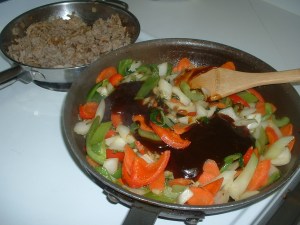
  5. In another large pan, heat 1 1/2 tbsp oil in pan; place piece of eggplant in oil; when it sizzles, add rest of eggplant.  Cook until soft, stirring frequently; then, add 1/4 cup of water and deglaze pan (scrape bottom with a wooden or heat resistance plastic spatula to loosen cooked on fond, see photo).  Cook until water is evaporated; this vegetable will be rather mushy.
  6. Stir in onions, lemon juice, and garlic; salt and pepper to taste.  If garlic is fresh, cook only until you can smell it; see Tomato/Feta Chicken-2016/07/25-for tips on cooking with garlic.  If using the frozen cubes, cook just until melted and blended in well.
  7. Gently stir in the can of black beans, which has been drained; do not over-stir, as this breaks down beans.  Adjust seasonings.  May set aside to finish just before serving.  If serving immediately, proceed to step 8, in which case turn down heat to med/low under eggplant (see photo at top of recipe for finished product).
  8. If finishing later, began this step 15 minutes before serving time, otherwise proceed now.  Blend together 4 tsp salt, 2 tsp fresh ground pepper, dried red pepper, garlic powder, ginger, and oregano; rub seasoning into tuna steaks.  (If bean mixture is cold, begin reheating it for 8-10 minutes over medium heat before sautéing tuna, stirring occasionally.)
  9. Melt 4 tbsp oil and 1 tsp sesame oil in a large sauté pan over med/high heat (this must be a heavy-bottom pan).  When oil is sizzling hot, sear steaks 2 minutes per side for med/rare, give or take 1/2 minute for rare or medium.  The time may need adjusting as thickness of steaks varies; you can check the color of tuna, by piercing thickest part of fish with a sharp knife to check for doneness (it should be somewhat red for med/rare).  The color will also show on the sides of the steak.  Do not overcook tuna.
  10. Serve with caramelized onions and carrots (next week’s post).  Enjoy!

Ensalada Iberica

ensalada Iberica

Ensalada Iberica is the perfect accompaniment to last week’s Portuguese pork, because of its sweet base of oranges and dates, along with an abundance of piquant onions and lemon-vinaigrette.  This quick salad pleases our palettes.  Its strong combination of complimentary foods is additionally enhanced with the spice coriander, which is also a “seasoning match made in heaven” for pork, as noted by Andrew Dornenburg and Karen Page in Culinary Artistry.  Thus these two dishes balance each other, resulting in excellent flavors and joy unspeakable.  1

During the 1980’s, my extensive cooking classes in Montana included a group of twelve professionals, all of whom were friends.  For years they came monthly for each new theme I presented.  We grew to love each other, as I taught them easy steps in making glorious food.  A grieving took place at our parting, brought on by my decision to move to Portland in February of 1986.

My strongest fan among them, Larry, organized a going-away party for me.  He chose an upscale Chinese restaurant, since a travel agent in the group had hoped to take me to China, to teach native foods on one of her tours.  At our celebration, they graciously presented me with a restaurant-caliber, 15 ½” x 10 ½” cake pan and a stock pot, as seen in my photos; how these have blessed my work.

At one of our classes, someone encouraged me to consider the then new concept of computers for my work.  I responded that I will never do that, for it was beyond me.  Technology, however, has enabled the expansion of my endeavors beyond my imagination.

Back then I wrote everything out by hand, as I constantly discovered new themes from various cultures and ages.  All my research came from hard copies of books and publications; I searched for the sources of my inspiration at the local library, in an array of cook books, and in such publications as Montana newspapers, the New York Times, and numerous fashionable magazines.  My existence was marked by creativity, as I developed my faculty for research.  This skill was further sharpened by my graduate work at Portland State University, 1988-91.

Discovering truths in food history is what I do; it is essential that I know their validity.  As a result, to this day, I prefer to obtain my information from actual books, which possess a soundness that I trust, over that of internet.

Both this and its subsequent post, on Portuguese foods, are from that early application of my studies in Montana.  These entries provide exceptional taste treats.  Enjoy!

  1. Andrew Dornenburg and Karen Page, Culinary Artistry (Hoboken, N.J.: John Wiley & Sons, Inc., 1996), pp. 159, 160, 268.

chopping orange segments

Ensalada Iberica  Yields: 5-6 servings.  Total prep time: 25 min.

Note: best to make and chill several hours before serving.

2 lg oranges  (Organic is best for flavor and quality, as orange skins readily absorb pesticides; these are often available at a good price at Trader Joe’s.)

1 small/med red onion, thinly sliced  (May use 2 small, organic cipollini onions; they are expensive, but so good!)

1 small can sliced ripe olives, net dr. wt. 2.25 ounces

1/2 c pitted dates, packed down, cut in halves lengthwise  (About 1/3 lb is needed.)

1/4 c olive oil

1/4 c lemon juice  ( 2-3 small lemons are needed.)

3/4 tsp salt, or to taste

1/4 tsp fresh ground pepper, or to taste

1/4 tsp ground coriander

Bed of spinach leaves or lettuce

  1. easy juicing of lemons

    Peel oranges, divide them in half, cut each half cross-wise in half again, so it is easy to separate segments (see photo above).

  2. Peel and slice onions thinly.
  3. In medium bowl, combine oranges, onions, olives, and date halves.
  4. Juice lemons with a hand-held juicer, watch market for this marvelous tool (see photo).
  5. Combine olive oil, lemon juice, salt, pepper, and coriander in a small sealed jar; shake vigorously; adjust seasonings.
  6. Pour over fruit, mix well, and refrigerate until serving time-preferably for several hours-so flavors can meld.
  7. Serve on a bed of spinach leaves or lettuce.
  8. This is a favorite of mine, which I have made since the early 1980’s.

Gingered Bok Choy with Ground Turkey

gingered bok choy with ground turkey

gingered bok choy with ground turkey

Today’s recipe, with its Chinese flair, is easy to follow, though it takes some patient chopping of vegetables. (The process of this preparation flows, especially after the first time you make it.)  My dish is low in carbohydrates, vitamin-proficient, and has an inexpensive, high-quality protein. Abundant health and pleasure result!

The inspiration for it grew in me.  Recently I was influenced by Chef Susanna Foo. She Americanized her Chinese cuisine by substituting our everyday ingredients, for their Oriental counterparts, which were challenging to get in the 1990’s.  Foo discovered that these simple adjustments actually enhanced her cooking; thus I chose apple cider instead of rice vinegar and, for heat, jalapeno instead of Szechuan peppers.  1

My palette was also crying for orange juice in the mix.  I added to these surprises typical Chinese ingredients: ginger, garlic, soy sauce, sesame oil, coriander, and bok choy, which is a Chinese cabbage from Brassica rapa-the same species that gave us the turnip.  Note: the spice coriander is common to Chinese, Indian and Mexican cooking; its fresh leaves are known as cilantro-see Munazalla, 2018/03/12.  The glorious blending of these foods thrilled me!

My whole family acquired the cooking gene, a rich inheritance received from our parents. However the grander bequest was that of their love: Mom and Dad cherished one another in a steadfast, unspeakable way.  This security has always belonged to our entire family.  It has never weakened, no matter what, for even death has not separated my parents.

My father went to heaven on November 16, 2006, but I contend that my mother enjoys his presence even more now.  At 93, she sits in Buzzy-baby’s chair and eats ice cream with him.  She joyfully informs me, when I call, that he is letting her finish his share too, as he always did while he was alive.

My parents each possessed individual attributes that allowed for their earnest commitment: my father had a beautiful heart and my mother unshakable faith. Over the years, I have declared that my greatest heritage of all comprises of these two qualities.  These endowments, along with the cooking gene, set the stage for all I get to do in this world.  They have formed me, for I am a food historian in love with my God.

This legacy of devotion and faith is more precious than gold.  My inherited strong heart, powerful faith, and ability to cook, all three, propel me into this marvelous, God-given destiny.  Give me pots, pans, and ingredients and heaven-sent food results.  My meals excite all your senses.

Now I encourage you: look to your life; discover your unique inheritance (your intrinsic gifts); go forward with them.  Indeed your birthright was ordained before time began.  In the meantime try my recipe!

  1. Andrew Dornenburg and Karen Page, Culinary Artistry (Hoboken, N.J.: John Wiley & Sons, Inc., 1996), p. 211.
assembly of gingered bok choy

assembly of gingered bok choy with sauce

Gingered Bok Choy with Ground Turkey  Yields: 5-6 servings.  Total active prep time: 1 1/4 hour.

7 tsp oil  (Coconut or avocado oil is best for sauteing; olive oil produces carcinogens at high temperatures.)

1 med/lg yellow onion, halved at the root and cut in even 1/8″ slices

2 carrots  (Organic carrots are very inexpensive; find them in 1 lb packages at Trader Joe’s.)

2 stalks of celery

l lg red bell pepper  (It is important to use organic bell peppers, as this vegetable really absorbs pesticides.)

1 lb bok choy  (Organic bok choy comes in smaller heads; weigh before purchasing.)

1 lb ground turkey  (Natural is important; Foster Farms is reasonably priced and good.)

4 tbsp fresh ginger, peeled and chopped fine

1 lg jalapeno pepper, minced small  (May use more for a hotter dish.)

5 large cloves fresh garlic, or 3 cubes frozen garlic  (Frozen garlic is available at Trader Joe’s, it provides ease in cooking, especially excellent for this recipe.)

1/3  c organic tamari  (May substitute soy sauce, but not as healthy or flavorful; tamari is available in the health section at Fred Meyer’s, or at other national chains such as Whole Foods.)

1/3 c apple cider vinegar  (Raw is the best; inexpensive at Trader’s.)

1/3 c orange juice  (May squeeze your own, or use orange juice that is not from concentrate, such as Florida’s Natural or Tropicana’s.)

1/4 c water

1 tbsp sesame oil  (This is found at a good price at Trader’s.)

1/2 tsp ground coriander

1/4 cup corn starch, dissolved in 1/4 cup cold water

Steamed rice  (I personally prefer brown basmati.)

  1. Heat 1/2 tsp of oil in an large saute pan over medium heat.  Add a small piece of onion; when it sizzles, oil is ready.  Add remaining onions and caramelize, by stirring every several minutes, until color starts to form; then, stir every minutes, until dark brown.
  2. Meanwhile cook turkey in a extra large frying pan.  Place in a bowl.
  3. Clean all vegetables, except ginger, with an inexpensive effective spray (a mixture of  97% distilled white vinegar and 3% hydrogen peroxide); let sit for 3 minutes and rinse extra well.  Set aside.  While waiting for vegetables, start cooking rice.
  4. Peel and mince ginger in very small pieces, set aside.
  5. Chop garlic fine, if using fresh, set aside.  (Frozen garlic from Trader’s works better with this recipe.)
  6. When onions are caramelized, add cooked meat to them, and turn off heat.  Note: you will reuse this extra-large pan for cooking the vegetables.
  7. Dissolve corn starch in 1/4 cup cold water, set aside.  Next slowly heat garlic, tamari, vinegar, orange juice, water, sesame oil, and coriander in a small saucepan over med/low heat.  It will take about 15 minutes for light bubbles to rise in liquid.  Meanwhile go to next step.
  8. Prepare carrots by scraping with a knife and thinly slicing at a diagonal. (Scraping, rather than peeling, preserves vitamins just under the skin.)  Cut celery in 3/4″-wide diagonal pieces.  Place carrots and celery in a bowl, set aside.
  9. Chop pepper in 3/4″ x 2 1/2″-wide strips.  Place in another bowl with bok choy, which is chopped in strips the same size as the pepper, including greens.  Set all aside.
  10. Heat remaining 1 1/2 tbsp oil in the extra-large pan.  Place a small piece of carrot in oil, wait for it to sizzle.  Also turn heat on to med/low under pan of meat/onions.
  11. Add carrots, celery, and ginger to hot oil.  Stir well to coat vegetables with oil.  Cook 3 min, stirring occasionally.  Add bok choy and pepper strips, mix well with carrots.  Cook for about 7 minutes, or until vegetables are done, but still crisp.  Be sure to stir frequently.
  12. The liquid sauce should be forming light bubbles by now; add the cornstarch, which is thoroughly dissolved in water; beat constantly with a wire whisk.  It thickens quickly.  Remove from heat when thick and clear. (This takes only about 15 seconds.)  Set aside
  13. Mix together: hot meat, finished vegetables, and sauce.  Serve immediately with steamed rice.  This pleases the palate!

Sauteed Squash with Curried Yogurt Sauce

sauteed squash with curried yogurt sauce

sautéed squash with curried yogurt sauce

This history-which follows-came to me, when a beloved friend asked me to concoct this recipe for sautéed squash; she fell in love with its original at an excellent restaurant, while traveling.  Goldie longed to enjoy repeats of this masterpiece, without having to leave the Portland area; thus, she trusted my expertise to supply her this powerfully good recipe-thanks to another chef’s inspiration!

This whole process made me aware that we need each other’s expertise; thus, we lend our strengths to one another in order to break through circumstances-both in the kitchen and life. This exceptional combination started in the mind of an adept chef, but I built on it using my own approach.  In turn, I encourage you to take it to your worlds, by innovating yet further.

None of us wants to miss playing out our foreordained part!  I loved acting in community theatre in days past.  Here I learned that there are no small actors, just small parts.   The eye can’t say to the nose I have no part in you, or where would the sense of smell be in the body.  In this manner, we can’t fulfill our destinies without each other’s help, while always remembering that every “body part” is critical.  We don’t want to forfeit, even by default, any of our precious chances to give or receive support.  This way we discover our life-purposes.

James Trager has been all that for me in my writings.  With a mind like mine for detail, he offers a feast of food history information in The Food Chronology.  His work equips me with an abundance of needed facts, to effect my God-given calling.

For instance he has four entries on squash.  The first dates back to 1527, when conquistadors returned to Spain with facts about New World foods.  They reported that the Aztecs consumed squash and beans among numerous other delicacies, such as: white worms, eggs of water bugs, and domesticated guinea pigs.  These tamed animals were eaten with the skin on-the hair being removed as with a suckling pig.  (Note: while studying food in 1985, I was offered guinea pig in Peru, one of the lands the conquistadors conquered in the 16th century.)  1

Next, Trager takes us to Virginia in 1588.  Then English mathematician Thomas Hariot wrote that these Virginia fields were planted Indian-style with squash, maize, beans, and melons.  However he noted they yielded five times more than the same acre in England.  2

I take this chance to build on Trager’s house: this New World area, nearly two centuries before the forming of America, was called Virginia, a word from the Latin virgo (stem virgin).  The land was named after Queen Elizabeth I, who was queen of England and Ireland (1558-1603).  She was known as “the virgin queen”; thus, this virgin land became Virginia.

Finally, our illustrious historian Trager details the early public appearances of spaghetti and calabaza squash in the United States.  The first, resembling spaghetti, was introduced in 1962 by a specialty produce company in Los Angeles.  3  Then, when Miami’s Grand Bay Hotel opened in 1982, Jamaican-born Chef Katsuo Sugiura had a loin of lamb among his specialties.  He smoked this over oolong tea and hickory chips; Sugiura served it with calabaza squash, grilled Portobello mushrooms, and yuca.  4

I love to share the bread of life through my recipes and words.  As you can see, my act of creating is so dependent on the works of others.  Now may you expand this, my fire, in your lives-both inside and outside your kitchens.

  1. James Trager, The Food Chronology (New York: Henry Holt and Co., 1995), p. 88.
  2. Ibid., p. 104.
  3. Ibid., p. 569.
  4. Ibid., p. 660.
preparing squash

preparing squash

Sautéed Squash with Curried Yogurt Sauce Yields: 3-4 servings.  Total prep time: 3/4 hr.

3 tbsp butter

2 tsp fresh ginger, peeled and chopped fine  (I have also substituted 1/4 tsp dried ginger, but fresh is better.)

1/2 large apple, peeled and chopped in very small pieces  (I prefer granny smith apples here, but not necessary.)

1/4 tsp curry powder

2 tsp honey

1/2 cup plain yogurt  (Nancy’s Plain with Honey is good; Stoneyfield organic plain Greek yogurt is even better.)

1/4 tsp salt, or to taste  (Real Salt is important; available in health section of local supermarket.)

1 lb butternut squash, peeled and sliced in 1/4″-wide strips

Roasted almond slices for garnish, optional  (May roast nuts ahead of time at 350 degrees for 10 minutes.)

  1. Put a serving platter in a warm oven.
  2. Melt 1/2 tbsp of butter in a small saucepan over medium heat.  Add ginger, apple, curry powder, and honey; sauté until fruit is soft; stir frequently. Remove from heat, add yogurt immediately, season to taste with salt.  Set aside.
  3. Meanwhile peel squash with a sharp knife.  Remove any seeds.  Place flat side of halved squash on counter and cut in 1/4″-wide slices; cut these slices into equal sized strips.  (See above photo.)
  4. In large frying pan, heat 1 1/2 tbsp of butter over med/low heat, until a small piece of squash, which is placed in it, sizzles.  Sauté as many strips in hot butter as will fit in pan; cook for about 4 min per side, or until soft and golden brown. Remove cooked pieces to warm platter and keep in oven.  When this batch is finished, add another 1/2 tbsp of butter to pan and repeat this step, until all the squash is done.
  5. Pour yogurt sauce on hot squash, garnish with optional almond slices, and serve.  Be prepared for joy unspeakable!

Thai Coconut/Lime Flounder

Salad with leftover Thai flounder

salad with leftover chilled Thai flounder

This delicious white fish dish resulted from a long-awaited-for marriage, which took place in my church in October.  A feast at my bountiful table was part of my wedding present to our venerated couple.

Our bride Dina was particularly interested in learning how to cook, with ease, for her new groom.  My bright idea was to begin my dinner gift in the kitchen with teaching her how to make the meal.  I prepared all the steps, just like you might see on a cooking show: the ingredients were set out in small individual dishes, along with the corresponding pans and utensils. All was in place for the lesson to flow naturally.

My priceless inheritance from my parents was a gene that “knows” food. Therefore I intuitively conceived this delicious dish, which was specifically geared for her husband’s dietary needs.  An exquisite, ultra simple recipe resulted.

Surprise and hesitancy occurred upon my friends’ arrival, as I informed Dina that she was going to make dinner, under my close direction.  She, being true to form, rolled up her sleeves with courage.  Her nervousness soon dissipated, for the facility of my simple instructions comforted her.  Joy unspeakable resulted: a chef was born! I have observed, as an aside, that this woman approaches all of life’s challenges with this same spirit.

Are you timid about stepping into the unknown, either in or out of the kitchen? May you receive encouragement to advance in faith; start by trying my recipes. They look lengthy at times, but are effortless!  The cause for this seeming protractedness is my inclusion of practical details, which make food preparation easy and enjoyable.  You’ll sense that you are in  cooking school, when you use my receipts, as I teach at every point.  Rest assured-I will educate you for the joy of cooking.

My favorite way to serve this smooth flounder, with its slight bite, is over a good pasta (however I used rice for my newly weds); either will bless the taste buds. Also, cold leftovers of this fish top off a salad superbly.

This feast pleased Dina and Dale; and me as well!

Thai coconut lime flounder dinner

Thai coconut/lime flounder dinner

Thai Coconut/Lime Flounder  Yields: 4 servings.  Total prep time: 40 minutes.

Note: flounders closely relate to soles; thus, you may substitute any sole here (also see Parmesan Dover Sole, 2017/03/27).

1 tsp coconut oil  (Other oils will do, but coconut is best for flavor and quality here.)

1 med yellow onion, halved at the core, and cut in even 1/8 inch slices

1 lime, juiced

7 oz Extra Thick Coconut Cream, or half of a 14 oz can  (This is available at Trader Joe’s.)

3/4 tsp dried, crushed red pepper  (Save spice jars and refill yearly with fresh, inexpensive “bulk’ spices.)

1/4 tsp salt

4 fillets of flounder, approximately 1 pound  (Wild-caught is best; may substitute a pound of sole, which is a close relative to flounder.)

Steamed rice or pasta, regular or gluten-free

  1. beginning stages of caramelization

    Start cooking rice, according to directions on package.  If using pasta, begin boiling water in a big pot; to which you add 2 tsp salt and 2 tbsp oil-any kind of oil will do.

  2. Place 4 individual dinner plates in oven; set the temperature on warm.
  3. Heat oil in a large sauté pan over med/low heat; stir in onions well; caramelize, by stirring every several minutes until they start to turn color (see photo); then, stir every minute until dark brown (see photo below); watch carefully while going to next steps.  (Do not crowd pan with onions, or they will sweat, taking much longer to cook.)
  4. Meanwhile roll lime on counter; press down hard with your hand, until the meat of the fruit is broken down and softened; juice lime; set aside.
  5. Place whole can of coconut oil in a small storage container; be sure first to gently stir milk and cream together thoroughly in can (this prevents a mess when emptying the can).
  6. Add half of the coconut cream (7 oz), lime, red pepper, and salt to caramelized onions.  Stir well and slowly bring to a soft boil over medium heat.  If preparing for guests, you may choose at this point, to set aside coconut/onion mixture and heat it 15 minutes before serving.  If you are waiting, be sure to have the plates warm, rice cooked, or water boiling when you start to cook the flounder.  (Note: you can freeze leftover coconut cream, or use within a week.)
  7. caramelized onions approaching finish

    Start cooking pasta in boiling water about 10 minutes before dinner time. Boil until it is al dente, about 7 minutes, do not over cook. Drain and place on heated dinner plates when done.

  8. Meanwhile add two fillets of flounder (more if using smaller sole) to hot coconut cream/onion mixture, which has been heated over medium temperature.  Poach briefly on each side, only until color in center is opaque.  Do not overcook.  Remove to heated dinner plates, on which you have placed pasta or rice.  Repeat this step with the remaining fillets.  Cover with sauce.
  9. Serve it forth!

A Simple “Frittata”

dinner with Dave

dinner with Dave

My pastors provide our congregation with fruits of their labors during the harvest season; this year’s bumper crop of tomatoes and zucchini inspired Pastor Dawn to create this frittata-like dish, which I have expanded on here. It boasts of these rich autumn vegetables. The receipt is so easy that it cries out for many encores.

The traditional frittata, or Italian omelette, has a two-stage cooking process.  You normally begin making this egg dish on the stove top and finish it in the oven. One may even purchase special pans for preparing this.  However my simplified version is made in a frying pan, solely on top of a burner.

The original frittata is a cross between an omelette and quiche, which is comprised mostly of eggs with some vegetables.

"frittata"

“frittata”

On the contrary, my “frittata” is mostly vegetables with several eggs scrambled in.  There is no guessing with these easy steps of preparation. The result is intense flavor, good protein, and creative cooking with fall produce.

My beloved cousin and his wife, whom I hadn’t seen since 1995, were here for dinner several weeks ago.  We indulged in this European creation and my honeyed-lime kale with turkey. (See Cooking with Kale, 2016/09/07.) The presence of God and this delicious food nourished our souls during our lavish repast.

You will relish this “frittata”-it is so good!  Enjoy.

A Simple “Frittata”  Yields: 4-6 servings.

1 tbsp oil  (Coconut or avocado oil is best.)

1 med yellow onion, halved at the core and thinly sliced

3 med/large tomatoes cut in eighths

2 med/small zucchinis, thinly sliced

½ tsp dried oregano  (A great, inexpensive, organic variety is available at Trader Joe’s.)

3/4 tsp dried basil

4 lg cloves of garlic, minced  (May use 2 cubes of frozen garlic from Trader’s.)

Salt and pepper to taste  (Real Salt is best, available in health section of local supermarket.)

4 lg white mushrooms, brushed, with mushroom brush, and sliced

3 oz good quality cheese, grated

3 lg eggs, beaten  (I like to use duck eggs, which are creamier and higher in protein.)

  1. Heat oil in a large frying pan over medium heat. Place a small piece of onion in hot oil. When it sizzles, add the rest of the onions.  Cook until golden brown; stir occasionally.
  2. Add chopped tomatoes, zucchini, herbs, garlic, salt, and pepper. Reduce heat to med/low. Cook vegetables about 40 minutes, or until liquid is gone and sauce is thick. Be sure to stir occasionally. Watch carefully toward the end of cooking, so vegetables don’t burn.  (May set aside at this point and reheat, to finish recipe, just before serving.  Watch carefully when reheating, so as not to burn the sauce.)
  3. Add mushrooms and cheese to hot sauce. Stir well.
  4. Add eggs to vegetables; stir gently several times, as they cook. Cook until eggs are done. Mixture will be soft.
  5. Adjust seasonings.
  6. This is delicious served hot, room temperature, or ice cold.  Leftovers are great!

Cooking with Kale

Honeyed Lime Kale with Ground Turkey

honeyed/lime kale with ground turkey

This series displays my relaxed creations with greens.  A close friend from my church blesses me with an abundance of fresh produce from her organic garden; I am wowed by its bountiful beauty.  She grows several species of kale; thus, I am always creating new recipes incorporating this health-giving vegetable.

Here I spell out detailed steps of preparation for cooking this green.  It’s easy to follow these directions.  Vibrant health results!

My recent series of posts on 19th century French foods defines Classic French Cuisine (see Chicken a la Oignon, 2016/07/04, Carrots au Beurre, 2016/07/11 and Meringues a la Ude, 2016/07/18).  These posts expound on that culinary period following the French Revolution in 1775.  The main cooking procedure in my kale series is sautéing, which originated during this culinary age.

Cooking methods changed at the end of the 18th century, as Esther B. Aresty described in The Delectable Past: fireplaces gave way to ranges with built-in ovens; French cooks quickly invented the sauté pan.  The word sauté means to jump-when the fat “jumps” in the pan it is ready for cooking. 1

Here I give instructions for employing this cooking method properly.  First heat the oil; then, add a small piece of food.  It is time to begin sautéing, when it sizzles or “jumps” in the pan.  This allows swift frying of food for optimum preservation of nutrients, as it inhibits the overcooking of vegetables and meats.

The following, easy recipe brings proficiency with cooking nutritious kale.  Next week I will share a shortcut, where this procedure is simplified even further, with prepared sauces and/or meats.

I pray this dish brings the same pleasure to you as it does me.  To our health!

  1. Esther B. Aresty, The Delectable Past (New York: Simon and Schuster, Inc., 1964), p. 126-127.
  2. https://en.wikipedia.org/wiki/Saut%C3%A9ing
Food processor assembled with wide-blade, chopping attachment

optional food processor assembled with straight-edged, chopping attachment

Honeyed/Lime Kale with Beef or Turkey  Yields: 4-6 servings.  Prep time: 1 1/4 hours.

2 tbsp oil  (Coconut oil is best here for quality and flavor; olive oil is carcinogenic, when heated to high temperatures.)

1 med yellow onion, halved at root, and cut in even 1/8 inch slices

1 lb ground turkey or beef  (Natural is best; Foster Farms’ natural ground turkey is inexpensive.)

Generous amounts of salt and pepper  (Himalayan, pink, or Real Salt is critical for optimum health; an inexpensive fine grind Himalayan salt is available at Costco.)

1-1  1/2 lbs of fresh kale  (Organic is best.)

4 carrots, thinly sliced at a diagonal  (Organic carrots are very inexpensive.)

Juice of 2 limes

2 tbsp honey

avocado, cut in thick slices

  1. beginning stages of caramelization

    Heat 1 teaspoon oil in a frying pan over medium heat, until a small piece of onion sizzles in pan; lower heat to med/low; add the rest of onions and caramelize-cook until dark brown.  Stir every two minutes, until color starts to form (see photo); then, stir every minute until dark brown.  Be sure to watch carefully, while going to next steps.

  2. Place 2 teaspoon oil in large saute pan, over medium temperature; test for readiness by putting a small piece of meat in hot oil; the temperature is right when it sizzles or “jumps”.  Add rest of turkey; salt and pepper heavily, before browning.  Set aside in a  bowl when cooked; save pan for cooking vegetables.
  3. Meantime spray carrots and kale with produce spray (a mixture of 97% distilled white vinegar and 3% hydrogen peroxide is a safe, cheap, and effective cleaning solution).  Let sit three minutes; rinse well in a sink full of water three times.
  4. May cut stems out of wet kale and chop into small bite-size pieces by hand-this is time-consuming.  Better yet prepare it with a food processor by using the straight-edged, chopping attachment.  (This is the large, round disk that fits onto the provided “stem”; place this tall, assembled cutting disk in the food processor where you normally put the smaller blade; see photo at top of recipe.)  If using a food processor, it is not necessary to cut stems out, but be sure to carefully pick out pieces of stems, after processing.  Set aside chopped kale.
  5. caramelized onions at mid-point

    Scrape cleaned carrots with a sharp knife (this preserves the vitamins just under the skin); slice carrots thinly at a diagonal; set aside.

  6. Heat lime juice and honey in a small saucepan, just until blended, set aside.
  7. Heat 1 tablespoon of oil over medium heat in the large saute pan; when a piece of carrot sizzles in hot oil, add carrots and cook for 2 minutes.
  8. Add 1/2 the kale, distributing the oils well and checking again for any pieces of stem left from processing.  Cover pan and cook kale down; repeat this step with remaining kale, when there is room.  Cook covered for 10 minutes, or until kale is totally limp, stirring occasionally.
  9. When onion is caramelized, mix this and meat into cooked kale; blend in the honeyed/lime juice; adjust seasonings.
  10. Enjoy topped with fresh avocado slices.


Sprouted Quinoa and Yam Salad


sprouted quinoa and yam salad

sprouted quinoa and yam salad

Sherry, my beloved friend from Montana, sent me this healthy recipe, which I improved on.  It literally sings in your mouth!

I learned about quinoa from a woman who healed terminal illnesses with food; she was on my sister’s prayer team many years ago.  People from all over the United States were going to Jeanette for her healing ministry with diet; thus, her culinary wisdom became a gold mine for my sister Maureen and me.  Many things that I now recommend originated with her.

We learned that sprouted quinoa was considered the number one power food on planet earth.  Eggs and quinoa are the only foods that have all the amino acids, thus making them a complete protein.

I was a vegetarian for six years in my twenties.  Back then, much of my knowledge for healthy eating came from the marvelous cookbook by Francis Moore Lappe, Diet for a Small Planet (New York: Ballantine Books, 1971).  These recipes utilized balanced combinations of plant foods and dairy; the combining of their differing amino acids complimented each other to make complete proteins.  For instance, its memorable Indian Pudding called for a balance of cornmeal, soy grits, milk, and eggs to form a strong protein; how I relished it hot, with rich vanilla ice cream melting around the edges, and I still do.

I was quite skilled in cooking this way in the 1970’s.  Just prior to moving to Tokyo in the fall of 1981, however, I began eating meat once again.  My father gently reproved me, for waiting until this move to do so, because beef was exorbitantly expensive in Japan, while being relatively cheap in America.  My thinking was that  I needed to be prepared for gracious Oriental hospitality.

Recently I made my friend Sherry’s simple recipe for quinoa and yam salad; nevertheless, I tweaked it.  Its food value is amplified by using what I learned from my sister’s prayer partner, the healer Jeanette.  Here I sprouted this ancient grain from Peru, which increases its food value dramatically.  Also I worked with the colors of the foods (color is real important); I incorporated red raspberries, purple sweet potato, and orange carrots.  Another important recommendation is the use of coconut or avocado oil, which is critical, as olive oil is a carcinogenic when heated to high temperatures.

This healthy salad is dynamite!  Make an abundance of it for leftovers.

To learn the differences between sweet potatoes and yams, go to African Nkyemire; for another great recipe using this tuber, go to Sweet Potato Pie, 2016/12/19.

Sprouted Quinoa and Yam Salad  Yields: 4 servings.  Total prep time 2 days (for sprouting quinoa)/  active prep time: 1 hr.

1 c quinoa, sprouted  (Sprouting directions are below; make 2 days ahead.)

1 tsp oil  (Coconut or avocado oil is best; olive oil is carcinogenic when heated to high temperatures.)

1 med yellow onion,  cut in even 1/8-inch slices

1 1/2 c yams, peeled and cut in 5/8-inch cubes  (Organic purple sweet potatoes are ideal; sweet potatoes and yams are just differing names for the same vegetable; they are interchangeable.)

2 med carrots, cut in 5/8-inch cubes

2 stalks celery, cut in 5/8-inch cubes

4 lg garlic cloves, chopped fine  (For easy preparation, may use 2 frozen garlic cubes from Trader Joe’s.)

2 tbsp freshly squeezed lemon juice

1 tbsp Bragg’s Amino Acids  (Available in any health store.)

1 tbsp real maple syrup

3/4 tsp dried cumin

Spinach or lettuce leaves

Fresh raspberries or dried cranberries, for garnish

Agave-roasted nuts  (See recipe in ‘Healthy Green Salads’, 2016/08/15.)

  1. Soak quinoa in ample water for 8 hours; drain well and let sit for 1-2 days, rinsing about every 8-12 hours.  The sprouting is complete when legs are at least 1/4 inch long.  (The sprouting may be done in a special sprouting jar, a bowl, or on a tray-if your choice is a tray, use parchment paper both under and on top of the grain.)  Note: this process brings the enzymes alive and increases food value dramatically.  For more details on sprouting see wikihow.com/Sprout-Quinoa
  2. For saving sprouted quinoa, place it in a sealed storage bag or jar, and refrigerate for up to 2 weeks.  Optional: if you are not ready to use the sprouts immediately, you may, with the use of clean parchment paper, spread them on a tray or large plate, to allow excess moisture to dry from sprouts (be sure not to rinse again before you start this drying process).  They should dry in about 12 hours; this aids in long-term storage.
  3. Heat oil in a large frying pan over med/low heat; add onion and caramelize, cook slowly until deep brown in color.  Stir every few minutes until onions begin sticking to bottom of pan and color just starts to turn; then, stir every minute, until dark brown.  For more detail on caramelizing onions, see Caramelized Onions and Carrots (2017/06/19).
  4. In the meantime, spray vegetables with an effective, safe solution (combine 97% distilled white vinegar and 3% hydrogen peroxide in a spray bottle); let sit for three minutes; rinse really well.  This kills parasites and cleanses inexpensively.
  5. Rather than peel carrots, scrape them with a sharp knife, to preserve vitamins just under the skin.  Peel yams.  Cut all vegetables into small, 5/8-inch cubes, set aside.
  6. Combine lemon juice, Braggs, maple syrup, and cumin in a large bowl; set aside.
  7. Add vegetables to hot caramelized onions; stir well to distribute oils.   Place 1/4 c water in with vegetables and cook covered, over medium heat,  for about 15 minutes, or until yams are tender, stirring occasionally.
  8. Blend fresh garlic into vegetable mixture; sauté only until you can smell the herb, about 20 seconds (if you are using frozen garlic, cook just until it thaws, stirring well).
  9. Place yam mixture and quinoa in bowl with salad dressing, mix well, chill several hours.
  10. Serve on a bed of lettuce or fresh spinach.
  11. Top with fruit and nuts.

Tomato/Feta Chicken

Tomato/feta chicken

tomato/feta chicken

An explosion of creativity occurred in my sister’s upscale kitchen this month: my siblings and I collaborated over one of my recipes during a trip home for my mother’s 93rd birthday.  Our three strong cooking minds worked together to perfect a dish I created years ago.

Nearly a decade has passed since I helped a friend every Monday, for she was bogged down in her professional responsibilities.  Aromatic ailments filled pots and pans, as I prepared her family’s nourishment for each upcoming week.

This particular friend had been to cooking school in Italy; her excellent input and feed-back sharpened my skills, while I was helping her family.  At her home, I created this recipe for tomato/feta chicken, which my siblings Maureen and Paul helped perfect recently.

One thing I learned from my friend was to add the garlic at the close of the sautéing process; she said this keeps it from burning.  I was adding it before this, as I was cooking the meat.  My friend’s ingenious tongue could taste the burnt garlic; thus, she suggested that I add it at the very end, which is how I had cooked with this herb since.

However, my siblings suggested that adding it early on allows for more flavor.  My brother explained the proper process: when you add garlic, while sautéing, cook only until you can smell it; then, immediately add the liquid for the sauce, to keep it from burning.

My sister employs an even more advanced method: she roasts lots of whole peeled cloves on a cookie sheet, in a preheated 300 degree oven, for at least an hour (or until golden brown). She stores this in the refrigerator, adding about three tablespoons per four-serving dish, while the dish is cooking-only cook briefly, however, if dish is dry.

After tasting our finished work, I am sold on cooking this herb longer, employing these safe ways.  The following recipe reflects this new directive; here the fresh garlic is cooked for a lengthy time in the wet tomatoes.

There was another point I learned from my siblings’ expertise.  Both urged me not to bother with washing pieces of cut meat; it is only necessary to clean the inside of the carcasses of fowl, where blood has collected.  This has made cooking easier for me.

This tomato/feta chicken recipe is exceptionally good; enjoy it!

Tomato/Feta Chicken  Yields: 4-6 servings.  Total prep time: 1 1/4 hr.

1 med/lg yellow onion, halved and cut in even 1/8″ slices

5 tsp oil  (Coconut or avocado oil is best, as olive oil is carcinogenic when heated to high temperatures.)

8 chicken tenderloins, thawed in water  (The frozen ones at Trader Joe’s are all natural and a good price.)

Salt and pepper to taste  (Himalayan, pink, or Real Salt is critical for optimum health; a fine grind Himalayan salt is available inexpensively at Costco.)

4 ripe tomatoes, chopped  (These must be ripe; organic is best.)

3/4 tsp dried oregano  (Organic is available at Trader’s; it is of excellent quality and very inexpensive.)

1 tsp dried basil

3-5 lg cloves of garlic, chopped fine  (2 cubes of frozen garlic from Trader’s is a much easier prep.)

1-16 oz package frozen broccoli florettes  (An inexpensive, organic variety is available at Trader’s.)

4 oz feta cheese  (This is best, when purchased in an 8-oz block, rather than the pre-crumbled version, which has been treated.)

Shaved or grated Parmesan cheese

Steamed brown rice (I prefer basmati brown rice)

  1. Take frozen broccoli out of freezer; it cooks better when partially thawed.  (Better yet, leave it in the refrigerator over night.)
  2. If chicken tenderloins are frozen, you may thaw them in warm water.  Pat dry with paper towel.
  3. caramelized onions

    In a large heavy-bottom frying pan, heat 1 tsp oil over med/low heat. Add onion and caramelize, cook slowly until dark brown.  Note: do not crowd onions in pan, or they will sweat and it takes longer to caramelize them.  Stir every few minutes for about the first 30 minutes; then, stir every minute afterwards, as onions begin to stick to pan and browning process accelerates; see photo. (For more details on caramelizing, see Caramelized Onions and Carrots-2017/06/19.)  Meanwhile go to next step.

  4. Chop tomatoes and garlic; set each aside separately.
  5. Heat remaining 1 1/2 tbsp oil in another large skillet.  Salt and pepper tenderloins generously; place chicken in hot oil, sautéing over medium heat quickly.  Cut tenderloins with spatula, as cooking, to check for doneness (should be slightly pink in center as they will cook more later).   As pieces are done, place in a bowl, saving juices in pan.  May add onions to this bowl, when they are done.
  6. Add tomatoes to hot pan in which you cooked the chicken; simmer over med/low heat for 10 minutes. Add dried herbs and garlic; cook down to a chunky sauce, about 20 minutes more.  Season with salt and pepper to taste.
  7. When onions, chicken, and tomatoes are cooked, may set all aside and finish recipe just before serving, if desired.
  8. When you are ready to serve, add thawed broccoli to pan of tomatoes and simmer over medium heat; cook until vegetables are tender and hot.
  9. Distribute chicken and onions in tomato sauce/broccoli; heat mixture.  Stir in feta, crumbling it with your fingers; adjust seasonings.  Cook briefly, so feta doesn’t completely melt.
  10. Serve over rice; top with shaved Parmesan cheese.

Curried Pineapple Ahi Tuna

Curried pineapple ahi tuna

curried pineapple ahi tuna

I had a fresh pineapple crying out to be used and a dinner guest about to arrive. This easy, outstanding dish resulted that tantalized my company. The sauce may be prepared ahead of time; you may cook the tuna just prior to serving it.

Nearly every person in my family (parents, siblings, nieces, and nephews) possesses this gift of developing imaginative, delicious recipes. Many are, or have been, professional chefs.  My brother Paul and sister Maureen were the backbone of inspiration behind my family’s restaurant high in the Rocky Mountains, at the east entrance to Glacier National Park in Montana.  This establishment belonged to my family for just over 50 years; it was famous in its day for its cherished food.  Paul and Maureen brought their polished innovations to our eatery.

My sister has taught me so much about cooking with optimum health benefits.   She is a master at creating beautiful foods that nourish body and soul.  I am so indebted to her for her nutritive excellence in my skills.

Intuitive wisdom about the preparation of ailments is in my family’s genes. It’s my fundamental inheritance:  I just know how to cook. My “formal” training in this endeavor is limited to one day, as a visitor, at Cordon Blue Cooking School in Paris, France.  The lesson was taught in French, of which I understood very little, but the dishes looked, smelled, and tasted glorious!  Note: I am the only one in my clan that applied higher education in food history to our joy of cooking.

Curried Pineapple Ahi Tuna  Simple and superb!  Yields: 4 servings.  Total prep time: 1 1/4 hr.

1 1/2 tbsp oil  (Coconut or avocado oil is best, as olive oil is carcinogenic when heated to high temperatures.)

1 med yellow onion, halved and thinly sliced

3 lg carrots, thinly sliced at a diagonal

10 oz frozen broccoli florettes, partially thawed  (Trader Joe’s has a good buy on organic.)

2 tbsp butter

4 tbsp flour

1-15 oz can of chicken, vegetable, or fish broth

2 c of fresh pineapple, cut in small pieces  (May substitute well-drained, canned crushed pineapple.)

4 ahi tuna steaks

salt and pepper to taste  (Himalayan, pink, or Real Salt is critical for optimum health; an inexpensive fine grind Himalayan salt is available at Costco.)

Brown rice, cooked according to directions on package

  1. Caramelize onions, by melting 1/2 tsp of coconut oil in a large frying pan, over medium heat.  When a small piece sizzles in oil, add rest of onion.  Reduce heat to med/low; stir every several minutes until onions begin turning in color; then, stir every minute until they are a dark brown.
  2. Heat remaining coconut oil in another pan; add carrots and broccoli and cook until tender. When done, add cooked onions.
  3. Melt butter in a medium saucepan. Add flour. Whisk and cook over a medium heat for 30 seconds. Slowly add broth, whisking well with each addition. Cook until thickened, stirring with whisk. Add pineapple (sauce will get runny with fruit.) Cook, whisking, until thickened again-it won’t be quite as thick.  Add to vegetables in the large frying pan. Season to taste with salt and pepper.
  4. May set aside at this point and finish, by cooking tuna, just before serving.
  5. Wash tuna steaks and pat dry. Salt and pepper generously.
  6. Place steaks in hot sauce mixture and poach. DO NOT OVERCOOK.
  7. Serve with rice.