Tabbouleh (Lebanese parsley and burghul salad)

tabbouleh

Let’s examine the background of tabbouleh and the process of making burghul, or bulgur, in the second of this series, coming from my 1980’s cooking class on Middle Eastern cuisine.  My recipe uses our 21st century food processor, which affords an easy preparation of this healthy, traditional taste-treat-a recurrent dish in my kitchen.

Background of Tabbouleh

Tabbouleh is mostly widely known as a Lebanese recipe, though it is popular throughout the Levant, the large area east of the Mediterranean Sea, including such countries as Lebanon, Syria, the Palestinian territories, Jordan, present-day Israel, etc.  The Levantine Arabic word tabbule is derived from tabil, which means “seasoning”; its literal translation is “dip”.  This salad is traditionally a part of the mezze, or first course of appetizers; it originated in the mountains of Lebanon and Syria, where they have favored qadb, or edible herbs, in their diet since the Middle Ages.

How is Burghul Made?

One of tabbouleh’s main ingredients is burghulbulgur-an ancient preparation of wheat-usually durum; it is made by partially cooking wheat berries, then drying them, producing a glassy hard interior.  Next, they are moistened again to toughen the outer bran area; then, ground into large chunks, removing the bran and germ in the process, while leaving the endosperm.   These pieces are then sifted and classified according to grade.  Coarse burghul (to 3.5 mm across) is commonly used in pilafs and salads, while a fine burghul (o.5 mm) is utilized in making sweets, such as puddings.  This particular wheat product is most prevalent in the Middle East and North Africa.  It has both long-shelf life and a quick-cooking features, thus making it is an ideal, basic ingredient for this time-tested salad.

Tabbouleh at Nicholas’ for the 32 Years

For all 32 years I have lived in Oregon, I have been indulging in this treasured salad at the Mediterranean establishment Nicholas’, one of my favorite Portland restaurants.  Presently it has three locations in our metropolitan area, with my current choice being the upscale version on N.E. Broadway, with its comfortable decor.

Nicholas’ original place on Grand Ave-Portland’s first Middle Eastern restaurant-however, was a mere hole in the wall until the late-nineties, when it was first remodeled.  The owners opened its two other locations in 2003 and 2010, with the exact same menus and prices, but with much more modern, “posh” environments.

When I started going to the original eatery on Grand, before its remodel, I would be instantly transplanted back to the romance of the small cafes I knew in impoverished Peru.  There I had the opportunity to study Peruvian food for three weeks in 1985, to augment my food history business (see Bolitos de Chocolat y Coco).  Even though I like more comfort now, it was actually this original Nicholas’ restaurant on Grand that thrilled my heart the most, with its quaint poverty contrasted by incredible food-oh the glorious, abundant food!

My Three Favorite Portland Restaurants

Back then, with pride in my city, I always took my out-of-town visitors to my three favorite restaurants: Nicholas’, Bread and Ink, and The Original Pancake House (listed as one of James Beard’s top ten in the nation in the 70’s-see Dutch Babies).  All of these have been serving great food since my 1986 arrival.  Hands down, my guests always proclaimed the exquisite, poorer Nicholas’ as by far the best.

Our Bountiful Vegetarian Repast

In those early days, our order always remained the same: humus, tabbouleh, and falafels, all of which came with their ever-present, gigantic, hot-from-the-oven pita bread, crowding the entire center of the table.  Though only consisting of three individual servings, this elegant, vegetarian repast was so abundant that if there were less than four of us, we took leftovers home-all for a pittance.  My guests marveled at the quality of both the food and experience, for it was definitely like being transported to a Third World country.

Age has mellowed me some, for today I love to frequent the more dignified Nicolas’ on N.E. Broadway.  Still wowing my guests with its exceptional food, I now order their incredible chicken kabobs, humus, and tabbouleth, of course, while ending with their exceptional baklava.  This amply pleases my friend’s great expectations, which I have encouraged, for there is great romance here, though perhaps not as pronounced as that of their captivating 1980’s café.

References:

https://www.britannica.com/topic/bulgur

http://cobornsdeliversblog.com/2015/02/03/demystifying-ancient-grains-bulgur/

Harold McGee, On Food and Cooking (New York: Scribner, 1984, 2004), p. 468.

finished product

Tabbouleh (Lebanese burghul and parsley salad)  Yields: 6 servings.  Total prep time: 35 min plus 1 hr for chilling.

3/4 c burghul, bulgur wheat  (Available in bulk at our local Winco, or organic burghul may be found at the national upscale New Season’s.)

2 c chopped curly parsley, 1 lg bunch  (Organic is best, which is only slightly more expensive.)

1 bunch green onions, chopped

2 firm, ripe med tomatoes  (May use organic Roma tomatoes, which are relatively inexpensive.)

Scant 1/4 c fresh lemon juice  (2 small lemons needed.)

1/4 c olive oil  (Avocado oil will also work; good olive oil, however, is more flavorful and really healthy when not heated to high temperatures, which makes it carcinogenic.)

1/4 c fresh mint, chopped  (May substitute 2 tsp dried mint, or to taste.)

1 1/2 tsp salt, or to taste  (Himalayan, pink, or Real Salt is important for optimum health; an inexpensive fine grind Himalayan salt is available at Costco.)

1/2 tsp freshly ground pepper, or to taste

  1. juicing lemons the easy way

    Boil 1 1/2 c water, stir in burghul, set aside to cool.

  2. Clean parsley, onions, and tomatoes with an inexpensive, safe, effective vegetable spray (combine 97% distilled white vinegar with 3% hydrogen peroxide).  Let sit for 3 minutes; then, rinse well in a sink full of water three times.
  3. Juice lemons, by first rolling them on counter, pressing down hard with hand, to loosen meat; extract juices; set aside. (See above photo of easy hand-held juicer, available at our local Bob’s Red Mill.)
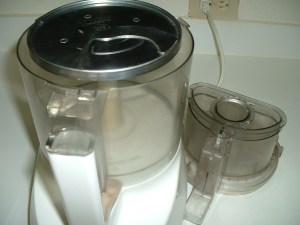
  4. Break stems off parsley and place in a food processor.  Chop small, by repeatedly pressing the pulse button-this may also be done with a knife, which is more laborious.  Place in a large bowl.
  5. Chop green onions (may include the green part, in addition); add to bowl.
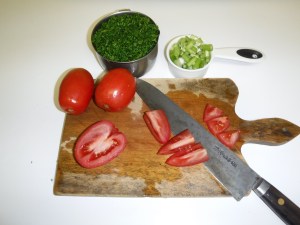
  6. For ease in slicing, cut tomatoes with the skin side down (see photo below).  Mix in with parsley and onions.
  7. chopping tomatoes so to conserve juices

    Place lemon juice in a glass 1-c measuring cup (should be a scant 1/4 c); fill the rest with olive oil to measure 1/2 c.  Add mint, salt, and pepper; beat well with a fork.

  8. Drain burghul when cool, add to vegetables, pour beaten dressing over top, and blend well.  Chill for 1 hour before serving (see photo of finished product at top of recipe).  This is so healthy and good!

Munazalla (a Syrian lamb, eggplant, and tomato dish)

Here is the heritage of the Syrian dish munazalla and its great recipe, along with the background and health benefits of cilantro.

This prized dish came to me in the early 1980’s, during my initial catering days in Billings, Montana; there I taught this recipe-the first in this series-in one of my cooking classes, as part of a complete Middle Eastern dinner.  It still graces my table today, especially when I am trying to impress guests, as it is par excellence.

Syria and its Background

Its origin is Syrian; thus recently, I was excited about serving it to company with an Assyrian heritage, not understanding that these are two very different cultures. Research proved their distinct differences: Syria, officially known as the Syrian Arab Republic, is a nation in southwestern Asia, on the eastern Mediterranean coast, with the capital of Damascus.  This delicious dish is from that republic, birthed in 1946, which was originally part of an ancient country, by that name, of western Asia that also included Lebanon and the Palestinian region.

Ancient Assyria

On the other hand, Semitic Assyria was an ancient empire, which was by far larger than the early country of Syria.  This was considered to be the greatest of the Mesopotamian empires, which had its start at the beginning of creation, as accounted for in the second chapter of Genesis.

Cilantro/the Leaf and Coriander/the Seed

This Syrian lamb, eggplant, and tomato recipe, calls for well-known cilantro, which is the leaf of the plant Coriandrum sativum, while the spice coriander is its seed.  Cilantro, sometimes botanically referred to as coriander, is said to be the most widely consumed fresh herb worldwide. As a native to the Middle East, its seed, which we refer to as coriander, was found in the tomb of King Tut.  (I got to see the tour of these ancient Egyptian remains in Seattle in the mid 1970’s.)

Cilantro Spreads throughout the World

Early on, this plant was taken to China, India, and Southeast Asia, and later to Latin America, being highly favored in all these regions.  In the New World, cilantro replaced culantro (Eryngium) its relative with a similar taste which is indigenous to Central and South America.  The latter has larger, thicker, tougher leaves, than those of the cilantro plant, with its rounded, notched, tender greenery; nevertheless, the flavor in both is almost the same.  Culantro, or saw-leaf herb, is still used in the Caribbean, but is most commonly found in Asian cuisine, especially that of Vietnam.

Cilantro Displeasing to Some Palates

Coriander leaf, cilantro, is sometimes described as having a soapy aroma; for this reason, it is not very popular in traditional European cooking.  The main component of the aroma is a fatty alehyde, decenal, which is very reactive; thus, this herb quickly looses this sense-element when heated.  As a result, it is used most predominantly in uncooked preparations, or as a garnish.

Health Benefits of Cilantro

This low-cholesterol herb, which is a good source of dietary fiber, has a practically non-existent caloric value, and it is high in minerals (including potassium, calcium, manganese, iron, and magnesium) and vitamins (such as A, C, K, E, and B vitamins).  Its health benefits are highly acclaimed by experts.  Among many health-promoting characteristics, it is said to: rid the body of heavy metals, lower bad-while increasing good-cholesterol, help reduce swelling caused by arthritis and rheumatic diseases, lower blood sugar levels, and provide antioxidant, antiseptic, disinfectant, and antibacterial properties.

Option of Coriander in this Recipe Below

As with traditional Europeans, this leaf’s pungency is offensive to me; thus, for flavoring in our munazalla, I give the option of substituting ground coriander seed, with its simultaneous flowery and lemony tastes.  Who knows?  This superb receipt may even excel more with fresh cilantro, for those who love it.

References:

The Holy Bible, KJV, Genesis 2:14.

Harold McGee, On Food and Cooking (New York: Scribner, 1984,2004), pp. 390, 407, 408.

https://draxe.com/cilantro-benefits/

https://articles.mercola.com/herbs-spices/cilantro.aspx

Munazzala (a Syrian lamb, eggplant, and tomato dish)  Yields: 5-6 servings.  Total prep time: 2 1/3 hr/  active prep time: 1 hour/  inactive cooking time: 1 1/3 hr.

10 large minced garlic cloves, or the equivalent

1 lb ground lamb  (Our local Grocer Outlet generally has a great deal on lamb.)

1/4 tsp allspice

1/4 tsp freshly ground pepper

1 1/4 tsp salt  (Himalayan, pink or Real Salt is important for optimum health; an inexpensive fine grind Himalayan salt is available at Costco.)

2 tbsp oil  (Coconut or avocado oil is best, as olive oil is carcinogenic when heated to high temperatures.)

1 lg onion, chopped

2 lb eggplant

4 med tomatoes

1/3 c cilantro, chopped  (May substitute 1 1/2 tsp ground coriander, or to taste.)

  1. forming meatballs

    Spray vegetables with an inexpensive, safe, effective vegetable spray (combine 97% distilled white vinegar with 3 % hydrogen peroxide).  Leave spray on for 3 minutes; then, rinse well.

  2. Mince garlic cloves by hand, or in a food processor; set aside.
  3. Using your hand, combine: lamb, 1/4 of minced garlic, allspice, pepper, and 3/4 tsp salt in a bowl; form meatballs the size of cherry tomatoes (see above photo).
  4. Over medium heat, fry meatballs in 1 tbsp hot oil, stirring with spatula until they stiffen.  Add chopped onion and cook until golden brown; drain fat and set aside (see photo).  Deglaze pan with small amount of water, scraping fond, or

    cooked meatballs and onions

    cooked-on juices, off bottom of hot pan with a spatula.  Set aside.

  5. Chop eggplant in small cubes (see photo below).  Heat remaining tbsp of oil in a large sauté pan over medium heat.  When a small piece of eggplant sizzles in oil, mix in remaining eggplant; add 1/4 c water, cover, and cook until pieces begin to soften, stirring occasionally.  Be sure to cover pan.
  6. Cut tomatoes in small chunks, chop cilantro-dried coriander may be substituted.
  7. chopping eggplant

    Mix meat, remaining garlic, tomatoes, cilantro, and 1/2 tsp salt into partially cooked eggplant.  Cover, reduce heat to med/low, and cook for 1 hour, stirring occasionally.  (After cooking for 1 hour, if preparing for company, you may wish to set this mixture aside, before the final 15-20 minutes of cooking).

  8. Raise heat to medium, adjust seasonings, and cook uncovered for 15-20 minutes, or until liquid is absorbed, stirring frequently.  (See photo of finished product at top of recipe.)
  9. Serve with pleasure!

Quick Pasta with Red Sauce and Ricotta

pasta with red sauce and ricotta

With our hurried society, we are always trying to conserve on time; thus, I try to respect this need for efficiency with my cooking instructions, where provision of optimum health is also a major focus.  My mind is made for details; henceforth, I spell out shortcuts that streamline cooking; this can make a particular recipe look long, but indeed it is concise, with an abundance of clock-conserving treasures.

This quick version of red sauce can be made in just 30 minutes, thus honoring our crowded schedules; it pleases with its added topping of ricotta cheese.

A dear friend always blesses me with gifts from her home, when she visits.  I never know what new gadget or food item she will introduce upon her arrival.  Several weeks ago, Wanda came bearing homemade ricotta, which she had made in a crock pot, with her suggestion to put it on top of spaghetti sauce.  As she cooks for a diabetic challenged husband, she serves just a little gluten-free pasta with lots of red sauce, topped with her ricotta; you may choose similar adjustments.  (A 5-star receipt for simple homemade ricotta cheese can be found at http://www.geniuskitchen.com/recipe/homemade-ricotta-cheese-crock-pot-345985)

Discipline is called for in any recipe, whether it be in the kitchen or life, with the constant need for balance between demands and desires.  Always we long for the best taste to be left in our mouths, but oh the challenge in allowing the time required for such quality.  Here I sacrifice some of the depth of flavor, which can be found in my moderately-more-lengthy instructions for Red Sauce for Pasta or Spaghetti Squash (2017/04/10).

Italian comes to mind when we think of red sauce; tomatoes, however, are a relatively new food in Italy.  In the 16th century, conquistadors introduced these to Europe, where they took centuries to become a leading world vegetable.  America didn’t fully accept this fruit-it is actually a fruit, not a vegetable-until the late 19th and early 20th centuries, a time that simultaneously saw an inundation of Italian immigrants on our shores.  For more on this history, see Spicy Sausage and Tomatoes (2017/09/25) and Ropa Vieja (2017/10/09).

If you are wanting a fine-textured red sauce, know that canned tomatoes, unlike fresh tomatoes, usually don’t boil down to a smooth puree, as calcium salts are added by many canners-this calcium firms the cell walls of tomatoes and keeps the pieces in tact.  Since these salts interfere with the disintegration process during cooking, be sure to check the labels on all canned whole tomatoes, only buying brands that don’t list calcium, unless a chunky sauce is desired.  I use canned tomato sauce here.

Pressured agendas bring loss of strength, while slowing down to smell the roses allows for the discovery of innate gifts, which were positioned by divine ordinance long ago.  We get to open these daily, if we but exercise patience.

References:

Reay Tannahill, Food in History (New York: Three Rivers Press, 1988, 1973), p. 206.

Harold McGee, On Food and Cooking (New York: Scribner, 2004, 1984), p. 331.

Quick Pasta with Red Sauce and Ricotta  Yields: 2-3 servings.  Total prep time: 30 minutes.  Note: may double the recipe.

15-oz can tomato sauce  (Organic is best, which is only slightly more expensive; available at most supermarkets.)

3/4 tsp dried oregano  (Trader Joe’s has an excellent organic bottle for $1.99.)

1 tsp dried basil  (Also found at Trader’s.)

3/4 tsp salt  (Himalayan, pink, or Real Salt is important for optimum health; an inexpensive fine grind Himalayan salt is available at Costco.)

4 med/lg cloves garlic  (For easy prep, use 2 cubes frozen garlic from Trader’s.)

1 tsp oil  (Coconut or avocado oil is best, as olive oil is carcinogenic when heated to high temperatures.)

1 med yellow onion, chopped small

2-3 servings of pasta

2 sausage links  (Natural sausage is best; I used Fence Line Hot Italian Style here.)

Spray oil  (Coconut is best for health; Pam coconut spray oil is available in most supermarkets; our local Winco brand, however, is much cheaper.)

2 tbsp tomato paste  (Freeze remaining paste in individual 1/4 c bags, to be thawed conveniently.)

Avocado slices

Ricotta cheese for topping

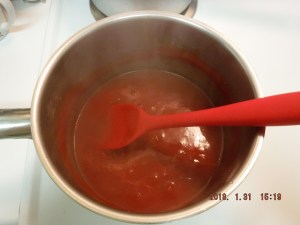
  1. tomato sauce simmering

    Take ricotta out of refrigerator, to bring to room temperature for serving.

  2. In a medium saucepan, place tomato sauce and 1/2 can of water, to which you have added seasonings and garlic.  Bring to a boil over medium heat; reduce heat to med/low and simmer, stirring occasionally.
  3. Heat oil in a sauté pan; sweat onion in hot oil (cook only until translucent); add to sauce.
  4. Fill a 3-quart saucepan 4/5th’s full of water, to which you have added a small amount of salt and oil (any kind will do).   Place over medium heat; when water boils, add pasta and cook for 7 minutes, or until al dente.
  5. Meanwhile cut sausage diagonally and sauté until light brown, in a frying pan sprayed with oil.  When done, add to tomato sauce.
  6. Slice avocados, set aside.
  7. When pasta is finished, drain in a colander, rinsing well.
  8. prepping pasta

    Finish the sauce, by adding tomato paste, stirring until thickened.

  9. Rinse pasta under hot tap water to warm it.  Place pasta on individual plates; pour sauce over top; garnish with large dollop of ricotta and a slice of avocado (see top photo).
  10. Quick, easy, delightful!

Quinoa Dishes

salad topped with cooked quinoa

Our bodies are the temples of God; only through his grace, do we have the capacity to care for these holy houses with good diet and healthy exercise.  For years, such attendance was beyond my natural ability, but now I highly esteem the enabling gift from God, which provides me with the means to execute both these disciplines effectively.

Clearly I recall the days, when weighing 226 pounds, walking caused painful rubbing together of my fleshy thighs.  Brokenhearted, after repeated failures and fresh firm resolve, I would yet again reach toward the “easy” goal of a 20-minute walk, 3 times a week.  I could never achieve this, try as I might.

Lo and behold, my challenge has been reversed: now I have to be careful not to obsess about exercise, as I so love walking aerobically, for this invigorates me, stimulating a marvelous sense of well-being in my soul.

My trustworthy instruction book, the Bible, warns that there are advantages in physical exercise, but these are limited, as they pale in sight next to the gains acquired by putting spiritual development first.  Thus, we must approach workouts with great wisdom, so they neither own us, nor escape us.

My days are jam-packed, for I am gratefully fulfilling my ordained achievements with my food history writings and other ministry.  The result is a thrilling existence, in which I can run out of time at the end of a day, leaving me with critical choices, with which I have to prioritize.

Our gracious Father has granted me a tool to do such: there is a winter wonderland scene at the Tualatin Commons, the man-made lake near my home.  All the trees surrounding this body of water are dressed in bright, white lights (the floating Christmas tree was taken down after the New Year).  This has become my piece de resistance, which early in my day I start anticipating: will this pleasure be mine at twilight?  Only supernatural help allows me to accomplish the needed organization to allow this longed-for walk.

Discipline in ordering my day is critical; by necessity, exercise has become secondary to my fulfilling the higher purpose of my calling.  Often I recall how this valued ambulation used to be such a burden, causing sores on my overweight thighs, but now I crave walking.  I didn’t bring this miracle about; my great Healer affected it in me over time.  I am literally his walking miracle!

Not only has my exercise been refined, but healthy eating has come to me supernaturally, as well.  Slowly I have attained excellent eating disciplines; incorporating quinoa (KEEN-wah) in my diet is one such development.  This is a cereal grain, sometimes referred to as a seed; all grains, legumes, and nuts are seeds.

Quinoa is a power-food that is native to northern South America; it was domesticated originally as food for livestock around 5000 B.C., near the Lake Titicaca basin of Peru and Bolivia-I spent a night on this pitch black, remote lake, the largest inland body of water in the southern hemisphere, which doesn’t have electricity.

Quinoa was a staple with the Incas, second only to the potato in importance, and is still in the forefront among their indigenous descendants the Quechua and Aymara people.  It is a grain from a plant called Chenopodium quinoa, which is a member of the same family as beets and spinach.

Like many ancient grains, this seed was almost lost: in 1532, the Spanish explorer Francisco Pizarro destroyed quinoa fields, in his attempt to annihilate the Incan culture; this crop, however, survived in the high Andean mountains.  Quinoa was reintroduced to the modern world in the 1970’s and 80’s.

This high-fiber, complete-protein food, rich in numerous vitamins and minerals, produces a starch gel, similar to that of risotto, giving it a kind of silky texture, according to Andrew Dornenburg and Karen Page in Culinary Artistry; they further state that its earth tones highly compliment the mineral and earthy components of lobster-try experimenting with this combination.

Here, however, I quickly prepare it in two savory dishes.  This pseudo cereal-not a member of the grass family, therefore not a true cereal-can also be cooked as a breakfast food; serve it with dried fruit, honey, and an alternative milk, such as almond or hazelnut.

My discovery of quinoa has blessed me immensely; may it benefit you  likewise.

References:

Harold McGee, On Food and Cooking (New York: Scribner, 1984, 2004), pp. 451-483.

https://en.wikipedia.org/wiki/Quinoa

http://www.ancientgrains.com/quinoa-history-and-origin/

https://www.smithsonianmag.com/arts-culture/quinoa-the-mother-of-grains-1-57670322/

Andrew Dornenburg and Karen Page, Culinary Artistry (Hoboken, NJ: John Wiley & Sons, Inc.), pp. 142, 143.

toasted yellow quinoa

Simple Cooked Quinoa  Yields: 3-5 servings, as a main course or side dish respectively.  Total prep time: 30 min/  active prep time: 15 min/  cooking time: 15 min.  Note: double this for healthy leftovers; this is especially good added to green salads (see photo above).

1 c quinoa  (Tri-color or red organic quinoa is preferable-color is important in diet.)

1-15 oz can of chicken, vegetable, or beef broth

1/2 tsp salt  (Himalayan, pink, or Real Salt is critical for optimum health; a fine grind Himalayan salt is available very cheaply at Costco.)

  1. Toast the grain in a hot, dry frying pan over medium heat, for about 6-10 minutes, stirring constantly as color starts to change; yellow quinoa will turn light brown in color (see above photo), while red quinoa  turns deep red.  This enhances the flavor of the dish remarkably!  Meanwhile go to next step.
  2. While quinoa is beginning to toast, pour broth in a 1 1/2-quart saucepan (or 3-quart pan, if doubling recipe).  Stir in salt and bring to a boil over medium heat; when liquid boils, add toasted seed and bring to a second boil. Reduce heat, cover, and simmer for 15 minutes; red quinoa may take longer to cook.  When done, water will be absorbed and quinoa will be soft and somewhat translucent.
  3. Serve immediately.  Refrigerate any leftovers to reheat for an entrée, or to add to a green salad (see first photo).

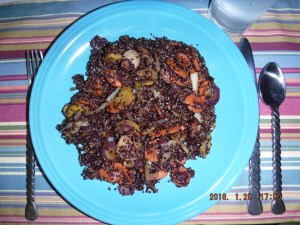
carrots and quinoa

Carrots and Quinoa  Yields: 4-6 servings, as a main course or side dish respectively.  Total prep time: 45 minutes.

1 med yellow onion, cut in even 1/8 inch slices

4 1/2 tsp oil  (Coconut or avocado oil is best, as olive oil is carcinogenic, when heated to high temperatures.)

8 med carrots, or other vegetable  (Organic multi-colored carrots are available at Trader Joe’s; color is important in diet.)

1 c quinoa  (Red or tri-color is good.)

1-15-oz can chicken, vegetable, or beef broth

1/2 tsp salt  (Himalayan, pink, or Real Salt is critical for premium health; an inexpensive fine grind Himalayan salt is available at Costco.)

  1. red quinoa as it is beginning to change color

    To caramelize onions, cook slowly over medium heat in 1/2 tsp of oil, stirring every several minutes, until a light color starts to form; then, stir every minute, until dark brown.  Be sure to use a small amount of oil; too much oil will require a much longer cooking time, as will crowding the pan.

  2. Spray carrots with a safe inexpensive, effective vegetable spray (combine 97% distilled white vinegar with 3% hydrogen peroxide); let sit 3 minutes; rinse well.
  3. Bring broth to a boil in a covered 1 1/2–quart saucepan, over med/high heat; add salt.  (Use a 3-quart pan is doubling recipe.)
  4. Toast quinoa in a hot dry frying pan, over medium heat, stirring constantly as color starts to change.  This takes about 6-10 minutes-yellow quinoa will turn light brown, while red quinoa will become deep red (see photo above).
  5. To preserve vitamins just under skin, scrape carrots with a sharp knife, instead of peeling; slice thinly.  (Meanwhile keep checking the onions.)
  6. finished product

    Add toasted quinoa to boiling broth, cover, and reduce heat to med/low.  Allow to simmer until all the liquid is absorbed and quinoa is soft and somewhat translucent (this takes about 15 minutes for yellow quinoa, while red quinoa may take longer).

  7. Heat remaining 4 tsp oil in an empty frying pan.  Add sliced carrots, cover, and steam until soft, stirring occasionally.
  8. Blend onions into carrots; mix cooked quinoa into vegetables.  Serve hot (see above photo).

Braised Celery

braised celery

Celery, along with only a few other vegetables, including broccoli, cauliflower, and brussel sprouts, is a relative newcomer to the world’s diet, where most common vegetables have been eaten since before recorded history.  This Apium graveolens is the mild, enlarged version of a thin-stalked, bitter Eurasian herb called smallage.

Wild celery is believed to have originated in the Mediterranean area.  Its woven garlands have been found in Egyptian tombs.  An archeological finding in Kastanas, Greece provides evidence that Apium graveolens was present there in the 9th century before Christ.  There is also great literary evidence establishing this, for selinon, which is believed to be the same as celery, is mentioned by Homer in both the Illiad and Odyssey (circa 850 B.C.).

Moving forward five centuries after Christ, this wild edible herb appears in Chinese writings; then following this, it is cited again in a 9th century A.D. poem, from either France or Italy.

Italians first bred this small, primitive plant in their gardens apparently in the 1500’s, using it for medicinal purposes only; other northern European countries also began growing it.  By 1623, a record of celeri in France, established it as being utilized as a food.  For the next 100 years, it was generally employed only to flavor dishes, though in France and Italy, its leaves and stalks were sometimes eaten accompanied with oil dressing.  By the end of this century, this vegetable had arrived in England.

The first evidences of improvement of this wild Apium were seen in late 17th and early 18th centuries in these northern European countries, resulting in selections with solid stems; this stalk celery, as it has been known, originally had a tendency to produce hallow stalks that were bitter and strong.  Years of domestication corrected this hallow characteristic; likewise, breeding countered the disagreeable flavors.  This latter development was achieved by choosing the cooler growing periods of late summer and fall-the plants were then kept into winter-as well as by employing blanching, a practice that pushes dirt up around the stalks’ bases, keeping the sunlight from turning the celery green.

We have two types of stalk celery varieties: the green or Pascal is popular in North America, while the yellow, also known as self-blanching, is preferred in Europe and the rest of the world.  Celeriac, celery root or knob celery, is also widely used in European countries, with a growing audience for it among trendy U.S. gourmets.  Chinese or leaf celery, which is also called smallage-of all the Apiums, this is the closest in form and flavor to the original Eurasian herb-is grown in Asia and the Mediterranean regions for its leaves and seeds; these are used for cooking and sometimes medicine.

In America, the presence of this vegetable was minor during colonial days, leaving no evidence as to which European group brought it here.  Nonetheless by 1806, four cultivated varieties were growing in the U.S., as is listed in the American Gardeners’ Calendar, printed that year.  After the mid-19th century, with further domestication having refined its taste and texture, Americans were eating it raw with salt, serving it in celery vases at the dinner table.

Organic celery tends to be on sale at our local Fred Meyer-Kroger-stores during any holiday.  Thus, having it on hand from a Christmas special, I created this exceptionally easy, delightful braised celery dish, for my annual, day-after-Christmas celebration with my long-time friend Janet.  We loved it; hope you will to.

References:

https://en.wikipedia.org/wiki/Celery

https://aggie-horticulture.tamu.edu/archives/parsons/publications/vegetabletravelers/celery.html

http://www.foodreference.com/html/celery-history.html

Harold McGee, On Food and Cooking (New York: Scribner, 1984, 2004), pp. 249, 315, 406.

finished product

Braised Celery  Yields: 4 servings.  Total prep time: 20 min/  active prep time: 10 min/  cooking time: 10 min.

1 1/4 lb celery  (Organic celery is relatively inexpensive.)

2 tbsp chilled butter, cut in small pieces

Salt and freshly ground pepper  (Himalayan or pink salt, such as Real Salt, is so important for optimum health; a Himalayan salt is available very cheaply in bulk, at our local Winco.)

1 tsp Herbes de Provence  (Trader Joe’s has a great deal on this dried herb.)

1/2 c broth  (May use chicken, vegetable, or a good beef broth.)

  1. preparation of celery

    Peel strings off celery with a potato peeler; spray with a safe, inexpensive, effective vegetable spray (combine 97% distilled white vinegar with 3% hydrogen peroxide); let sit 3 minutes; rinse really well.  Save leaves for garnish.

  2. Cut celery in 4-inch pieces; place in a single layer-the indented side up-in the bottom of a large sauté pan; dot with pieces of butter; salt and pepper generously; sprinkle top with Herbes de Provence.  (See photo above.)
  3. Pour broth over celery; bring to a boil over med/high heat; reduce heat to med/low; cook covered for 5 minutes.
  4. Meanwhile chop the leaves, to be used as an optional garnish.
  5. Remove cover, stir well, raise heat to medium, and cook for 4 minutes more (see photo below).
  6. Raise heat to med/high and cook liquids down, stirring constantly, until juices form a glaze, about 1 minute (see photo at top of recipe).
  7. celery while cooking

    Arrange in a serving dish, garnish with chopped leaves, and serve with pride!

Turkey with Shallots, Cauliflower, and Bell Pepper

turkey with shallots, cauliflower, and bell pepper

It’s that time of year again for turkey,  Learn about the history of this bird and access a great recipe using either leftover roasted fowl or its ground version, which comes in one pound packages at any food market; the latter makes this dish accessible year-round.

Background of Turkey

Turkey is in the genus Meleagris, which is native to the Americas; the Mexicans domesticated it by 800 BC.  It was either introduced to Southwest U.S., or tamed here independently, by 200 BC; these indigenous people used its feathers for ceremonies, as well as in making robes and blankets; they didn’t, however, consume it as a meat until around 1100 AD.

Cortes Brought Turkey to Spain

This bird arrived in Europe in 1523-24, when the Spanish conquistador Hernando Cortes brought certain foods back from Mexico; in Spain, it was known as gallopavo (peacock).  There is some confusion concerning the exact derivation of its subsequent name turkey; most likely this was taken from our American bird’s mistaken resemblance to the African guinea fowl, which the Europeans knew as turkey fowl, as these were imported from Turkey.

England Adopted Turkey

Many believe that English navigator William Strickland introduced this food to England; indeed a tribute was made to him in 1550, in that he was granted a family coat of arms, including a “turkey-crop in his pride proper”; this coat of arms, with its turkey crest, is still in use today.

Christmas “Goose Clubs” Established in England

Until recent times, this bird was considered an extravagance in Europe, where native grouse and pheasant were cheaper alternatives.  In the 19th century, the English working class aspired to partake of goose for their holiday celebrations; Christmas “goose clubs” were established in England in the 1800’s, so these impoverished people could insure the necessary savings for their festive meal.

“The Christmas Carol” Goose Replaced by Turkey Today

One of the first mentions in literature, of turkey becoming this celebratory roast, is Charles Dickens’ vivid portrayal in A Chistmas Carol: a resultant, decadent Christmas dinner occurred, when the reformed Ebenezer Scrooge replaced Bob Crachit’s meager goose with a massive turkey.  Nevertheless, only since World War II, as growing conditions for turkey became less expensive, has this developed into the holiday fowl of choice in England.

Turkey Would Have Been a Better National Bird

In U.S. history, Benjamin Franklin was disappointed when turkey was not selected for our national bird; he argued that it is a true original native, whereas the eagle can be found in all countries.

“Heritage” Birds

With our present heightened fascination in high cuisine, “heritage” birds are gaining in popularity.  These are traditional breeds, much like Strickland and Dickens encountered, which can trace their ancestry to the earliest domesticated animals.  They have a ratio of dark to white meat of about 50/50.

Broad Breasted Whites have been sold predominantly in grocery stores for decades; these were bred to have a ratio of 65% white meat to 35% dark, while weighing up to 50 pounds; the maximum weight of a wild turkey is 25 pounds, which is also the upper weight of the traditional heritage birds.  These latter come with such colorful names as Bourbon Red, Royal Palm, and Midget White; even with their gamy taste, people are willing to pay $9, or more, per pound to partake of this delicacy, while Broad Breasted Whites are often given away free, as promotional deals, at local supermarkets nowadays.

You may call me penurious, but I made this dish with all-natural Foster Farms ground turkey, which is close to $3 a pound; my recipe, however, is great for Thanksgiving leftovers, whether they be of a Broad Breasted White or a heritage breed.

References:

  1. James Trager, The Food Chronology (New York: Henry Holt and Company, Inc., 1995), pp. 86, 87, 180.
  2. http://www.history.com/news/hungry-history/turkey-talk-the-story-behind-your-thanksgiving-bird
  3. http://www.historyextra.com/article/premium/turkeys
  4. https://en.wikipedia.org/wiki/Turkey_(bird)

flavorful onions caramelized with vinegar

Turkey with Shallots, Cauliflower and Green Pepper  Yields: 5-6 servings.  Total prep time: 50-60 min.

5 tsp oil  (Coconut or avocado oil is best for health; olive oil is carcinogenic, when heated to high temperatures.)

1 med yellow onion, cut in even 1/8” slices

4 oz shallots, chopped in 1” pieces

1 tbsp butter

1 lb natural ground turkey  (May use leftover roasted turkey, broken in bite-size pieces.)

Salt to taste  (Real Salt is critical for good health; available in nutrition center at local supermarket.)

Fresh ground pepper to taste

2 lb cauliflower  (Yellow or orange cauliflower is sometimes available, in the organic section, at our local Fred Meyer-Kroger-stores.)

1 lg bell pepper  (In particular, it is important that peppers be organic, as they readily absorb pesticides.)

3-4 tbsp flavored vinegar  (I used elderberry vinegar, which I purchased in Montana.)

  1. For caramelizing, peel and cut onion in even 1/8” slices.  Heat 1 tsp oil in a large sauté pan over medium heat; when a small piece sizzles in oil, reduce heat to medium/low; add rest of onions and slowly cook, stirring every 2 minutes, until color begins to form.  (It is important to not crowd pan, or add too much oil, as

    cutting shallots in 1″ pieces

    this will slow down the cooking process.)  When a light golden color is beginning to form, start stirring every minute, until dark brown.  Deglaze pan of onions-scrape fond, browned, cooked-on-juices, off bottom of pan with a spatula-by adding 1-2 tbsp of the vinegar (see above photo of caramelized onions with vinegar).  Go to the next steps, while onions are cooking.

  2. Spray cauliflower and pepper with an inexpensive, effective produce spray (combine 97% distilled white vinegar with 3% hydrogen peroxide in a spray bottle); let sit for 3 minutes; rinse well.
  3. Peel shallots, cut large ones in 1” pieces, and set aside (see photo above).
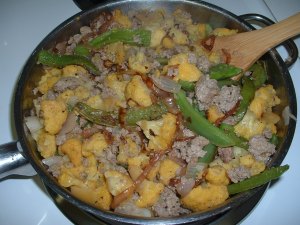
  4. In another frying pan, melt butter; add shallots; and cook over medium heat, until they are translucent.  Add raw turkey, salt and pepper generously, cook until pink is gone-see photo below.  (If your turkey was previously frozen, there will be lots of juices, but if cooking fresh-ground, you may need to deglaze hot pan with 1-2 tbsp of vinegar; if using roasted turkey pieces, just stir these into shallots-do not cook.)  Set turkey/shallots aside in a large bowl.
  5. cooked turkey and shallots

    Cut peppers into 1” x 3” strips, set aside.

  6. For ease in dividing the cauliflower into bite-size florettes, first break chunks of cauliflower off the head; next, cut off all excess stalk from these bigger sections; then, make small knife-cuts in the stems of these pieces, gently pulling apart small florettes with fingers; set aside separately in a bowl.
  7. Heat 1 tsp of oil over medium heat in the above, empty meat pan; when a  piece sizzles in hot oil, add the remaining peppers; cook until somewhat soft, but still crisp.  Deglaze hot pan, with a tbsp of vinegar-may have to deglaze with water instead, for only a total of 3-4 tbsp of vinegar should be used for all deglazing, in entire recipe; vinegar adds delightful flavor, but too much is overpowering.  Put peppers in with bowl of meat.
  8. When onions are done, mix together thoroughly with meat/shallots/peppers.  Heat last tbsp of oil in this pan, over medium heat; after a small piece sizzles in hot oil, add rest of cauliflower; salt and pepper florettes, distributing oil evenly among them.  Add 1/4 c water, cover pan, and cook until soft, stirring occasionally.
  9. finished product

    Blend turkey and vegetables into soft cauliflower, adjust seasonings, and heat thoroughly (see photo).  Serve with anticipation!

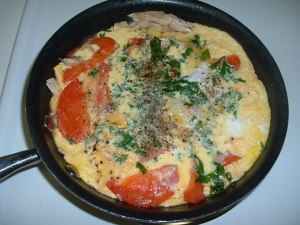
Ropa Vieja (Omelette)

ropa vieja (omelette)

Here we examine the historical and botanical make-up of tomatoes, the importance of Africans in the forming of southern cuisine, and details about the publication of cook books in the American south.

America’s Food Heritage

Our typical American cuisine was inspired by the familiar recipes brought over by English, French, Spanish, and Dutch settlers, as well as those of Scotch-Irish and German colonists, who followed these early immigrants; all of this European influence merged with the available foods of the Native Americans present on this continent.  1

Southern Cuisine Developed by Africans

African slaves played a broad part in fashioning our distinctive southern cookery.  The mistresses of these slaves initially taught them-our people-receipts recalled from these mistresses’ individual heritages, as listed above; then, prized dishes were developed, with the Africans’ natural appreciation of and aptitude for cooking.  These foods were used in the strong social competition among the plantations.  Such delicacies, which in large part formed this region’s cuisine, were not initially compiled in books for the public, but rather closely safeguarded within each family, due to the rivalry among these established settlements.  Thus, there were no Southern cook books until the first quarter of the 19th century; a few recipes from this geographic area were preserved, however, in some American cook books, mostly those published in and around Philadelphia.  2

Mrs. Mary Randolph’s The Virginia Housewife, printed in 1824, in Washington D.C., is part of the advent of cook books specializing in foods from the South.  It also includes some Northern recipes, as well as a few Spanish dishes, of which our Ropa Vieja omelette is one.  This promising recipe boasts of only five ingredients, one of which is the garden tomato, and just a few succinct instructions; its simplicity makes it exceptional.  3

Botanical Make-up of Tomatoes Produces a Powerful Food

In On Food and Cooking, Harold McGee explains why this sweet-tart, botanical fruit tomato, which is used as a vegetable, has such great appeal.  He attributes this attractiveness to the unique flavor brought about by its low sugar content-3%; other great features are its large amount of savory glutamic acid-as much as 0.3% of its weight-and its ample quantities of aromatic sulfur compounds.  These two latter ingredients, present in ripe tomatoes, predispose them to complement the flavor of meats.  This is because these two substances exist more commonly in animal flesh than fruits; thus, their rich presence in tomatoes allows for added taste to meat dishes.  Savory glutamic acid and sulfur aromas likewise bring out great depth and complexity in sauces and other food combinations; therefore, this particular produce can even replace meat in flavoring vegan dishes.  4

American Origins of Tomatoes and their Slow Acceptance in Europe

Tomatoes originated in the west coast deserts of South America.  Extensive varieties existed in Mexico, by the time Hernando Cortez and his 400 Spaniards discovered this land in 1519.  The tomato was incorporated in American (and later European) cookery in various ways.  At the time of Cortez’ arrival, Mexicans used thin shavings of this green, unripe fruit in many dishes; they also mixed ripe tomatoes with chillis in a sauce to top cooked beans.  Subsequently, the Spaniards in Europe readily adopted this fruit in their cuisine.  5

When Francisco Pizarro began his bloody attacks in Peru in 1532, this South American land, with all its royal Incan wealth, was eating mostly a vegetarian diet of maize, potatoes (including sweet and manioc potatoes), squash, beans, peanuts, avocados, chillis, and our beloved tomato.  6

Some time later, the Italians were adding it to broths and soups, as noted by the Quaker merchant Peter Collinson in 1742.  Tomato sauce for pasta followed several decades hence.  7

Britain lagged behind Italy, in accepting this item, due to their long-held mistaken viewpoint, which had originated on the Continent, connecting it with a deadly nightingshade, being it was of this same family.   Not until the 20th century did the English acquired a taste for tomatoes, particularly canned tomato soup.  8

Popularity of Tomatoes Grew Slowly in the United States

North America was almost equally slow in receiving this fruit, probably due in part to these same European misconceptions; they considered it to be lacking in nourishment and substance, as well as a cause for gout.  9

During the late nineteenth and early twentieth centuries, the U.S began what was to become a wide acceptance of tomatoes, primarily due to the strong influence from the great Italian immigration then.   Nevertheless, their first appearance here was when Thomas President Thomas Jefferson brought back seedlings from a diplomatic trip to Paris.  There the Parisians had just accepted this “love apple”, believed to be an aphrodisiac; their acceptance directly resulted from the effect Italian cooking had on French troops during the French Revolution at the end of the 18th century (see Spicy Sausages with Tomatoes & Turnips).

It is interesting to note that our third president had an extensive garden of 170 varieties of fruits and 330 varieties of vegetables and herbs; his grand kitchen utilized most of this produce, even producing ketchup for our epicurean leader, who primarily chose a vegetarian diet.  Ketchup at this time, however, was a vinegar-based condiment made from such ingredients as walnuts and mushrooms, not tomatoes.  10

Be sure to access my other tomato recipes: Parmesan Dover Sole and Rosemary Eggs.

References:

  1. Esther B. Aresty, The Delectable Past (New York: Simon and Schuster, 1964), p. 181.
  2. Ibid., pp. 182, 183, 193.
  3. Ibid., p. 193.
  4. Harold McGee, On Food and Cooking (New York: Scribner, 1984, 2004), pp. 329, 330.
  5. On Food and Cooking (New York: Scribner, 1984, 2004), Reay Tannahill, Food in History (New York: The Three Rivers Press, 1988, 1973), p. 206.
  6. Ibid., p. 214.
  7. Ibid., p. 207.
  8. Ibid.
  9. Ibid.
  10. www.monticello.org/site/house-and-gardens/historic-gardens

ingredients for ropa vieja

Ropa Vieja (Omelette)  Yields: 2 servings.  Total prep time: 25 min.  Adapted from an 1824 southern recipe found in Esther B. Aresty’s The Delectable Past (New York: Simon and Schuster, Inc., 1964).

2 lg firm ripe tomatoes, cut in eighths, seeds and juice removed

2/3 c shredded leftover chicken, ham, or beef

4 lg eggs, beaten lightly  (May use 3 duck eggs, which are bigger than chicken eggs; for info on duck and chicken eggs, see Rosemary Eggs.)

2 tbsp butter

1 tbsp chopped parsley, optional

Salt, to taste  (Himalayan, pink, or Real Salt is critical for optimum health; an inexpensive fine grind Himalayan salt is available at Costco.)

Fresh ground pepper, to taste

  1. cooked tomatoes

    Spray the optional parsley with a safe, inexpensive, effective produce spray (mix 97% distilled white vinegar and 3% hydrogen peroxide); let sit 3 minutes: then, rinse well and chop fine.

  2. Cut the tomatoes in eighths, gently scoop out liquid and seeds with a spoon (it not necessary to peel the tomatoes), place in a bowl.
  3. Shred and measure the meat, set aside.
  4. Beat the eggs, only until whites and yolks are lightly blended.
  5. Over medium heat, melt 2 tablespoons butter in a non-stick skillet; mix in meat, heating for one minute.  Add tomatoes and cook for six minutes, or until mixture is hot and tomatoes are somewhat softened, stirring occasionally (see above photo).
  6. Reduce heat to med/low; sprinkle parsley over cooked tomatoes and meat; pour beaten eggs over this mixture, quickly distributing the meat and tomatoes evenly in eggs.
  7. finished product

    Salt and pepper generously before covering; cover and cook slowly, until eggs are set on top (see photo).

  8. When done, you may remove any loose pieces of skin from tomatoes that appear on top of omelette; fold it over; cut in half to serve two people.

Spicy Sausage with Tomatoes and Turnips

spicy sausage with tomatoes and turnips

Nothing pleases the palate as much as tomatoes fresh from the garden; read below details concerning how they traveled from America to Europe to the whole world; then, experience this great tomato recipe.

How I love this time of year, as it explodes with their bounty.  Nevertheless, at times the question is what to do with them all.  When faced with this dilemma recently, I mixed this fruit with turnips and my favorite Aidells Spicy Mango with Jalapeno Chicken Sausages, both of which I had on hand; thus, this relatively quick and easy recipe evolved.  Enjoy.  (For another delicious Aidells sausage recipe, see Sausage with Zucchini and Eggplant .)

Where Tomatoes Originated

We think Italian cuisine, when tomatoes are mentioned, as we readily do with references to sweet and hot peppers, eggplant, potatoes, turkeys, and corn (in particular polenta).  None of these foods, however, were present as part of this country’s heritage, until after the discovery of America.  1

The tomato, Lycopersicon esculentum, along with its relatives the potato, chilli, and tobacco, are part of the nighingshade family; tomatoes were domesticated first in Mexico, long before Christopher Columbus’ arrival here.  2

Cortez Brought Tomatoes Back To Spain

In 1519, twenty-seven years after Columbus’ first voyage, this fruit was officially discovered in Mayan towns by Spanish adventurer Hernando Cortez.  In 1527, conquistadors brought it back to Spain, along with the avocado and papaya.  3

Tomatoes Spread Throughout Europe

Nearly three decades hence, in 1554, an Italian chronicle listed the first identifiable description of this yellow cherry tomato as pomo d’oro (golden apple).  By the end of the 16th century, both red and yellow tomatoes were present in European gardens, but only as exotic ornamental plants.  There was a long period in which great suspicion was attached to them throughout this continent, due to their close resemblance to a deadly nightingshade.  Circumstances of the French Revolution, at the end of the 18th century, however, established them as an acceptable food.  4

Italy Leads The Way In Eating Tomatoes

Outside of Mexico, Italy was first to heartily incorporate this fruit in its food preparation; inadvertently it became a leader in this adaptation.  The story unfolds with the French region Provence, whose cuisine was closely related to its Italian neighbor; these men from Provence formed the Marseillaise legion during the French Revolution.  Being richly exposed to Italian cooking, these soldiers had adopted the Italian “love apple”, as it was called, for it was considered an aphrodisiac.  In turn, this Marseillaise legion introduced this treasure to the Parisian troops, who took it back to their great city; thus, skepticism concerning tomatoes ceased in Paris.  Acceptance followed throughout Europe and subsequently the whole world.  5

The week after next, I will post a Spanish recipe Ropa Vieja, from a 19th century American cook book, with more information on the history of tomatoes.  This is an omelette using our prized fruit and leftover meat; it doesn’t get any simpler, but oh so taste-provoking!

References:

  1. Ilaria Gozzini Giacosa, A Taste of Ancient Rome (Chicago and London: The University of Chicago Press, 1994), p. 11.
  2. Harold McGee, On Food and Cooking (New York: Scribner, 1984, 2004), p.329.
  3. James Trager, The Food Chronology (New York: Henry Holt and Company, 1995), pp. 86, 88, 96, 97.
  4. Ibid.
  5. Esther B. Aresty, The Delectable Past (New York: Simon and Schuster, 1964), pp. 129-130.

Spicy Sausage with Tomatoes and Turnips  Yields 4-6 servings.  Total prep time: 1 hr.  Note: leftovers taste even better, as flavors meld.

5 1/2 tsp oil  (Coconut or avocado oil is best; olive oil is carcinogenic when heated to high temperatures.)

1 medium yellow onion, cut in even 1/8″ slices

12 oz Aidells Spicy Mango with Jalapeno Chicken Sausages  (May use any hot sausage of your choice, though this particular Aidells sausage is ideal; available at many supermarkets, including our local Winco and Fred Meyer-Kroger-stores.)

preparing turnips

1 lb turnips, cut in small 1/2″ dice

1 1/4 lb fresh tomatoes, chopped

3/4 tsp dried oregano  (Trader Joe’s has an excellent organic dried oregano for $1.99!)

1 tsp dried basil  (Also available reasonably at Trader’s.)

1 tsp salt  (Himalayan, pink, or Real Salt is critical for optimum health; a fine grind Himalayan salt is available at Costco for $4.95 for 5 lbs.)

1 tsp fresh ground pepper

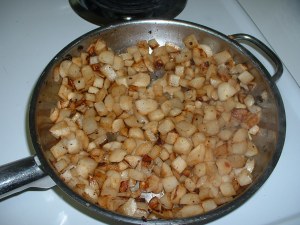
cooking turnips

Avocado slices  (These are high in potassium and other powerful nutrients.)

  1. Spay vegetables with an effective, inexpensive spray (combine 97% distilled white vinegar and 3% hydrogen peroxide); let rest for 3 minutes; rinse really well.
  2. To caramelize onions, melt 1/2 tsp oil in a sauté pan over medium heat; when a piece of onion sizzles in pan, lower heat to med/low; add rest of onions (do not crowd or they will sweat, taking much longer to caramelize). Stir every several minutes, until they began to change color; then, stir every minute, until dark brown; set aside.  Watch carefully while proceeding to next steps.
  3. In another frying pan, heat 2 tsp oil over medium heat; when small piece of sausage sizzles in pan, add the rest; cook quickly until browned, watching closely so as not to burn; place in a bowl, carefully saving juices in pan.
  4. Deglaze hot pan with 2 or more tablespoons of water (scrape fond, cooked-on juices, off bottom); set pan aside.
  5. Peel turnips, dice in small 1/2″ cubes, place in a large bowl, see photo in list of ingredients.
  6. Over medium heat, heat 1 tbsp more of oil in the above pan with juices. When a piece of turnip sizzles, stir in the rest, coating well with oils.  Cook covered until soft, about 10 minutes; stir every few minutes, deglazing pan each time you stir, by adding 2-4 tbsp of water; this additional water will steam the turnips; see above photo.  (Be sure to cover while cooking.)
  7. cooking tomatoes

    Meanwhile chop tomatoes; set aside in a bowl.

  8. Mix tomatoes into soft turnips; sauté uncovered, over medium heat, until they are cooked down-about 15 minutes-at which time a chunky sauce will be formed (see photo). When tomatoes initially begin cooking, stir in oregano, basil, salt, and pepper.  Be sure to cook this uncovered.
  9. Mix in sausage and onions after a somewhat-thick sauce has formed, having chunks of tomato in it; adjust seasonings (see photo).
  10. finished product

    Serve topped with avocado slices, for added health benefits.

Quick and Delicious Leek Soup

bowl of leek soup

The history of leeks is colorful. They have been cultivated both in Europe and Central Asia for thousands of years; they are considered to be native to Central Asia and the Mediterranean, though historical texts from other areas mention them as well.

There are Biblical accounts of their presence in Egypt-in northeastern Africa-during early world history.  When times got tough in the wilderness, the children of Israel longed for this delicacy, to the point that they were willing to return to their captivity under Pharaoh; archaeological digs support the presence of leeks in the Egyptian diet for the past 4 millennia.

Shortly after Christ’s presence on earth, during the first century A.D., the Roman Emperor Nero consumed them daily, for he adhered to their healing power in strengthening one’s singing voice.  Greek philosopher Aristotle concurred with this commonly accepted belief in ancient times, for he attributed the clear voice of the partridge to its diet consisting of this vegetable.

As the Roman Empire spread, its soldiers allegedly brought this choice food to the tables of the United Kingdom, where its popularity grew greatly.  According to legend as far back as the 6th century A.D., Welsh soldiers were wearing a leek in their helmets for identification purposes-a tradition that was carried on in subsequent centuries.  Shakespeare, whom I studied in London in 1974, refers to this Welsh passion in Henry V.  Such enthusiasm continues in Wales in present times, for this member of the onion family is now its national emblem, along with the daffodil.

My first encounter with this Allium occurred in the 1980’s in Billings, Montana, when an Irish friend taught me how to make leek soup, as part of a complete Irish meal.  I had need to know how to cook this national cuisine authentically, for I had contributed a catered St. Patrick’s Day dinner to a fundraiser’s auction, which the local radio station had promoted well; thus, I had ten eager winners expecting the best.  My friend, whose roots were in Ireland, put his heart into equipping me for this fun event; he even made a huge Irish flag, which I still possess.

Leek soup is prevalent in many different nationalities; I serve a Potage Bonne Femme, a potato and leek soup, in a 19th century French banquet, from my repertoire of historical meals.  This present version, however, is superior.  For more recipes and information on leeks, go to  Zucchini Chicken with Leeks and Shallots and Kale, Leeks, and Chicken.

Enjoy this fast soup recipe both now and for years to come; it is that good.

References:

https://draxe.com/leeks/

http://foodfacts.mercola.com/leeks.html

http://www.historic-uk.com/HistoryUK/Historyof Wales/TheLeek-National-emblem-of-the-Welsh

www.wales-calling.com/culture/leeks-and-daffodil.htm

trimming leeks

Leek Soup  Yields: 2 qts.  Total prep time: 1 hr.

3 leeks, white and light green part, 2/3 lb trimmed

1 med/lg yellow onion, chopped small

2 celery ribs, in small dice  (If desired, may omit the celery and double the potatoes, or vice versa double the celery, omitting the potatoes, to be diabetic friendly.)

5 tbsp butter, preferably Kerry butter (If using only celery, 7 tbsp butter will be needed.)

2 small Yukon potatoes, 2/3 lb, peeled and chopped in 1/2″-cubes  (May substitute sweet potatoes, which have a low glycemic index; these add great flavor to soup.)

4 c chicken broth  (Bone broth is best for food value;  for easy recipe, see Tortellini Soup.)

1/2 c water

1 bay leaf

1 tsp salt, or to taste  (Himalayan, pink, or Real Salt is critical for optimum health; a fine grind Himalayan salt is available at Costco for $4.95 for 5 lbs.)

1/2 tsp white pepper, or to taste

1/4 tsp nutmeg, or to taste  (Fresh ground is best.)

1/2 bunch, or 1/2 c chopped, Italian flat parsley  (Organic is only slightly more expensive and much healthier.)

2 tbsp flour, 2 tbsp butter, for roux

1 c whipping cream

1 tsp Better than Bouillon soup base, or to taste  (Chicken flavor is best, but vegetable flavor will also do.)

  1. Spray all vegetables, including parsley, with a vegetable spray (a mixture of 97% distilled white vinegar and 3% hydrogen peroxide is effective and inexpensive).  Let sit for 3 minutes; rinse well.
  2. rinsing chopped leeks

    Remove dark green top off leeks, leaving the white and light green part.  With the root in tact, cut leek in half lengthwise (see above photo); fan out under running water to remove dirt.  Holding the two halves together, cut each leek in 1/4″-thick-slices; place pieces in a large container.  Rinse well with water, stirring with hand (see photo); drain in a colander.

  3. Chop onion and celery, set aside.
  4. Melt 1/4 c butter in a large stock pot over medium heat; chop the celery in small 1/4″-dice.  Watch butter so as not to burn.  (Use 6 tablespoons of butter, if doubling the celery, by omitting the potatoes.)
  5. Add leeks, onion, and celery to melted butter, distributing it well throughout vegetables; cook covered for about 8-10 minutes, stirring several times (this will sweat the onions and leeks, or turn them translucent).
  6. Peel and cut potatoes in small 1/2″-pieces, placing them in a bowl of water to keep them from turning color.
  7. When leeks and onions are translucent, add drained potatoes, broth, 1/2 c water, bay leaf, salt, pepper, and nutmeg to pot.
  8. making roux

    Cover and bring to a boil over med/high heat; lower heat and simmer, partially covered, for about 20 minutes, or until potatoes are soft.  Stir occasionally

  9. Wash parsley, remove stems, chop, and set aside
  10. Make a roux by melting 2 tbsp butter in a small saucepan over medium heat; blend in 2 tbsp of flour with a wire whisk.  Cook until golden brown, mixing continuously.
  11. When potatoes are soft, whisk 1 c of the hot soup broth into pan of roux; add a second c of broth, blending thoroughly-this mixture will be quite thick-then, add this back into the soup.
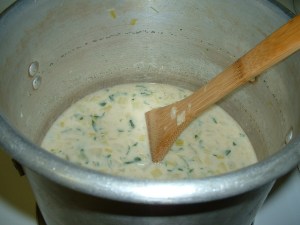
  12. Mix parsley, cream, and roux into soup in stock pot; add a tsp of Better than Bouillon, to heighten taste.  Adjust seasonings and simmer for another five minutes (see photo of finished product).
  13. finished product

    Serve hot and enjoy!  (Flavors meld best after sitting for a day.)

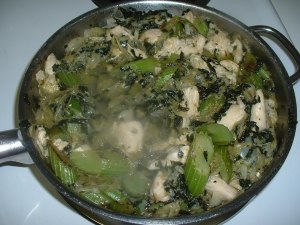
Kale, Leeks, and Chicken

kale, leeks, and chicken

A friend from my church has a very large garden; sharing its bounty is her joy.  Last summer’s series on simplified kale receipts was inspired by her gracious contributions (for recipes, see Cooking with Kale    and  Cooking with Kale Made Extra Easy).

My mind creates recipes according to what is in my larder, which usually boasts of provision supplied by church members.  Lately Goldie has been bringing her organic kale again, as well as leeks and celery; this mouth-watering chicken dish resulted.

For a wedding present last year, I gave a marriage supper, complete with a cooking class, to newlyweds in our congregation (see Thai Coconut Lime Flounder,)  My desire was to release the gift of excellent nutrition in them.  Several weeks ago, we celebrated their holy matrimony again, with a new set of instructions and dinner following, rejoicing over God’s goodness in our lives.

The first time I coached Dina, she exhibited such courage in overcoming her unfamiliarity with food preparation.  Hope, however, grew this recent session, for she has grown exponentially in her eager steadfastness in the kitchen.

This teaching includes my chicken dish, using my recent acquisition of kale, shallots, and leeks.  These steps are straightforward, though they are time-consuming, with the preparation of leeks and kale, but oh the benefits of health and taste!

Leeks are one of the world’s oldest vegetables, which are more delicate in flavor than either onions or shallots; they are considered highly nutritious, with cancer fighting attributes, as well as antiseptic, laxative, and diuretic properties, among many other health-promoting values.  This vegetable is particularly strong in vitamins K and A (when eaten raw, one 3.5-ounce serving contains 52 % daily requirement of vitamin K and more than 29% that of vitamin A).  Though research on this particular Allium is hitherto limited, it can well be assumed that its health benefits are comparable to those proven in its closely related onion and garlic cousins.  Its notable amount of flavonol kaempferol, in its substantial polyphenol content, thereby combats many health problems related to oxidative stress and chronic low-level inflammation; among these are rheumatoid arthritis, obesity, and type 2 diabetes; thus, this recipe is beneficial to Dina, whose husband is presently overcoming diabetes.  For an additional recipe and more on its history, go to Zucchini Chicken with Leeks and Shallots .

Enjoy making today’s clear, detailed chicken recipe for leeks, shallots, and kale; my next entry will expound on the colorful history of leeks, with a delectable soup.

References:

www.foodfacts.mercola.com/leeks.html

www.whfoods.com/genpage.php?tname=foodspice&dbid=26

www.historic-uk.com/HistoryofWales/TheLeek-National-emblem-of-the-Welsh/

finished product

Kale, Leeks, and Chicken  Yields: 5-6 servings.  Total prep time: 1 1/2 hr (lengthy, but well worth it with these simple, detailed directions).

1 1/2 lbs chicken tenderloins, about 8-10 lg pieces  (Natural is best; available reasonably in Trader Joe’s freezer.)

2 lg carrots, optional

3 lg stalks of celery

1-1 1/2 lbs of kale

chopping leeks

4 leeks, white and light green part, 3/4 lb trimmed  (The best leeks are fresh-not more than a week old-and 1 1/2 “in diameter.)

5 lg cloves of garlic, minced  (3 cubes of frozen garlic from Trader Joe’s is much easier.)

4 tbsp butter

8 tsp oil  (Coconut or avocado oil is best, as olive oil is carcinogenic, when heated to high temperatures.)

1-2 tbsp fresh thyme, removed from stems, and coarsely chopped

Salt  (Himalayan, pink, or Real Salt is critical for optimum health; a fine grind Himalayan salt is available at Costco for $4.99 for 5 lbs.)

Fresh ground pepper

  1. Place chicken in a large bowl of warm water to thaw, set aside.
  2. Spray all vegetables with an inexpensive effective spray, by combining 97% white distilled vinegar and 3% hydrogen peroxide; let sit 3 minutes.  While waiting, if using fresh garlic, mince it now.  Rinse sprayed vegetables in a sink full of water three times.
  3. Cut celery diagonally in 1″ pieces.  Scrape optional carrots with a sharp knife (this preserves vitamins just under the skin); slice thinly at a diagonal.  Set both aside together in a bowl.
  4. Prepare leeks by first discarding outer leaves; cut off the dark green at the top and root hairs on bottom, leaving the white and light green part.  Cut each leek in half lengthwise; rinse well; then, cut each half in 2″ pieces, by placing leek cut-side up on board.  Finally, slice these 2″ lengths, cut-side up on board,

    cutting ribs out of kale

    into thin strips (see photo above).  Place pieces in a large container.  For final cleaning, rinse strips well with water, stirring with hand; then, drain in a colander.  This is known as the chiffonade-cut.

  5. Melt butter over medium heat in a sauté pan; as soon as a small piece sizzles in pan, add half the leeks, coating strips well with the hot butter. Reduce heat to low; cook down in pan, to make room for the rest of leeks, distributing oils well with each addition.  When all leeks are in pan, add garlic and slowly cook, covered, over low heat, stirring occasionally.
  6. straight-edge blade of food processor for chopping

    Cut ribs out of kale with a sharp knife (see above photo). May chop by hand, or quickly chop greens mechanically, by using the straight-edge blade of a food processor (see photo).  Turn processor on and place kale pieces in feeder tube (see photo below); set aside.

  7. Place thawed chicken on paper towel, salt and pepper GENEROUSLY.  Heat 1 tbsp of oil in a large frying pan over medium heat; when a small piece of chicken sizzles in oil, add the rest of the tenderloins; cook until light pink inside (do not overcook, as these will cook more later); cut tenderloins in bite-size pieces, removing them to a large bowl.  CAREFULLY SAVE JUICES IN PAN.
  8. Add 1 tbsp of oil to these juices; mix in half the kale, distributing oils evenly.  Over medium heat, cook this vegetable down until there is room to add more; mix in oils with each addition, until all is in the pan; cook covered, until limp, about 10 minutes, stirring occasionally.  As needed, deglaze pan (scrape fond, cooked-on juices, off bottom with a spatula, after adding 2 or more tbsp of water).  Remove to bowl of meat when done.
  9. placing kale in feeder tube of processor

    Meanwhile gently peel thyme off stems, chop coarsely with a sharp knife, set aside.

  10. Put last 2 tsp of oil in hot pan after kale is removed; add carrots and celery; mix well; cook until tender, stirring every couple of minutes.  Meantime go to next step.
  11. Blend 1-2 tbsp chopped thyme, 1/2 tsp salt, and 1/2 tsp pepper into leeks; stir in chicken/kale; continue cooking over low heat, until all is hot.  Add this mixture to pan of celery, when tender.  Adjust seasonings.  One final time, scrape bottom to deglaze pan, using the juices from the added leek mixture.  Serve with confidence!