1880’s Ozark Honey-Oatmeal Cookies

Ozark honey-oatmeal cookies

Here we will look at the detailed history of shortening and the background of early cook books in America, including Miss Parloa’s New Cook Book, 1880; this cook book gives us these delicious Ozark honey-oatmeal cookies.

Early American Cook Books

My library holds many old cook books, some copyrighted in the 1800’s; I also have a number of facsimiles, exact reproductions of the originals.  These latter aren’t considered costly with collectors, but are highly valuable to me, with their precise historical evidence required for my work.

A number of these republications help me with my need for early U.S.A. food history.  For instance one illuminates the 18th century: American Cookery, by Amelia Simmons; this was the first truly U.S. cook book, with such strictly American dishes as Indian pudding, Indian slapjack (pancakes), and johnnycake (flat corn cakes).  1

All early cook books, that were published on our soil, prior to this 1796 publication, were actually reprints of English cook books, none of which contained American ingredients such as: cranberries, clams, cornmeal, shad (fish of the genus Alosa), terrapin (turtles), etc.  2

Interestingly, recipe books were not in demand in our young country, where rivaling colonial plantations jealously guarded their family’s treasured receipts, and rich city dwellers adhered to their individual Old World cooking traditions.  (See Ropa Vieja, for more on the development of American cuisine.)  3

Washburn-Crosby Co. Publishes Miss Parloa’s New Cook Book

In a recent cooking class, I taught Ozark Honey-Oatmeal Cookies from one of my facsimiles: the Silver Dollar City Edition of Miss Parloa’s New Cook Book, which Washburn-Crosby Co. published in Boston originally, in 1880.  Its facsimile was issued at an unknown date during the 20th century, by General Mills, the successor to Washburn-Crosby Co.  Access the fascinating history of Maria Parloa and her cook books, these two flour mills, and this period cuisine at my following entries: 1800’s Escalloped Salmon1880’s Minced Cabbage, and 1880’s Philadelphia Clam Chowder.  4

The History of Shortening

These cookies call for shortening; its definition is fat used in cooking, made from animal, vegetable, or compound manufactured substances.  Examples of the latter are margarine, discovered in France in 1869, and Crisco, which is a hydrogenated vegetable oil, created in America in 1911; Crisco usually comes to mind when shortening is mentioned today.  5

The term shortening, however, first surfaced in the early half of 18th century; it is considered to be American.  As far as cook books are concerned, it appeared in several of Amelia Simmons’ recipes in American Cookery, 1796, such as johnnycake and “another plain cake”, though she doesn’t define the word shortening, which for her purposes probably meant butter or lard.  6

In the April 6, 1892 edition, the New York Times promoted Cottolene, as a “New Shortening…a vegetable product far superior to anything else for shortening and frying purposes”.  This, the first hydrogenated vegetable oil, was primarily used as a cooking medium, in some households.  7

In June of 1911, Procter and Gamble began selling hydrogenated cottonseed oil, as Crisco (short for “crystallized cottonseed oil”); they discovered this shortening in their quest to generate a raw material for soap, through a technique that had its origins in 1897 France.  8

Because of an intense promotional campaign, it became the first popular national shortening product of its kind (this ingredient is extremely prevalent in 20th century recipes).  To this day, Crisco remains the best known brand for this item in the U.S.; there are other well-known brands in a number of other countries.  9

Healthy Ingredients in Ozark Honey-Oatmeal Cookies

These Ozark Honey-Oatmeal Cookies allow for a healthy means to satisfy our sweet tooth, for they are made with such powerful foods as: organic oats, semi-sweet chocolate chips, organic raisins, unsweetened coconut flakes, pumpkin seeds, nuts, raw honey, etc.  In place of required refined sugar, I use the healthy alternative coconut sugar.

The recipe, from this 1880’s cook book, calls for shortening, which probably referred to either butter or lard initially, though those baking from its facsimile, in the 20th century, would have used then popular Crisco.  I leave this choice up to you.

This recipe is easy to make and is extremely good!  Enjoy.

References:

  1. Facsimile of Amelia Simmons, American Cookery, 1796 (Grand Rapids, MI: William B. Eerdmans Publishing Co., 1965), pp. 57, 58.
  2. Esther B. Aresty, The Delectable Past (New York: Simon and Schuster, 1964), pp. 183-186.
  3. Ibid.
  4. Silver Dollar City Edition of Maria Parloa, Miss Parloa’s New Cook Book (Minneapolis: Washburn-Crosby Co., 1880); this facsimile was reproduced by General Mills at an unknown date  in the 20th century.
  5. http://www.foodtimeline.org/shortening.html and https://en.wikipedia.org/wiki/Shortening
  6. Ibid.
  7. Ibid.
  8. Ibid.
  9. Ibid.

mixing oatmeal into dough in stages

1880’s Ozark Honey-Oatmeal Cookies  Adapted from a recipe in General Mills’ 20th century Special Silver Dollar City Edition of Miss Parloa’s New Cook Book, originally published in 1880.  Yields: 4 1/2 dozen.  Total prep time: 1 hr.

1 3/4 cup flour  (May grind 1 1/3 cups organic hard red spring wheat berries, a berry with a high protein content; this makes 2 cups of flour.  (BE SURE to remove 1/4 cup of flour, after it is ground, for the required 1 3/4 cup.)

1/2 c butter, or shortening

1 1/4 c sugar  (Coconut sugar has the most health benefits; see The Best Zucchini Bread for details.)

2 lg eggs

1/3 c honey

1 tsp baking soda

1 tsp salt  (Himalayan, pink, or Real Salt is critical for optimum health; an inexpensive fine grind Himalayan salt is available at Costco for $4.95/5 lbs.)

2 c oats  (Organic is only slightly more expensive; so much healthier.)

1/3 c unsweetened coconut flakes  (Available inexpensively in bulk at our local Winco.)

1/3 c pumpkin seeds

1/3 c nuts, chopped

1/3 c raisins  (Organic is important; available reasonably at Trader Joe’s.)

1/2 c chocolate chips  (High quality, semi-sweet chocolate chips are available at Trader’s.)

Parchment paper, wax paper, and 2 cookie sheets

  1. Preheat oven to 375 degrees.
  2. If grinding your own flour, begin to do so now.
  3. In a large bowl, cream butter and sugar with a fork; beat in eggs, one at a time; blend in honey.
  4. shaping dough in rough rounds

    Stir salt and baking soda into flour, in another large bowl.  (Instead, may place these ingredients in a sealed gallon-size storage bag and shake vigorously.)

  5. Mix this flour mixture into the shortening/sugar/eggs; do not over beat the dough, as this makes cookies tough.
  6. Stir coconut, pumpkin seeds, nuts, chocolate chips, and raisins into this mixture, distributing evenly.
  7. Mix half the oats into this dough gently; then, add other half (see photo at top of recipe); stir with a large rubber spatula or spoon, just until blended.
  8. Using a teaspoon, drop dough 2 inches apart on parchment-paper-covered cookie sheet, shaping rounds roughly with fingers, as you go (see above photo).
  9. Place pan in preheated oven for about 9-10 minutes, or until golden brown.
  10. Meanwhile, start shaping dough-rounds on a second parchment-lined pan.
  11. When first pan is done, immediately start baking this second pan.
  12. cookies baked to perfection

    Cool baked cookies on cookie sheet for 2 minutes (see photo).   Remove and place them on a large piece of wax paper.

  13. Using a new piece of parchment paper, prepare the third pan of cookies, to be ready for the oven as soon as second batch is done (pans should be cool before spooning dough on them-may place them in the refrigerator).  Repeat until all the dough is used.
  14. These freeze well, to have on hand for healthy snacks.

Blum’s Coffee Toffee Pie

Blum’s Coffee Toffee Pie

The following is the colorful story of the arrival of Blum’s Coffee Toffee Pie in my family’s history; more over it marks the beginning of the hand of Providence saving me for my work as a food historian.

Multiple Variations of this Pie

This recipe served as the basis for numerous delightful variations, which we served in our family restaurant in Montana’s glorious Glacier National Park (see Nutty Coconut Pie and Chocolate Mint Pie).

Blum’s Background

It all started with my need for a unique eye operation in San Francisco in 1968.  As we walked these lively streets, we witnessed our nation’s struggle to discover love through the hippie movement.  We, however, nurtured our hungry souls at the beloved Blum’s everyday.

This confectionery, bakery, and restaurant began charming San Francisco in the 1950’s; it closed in the 70’s.  There we devotedly indulged in its famous Coffee Toffee Pie; my strong mother bravely asked for the recipe, which they gave her.  (They must have given it to many others as well, for numerous recipes of this are now available on-line.)

Over the decades through my family’s development of it, this receipt has emerged in ways that are outstanding, making its preparation simply foolproof.  Among many improvements, we freeze this pie for long-term use, preferring it only partially thawed, which gives it an ice cream-like texture.  Numerous tips make this dessert a pure joy, to be made with ease.

My Destiny as a Food Historian

Without any doubt, our lives have purpose, for we are created to fulfill specific works that only we are equipped to do.  My calling, as a writer of food history, has taken shape over my entire life.  Many times death has tried to steal this precious gift from me.  My mother’s prayers, however, have covered me with the required protection, for without prayer God’s hands are tied.

My first monumental memory of our Father’s intervention was in 1967, when I incurred a near fatal concussion from a car accident.  Mom’s simple faith brought me back from what spelled destruction: I was neither dead nor a vegetable, as doctors were declaring.  Though I didn’t yet know Jesus personally in 1967, Mom’s steadfast heart acted as my shield and miracles occurred.

The preservation of my life was the first wonder, but another ensued.  Due to the concussion, the part of my brain that controlled my oblique eye muscle was severely damaged, resulting in intense double vision.

Unique Eye Operation Taking Us to San Francisco

At that time, there were only three doctors in the U.S. that could perform the needed operation, then with only a 50% chance of any correction.  Thus in the spring of 1968, we were off to San Francisco, where Dr. Paul at University Hospital perfected my sight completely!  As always, Mom’s prayer life brought rich dividends.

This surgeon took my eye out of my head to shorten the errant muscle, so I saw this lively city with only half my vision, as a patch covered the deep blood-red of that, where his skillful hands had been.  Nevertheless, San Francisco charmed me.

Celebration Then and Now

Celebrate, with me, God’s good and entire provision for our lives; receive this outstanding historical receipt, with its foolproof directions!

Blum’s coffee toffee pie

Blum’s Coffee Toffee Pie  Yields: 1-10″ pie.  Total prep time: 1 1/2 hr, plus 1/2 hr for cooling/  active prep time: 1 1/4 hr/  baking time: 15 min.

1 c flour  (Optional: may grind 1/3 c organic hard red spring wheat berries and 1/3 c organic soft winter white wheat berries to make a total of 1 c of fresh ground flour.)

1/2 tsp salt  (Himalayan, pink, or Real Salt is important for optimum health; an inexpensive fine grind Himalayan salt is available at Costco.)

3/4 c butter, softened

1/4 c brown sugar, packed down  (Organic is best; available sometimes at Costco and always at Trader Joe’s.)

3/4 c walnuts, chopped fine

2 oz Baker’s unsweetened chocolate, plus extra for garnish

1 tbsp water

1 tsp vanilla extract

3/4 c cane sugar  (Organic is ideal, best buy is at Costco, also available in a smaller quantity at Trader’s.)

2 lg eggs, at room temperature  (If sensitive to raw eggs, may use pasteurized eggs for extra safety, which are available at some grocery stores.)

8 tsp instant coffee

2 c heavy whipping cream

1/2 c powdered sugar  (High quality organic is available at Trader’s.)

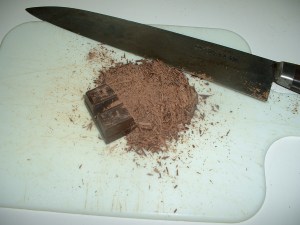
  1. grating of chocolate

    IF grinding fresh flour, do so now.

  2. Preheat oven to 375 degrees.  Place a bowl in freezer for whipping cream (the whipping of cream is greatly facilitated when utensils are ice cold).
  3. Combine flour and salt; blend in a scant 1/4 c butter with a fork until mealy in texture.
  4. Mix in brown sugar, walnuts, and 1 oz chocolate, grated with a sharp knife (see photo); add water and vanilla; blend well.
  5. Butter a pie plate generously; press pie dough in pan firmly with fingers. Bake for 15-18 minutes, or until light brown; begin cooling on a rack, for about 10 minutes, finish cooling in freezer.
  6. While crust is cooling, melt 1 oz chocolate over med/low heat, watching carefully as not to burn. Set aside and cool.
  7. Beat 1/2 c butter in a large bowl with an electric mixer until creamy.  Gradually add 3/4 c cane sugar, beating well with each small addition.
  8. Add 1 egg; mix on medium speed for 5 minutes.  (The following makes this preparation foolproof.  It is so important to have ingredients at room temperature; if your kitchen is either really hot or cold, this mixture may curdle.  You can easily correct this: if it curdles or breaks because it is too hot, make the addition of the second egg a cold one, directly out of the refrigerator, to bring the filling back to its full volume.  If the butter/sugar/egg combination is too cold and curdles, warm the chocolate a little and mix this in before adding the second egg; then, follow the directions for beating.  Ideally when done, this mixture should be like fluffy whipped butter or soft whipped cream, providing ingredients are room temperature, in a moderate kitchen.  In this way, you will never fail with this recipe!)
  9. assembling of pie

    Blend in cooled chocolate and 2 tsp of coffee into whipped filling.

  10. Add second egg and beat for 5 minutes more.
  11. Wash beaters and put in freezer, for whipping cream.
  12. Place filling in cold pie crust; put in freezer for 30 minutes, for filling to set up.
  13. With ice cold bowl and beaters, beat cream until it starts to thicken.  Add powdered sugar and 2 tbsp coffee; continue beating until stiff.  Cover pie with whipped cream and garnish with chocolate curls.  See photo at top of recipe.
  14. May eat now, or for long-term use return to freezer; when frozen, cover well with plastic wrap, to cut pieces as needed.  Serve partially thawed for optimum pleasure.

Portuguese Figos Recheados

figos recheados

This is the third and last of my Portuguese recipes for this great ethnic meal; I, however, serve this candy/fruit figos recheados with many other meals as well.

When I entertain, I always serve homemade candies along with the dessert.  Usually these are my Peruvian bolitos de chocolat y coco (see 2016/11/28) and the treasured national candy of India barfi; this recipe will follow in the future.  Lately, however, Portuguese figos recheados (figs stuffed with chocolate and almonds) are the final inspiration at my dinners.  Such was the recent case with my beloved missionary friends Val and Waffle Lomilo.  I take a tangent today into their world, so we can learn better to eat with reverence.

My relationship with Val goes back 22 years.  Our mutual friend Kelly, who now resides in heaven, introduced us to each other in 1995, over slides in her basement of Val’s mission work in Uganda.   My heart had just been softened, by my asking Jesus to live in it; thus, my supple emotions were mesmerized by this people and especially their food.

I learned that the meager diet of these poorest of poor, which are in my friends’ arid, mission region, consists primarily of foraged herbs and a bitter fruit with its nut, which is boiled three times to make it palatable; garden vegetables are available only as the frequent droughts allow; maize (cooked corn mush) and beans are also a luxury, which they can’t always afford.

The diet of the wealthier, in Uganda’s more lush areas, has a greater amount of organic garden vegetables, along with such fruits as mangoes and papayas, and ample beans and maize.  Also to my delight, it includes the ceremonial slaughter of a chicken for honored guests.

This nourishment of these better-off is simple and pure, making it healthier than ours with all our fast foods and altered ingredients, such as added hormones in meat/dairy products, foods with GMO’s, etc.  (Note: in this poor country genetically moderated organisms being added to their crops is just now becoming a controversy; they have already lifted the ban for GMO’s in the banana crop, due to its recent huge failure.)

In America food is so available that obesity is a major problem.  Our countrymen are often thrilled with weight loss when they visit Africa.  On the other hand, Africans are overjoyed with the compliment ‘you look so fat’, and gratitude is expressed after a meal with ‘thank you for increasing my volume’.

At present there is a famine in Uganda’s arid region, which hurts the children and elderly the most.  We in this country can’t comprehend such food shortage and its effect on the human spirit.  According to my friends, it produces a sense of deep community, in those that withstand it, as they share each other’s pain.   These humble people know the true meaning of God’s grace that keeps them alive in stark adversity.

Waffle and Val, who experience a heart for the broken, feed these hungry souls the word of God, which is also known as the bread of life.  This proven substance, in turn, can provide them with answers to their natural needs, for this is what our gracious Father does best.

We are grateful for our vast provision here in America, as we strive to honor our bodies with healthy eating.  At the same time, our faithful prayers move mountains as we intercede for those less-fortunate.

Now, may we take courage to experience moderate, joy-filled pleasure in this incredible dessert: be blessed by these simple figos recheados, the last recipe in my Portuguese series.

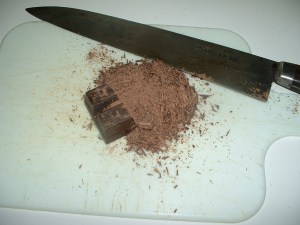
shaving chocolate

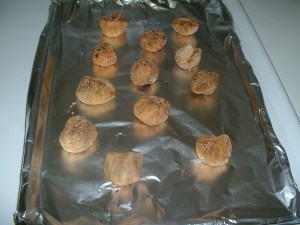
figs ready for baking

Figos Recheados (dried figs stuffed with almonds and chocolate)  Yields: 12 large stuffed figs.  Total prep time: 35 min.

Note: these are best served hot, but they are also great at either room temperature or cold.


1/4 cup almonds, plus 12 extra almonds (18 extra almonds will be needed for topping smaller figs, such as mission figs.)

12 large figs   (Turkish figs are best for size and quality; 18 figs will be needed, if using the smaller mission fig.)

1/2 ounce (1/2 square) semi-sweet chocolate, finely grated

  1. For hot figs at the end of a meal, do steps 2-9 ahead; then, set aside.  Twenty minutes before serving, preheat oven to 350 degrees and bake as directed in step 10-11.
  2. Preheat oven to 350 degrees.
  3. Place almonds on a cookie sheet and bake for 15 minutes in middle of oven; go to next step.
  4. With a sharp knife, finely grate the chocolate, place in a small bowl, set aside (see photo above).
  5. Cut off stems of figs; make a careful, but deep, indentation in the opening of each with the tip of your finger; set aside.
  6. After nuts are toasted, remove from oven, and take off pan to cool quickly.  Set aside 12 almonds (18 for smaller figs) and pulverize the other 1/4 cup in a food processor, by repeatedly touching the pulse button.  (May use a blender or Vita Mix.)
  7. Add almond meal to grated chocolate; mix well.
  8. Using a spoon and your finger, press this mixture in the hollow of each of the figs; pinch openings together firmly (see above photo).  Place stuffed figs, stem side up, on a foil-lined baking sheet.
  9. Bake in middle of an oven, preheated to 350 degrees, for 5 minutes; then, turn figs upside down and bake for an additional 5 minutes.
  10. Gently, but firmly, press a whole toasted almond in top of each hot fig.
  11. May keep leftovers in refrigerator for future use  (cold figs are also excellent).

Sweet Potato Pie

sweet potato pie

sweet potato pie

Sweet potato pie and Christmas go together.  “Ring those Christmas bells; light the Christmas tree!”  This familiar carol burst forth vitally for me first in 1994; then, I had just invited Jesus into my heart.  Incipient, living joy impacted me with this song, in my initial Sunday service, during that month of December.

For decades the Salvation Army has rung those Christmas bells every holiday season; they have invited us always to reach out to the less fortunate.

Last year a dear bell-ringer came into my life; George lite up the Fred Meyer’s grocery store, where I took my daily coffee.  During the holidays, this man reminisced about his mother’s sweet potato pie.  As he formed his words, my heart contrived an extraordinary surprise: I could develop a sweet potato pie for him.

Days later Christmas came alive for me much the same as in 1994: I delivered my newfound creation, this seasonal treat, to my cherished bell-ringer.

My heart leaped with joy, when George returned this year, for once more I got to give my sweet potato pie to him.  May you, too, shower your loved ones this holiday with this blessed recipe!

To learn more about the differences between sweet potatoes and yams go to African Nkyemire.  Also enjoy this tuber in my Sprouted Quinoa and Yam Salad, 2019/09/05.

  1. dscf0070Sweet Potato Pie  Yields 1-10″ pie.  Total prep time: 3 1/4 hr/  active prep time: 3/4 hr/  baking time: 1 hr (for sweet potatoes the day before) and 1 1/2 hr (for pie the day of).

2 c baked, peeled sweet potatoes, packed down in cup  (You will need 1 1/2 lbs or 2 medium sweet potatoes-note that yams are a variety of sweet potatoes in America.)

1 1/4 c half and half

1 c brown sugar, packed  (Organic is best; available at Trader Joe’s; coconut sugar is also excellent.)

3/4 tsp salt  (Himalayan, pink, or Real Salt is critical for optimum health; a fine grind Himalayan salt is available inexpensively at Costco.)

4 1/2 tsp cinnamon

1 tsp ginger

1/4 tsp ground cloves

1 tsp vanilla

4 lg eggs

  1. Preheat oven to 350 degrees.  Wash sweet potatoes, dry, and pierce with a fork.  Wrap potatoes in foil and place on a cookie sheet.  Bake in oven until soft, for about 1 hour, depending on size of potatoes.  Cool.  MAY BE DONE A DAY AHEAD.
  2. Note: if you don’t have a food processor, go to step 5 for doing this by hand.  If using a food processor, place 2 c peeled sweet potatoes in the processor.  Blend well.
  3. Place mashed sweet potatoes in a large bowl and add cream, milk, sugar, salt, spices, and vanilla; blend well with a wire whisk.
  4. Add eggs and beat again; set aside.  Proceed to pie crust.
  5. If doing this by hand, mash well peeled sweet potatoes, with a potato masher or large fork; follow steps 3 and 4.  Set aside when filling is complete.  Proceed to pie crust.

Pie Crust  Yields: 2  pie crusts.  (Note: this recipe requires 3/5’s of these 2 crusts; the rest may be baked into cinnamon sugar strips.)

1 1/4 c unbleached white flour  (Bob’s Red Mill organic is high quality.)

1 c whole wheat pastry flour  (I grind 2/3 c organic soft winter wheat berries, to make 1 c of whole wheat pastry flour.)

1 tsp salt

2/3 c oil  (Grapeseed or canola oil is best.)

1/3 c plus 1 tbsp boiling water

Wax paper  (This makes for a mess-free rolling out of the pie crust.)

  1. Preheat oven to 350 degrees.
  2. With a fork, blend flours and salt together in a medium bowl.
  3. Mix in oil and boiling water until all flour is incorporated.
  4. Form into two balls and cover in plastic wrap.  (One ball should be 3/5’s of the dough; the other smaller ball can be made into cinnamon strips and baked along with the pie.)  Place balls on top of hot oven to keep warm.
  5. Using a rolling-pin, roll out larger ball, between 2-18″ pieces of wax paper. Make a big, slightly oblong circle-12 1/2″ x 15″-with the dough (see above photo).  Peel off top piece of wax paper.  Turn upside down and gently place pie crust over a 10-inch pie plate, with the wax paper side up.  Very carefully peel the wax paper off.  With fingers, seal any cracks in crust and form a rim around the edge of plate with the dough; patch lean areas of the crust with excess from other areas.
  6. Pour the sweet potato puree in the pie crust.  Bake for 1 1/2 hr, or until a knife comes out clean, when inserted in center.
  7. This is good!

Bolitos de Chocolat y Coco

Bolitos de chocolat y coco

bolitos de chocolat y coco

1985 was a big year for me, for I traveled to Peru-from whence this recipe is derived-that summer to study food, while later in September I went to Paris, with the intent of moving my business there. (Read more about my time in France in Balsamic Vinaigrette, 2016/08/22.)

My jocund days in Peru were filled with the warm blazing sun, but nights were very cold, as July brings winter to this nation in the southern hemisphere.

Machu Picchu met my love for mountains in a grand way.  The ancient trail leading to these ruins made for an arduous climb; we got off the train and labored, with copious sweat, for hours to complete its last leg.  What a memorable day!

My far-reaching, historical catering business was three years old during my time in South America, in the 1980’s, and my mind was a sponge for details about food. While there, every morsel that went into my mouth came out as a comment in my journal.  Most of this keen eating took place in inexpensive cafes, where chickens were always roasting on open hearths.  The better of these humble restaurants had guinea pig and Cebiche, raw white fish “cooked” in lemon juice.  Street vendors’ food also provided me with rich information, but my greatest joy was the private dinner invitations I received, to both rich and poor homes.  Note: there are only these two classes there.

Karen, my then neighbor in Billings, Montana, and her Peruvian boyfriend inspired me to make this colorful sojourn.  Indeed Chino’s family blessed my trip: I may not be alive today, but for them, as great trauma occurred for me in this country. Fortunately for me, his family was extremely influential; for instance, his second cousin was president during my visit.  (This man was ousted a number of days after I left; Chino’s brother-in-law was murdered by terrorists several months later.)

My trouble came when I and my traveling companion, a longtime friend from Paris, let down our guards.  We always covered each other’s backs in the marketplace, as robbery is ever-present in this poor nation; we, however, went our separate ways one day in Cusco.  On my own, I was mesmerized by the wide array of vendor’s goods: blankets on the ground displayed raw meats, brightly dressed women loudly announced their vibrant vegetables, modest pots and pans were set up elsewhere.  Stopping I indulged in a delicious, doughnut-like pastry; next, I reached for my funds to buy freshly squeezed orange juice.  My wallet was gone!

Absolutely everything of importance was in it: my passport, money, travelers’ checks, credit cards, and return ticket home.  This unseasoned traveler was without identity and provision in a volatile place.

God’s grace got me to my homeland safely through a multitude of miracles. The last of these happened just hours before my plane’s departure, for the president of Aero Peru, a friend of Chino’s family, reinstated my plane ticket at this critical moment.

Even before I experienced this culture, my repertoire of catered meals included a Peruvian dinner. The background for this authentic repast came from a cook book, from that country, shared by Chino’s girlfriend; nevertheless, this account was strictly for the upper class.  For hors d’ouvres at these events, I used the youth’s favored dish Ocopa-chunks of boiled, bland purple potatoes, topped with cheese, walnuts, mild chiles, and eggs. The main course boasted of Aji de Gallina, an incredible walnut chicken. Dessert was Suspiro Limeno, a light, airy custard; the feast ended with Bolitos de Chocolat y Coco.  To this day, these chocolate/coconut balls are the finishing touch at ever meal I host.

Chocolate has an interesting history.  Spanish explorer Hernando Cortez introduced cocao beans to Europe in 1528, when he returned from “New Spain”.  There the Aztecs mixed cocao paste with spices to make a thick drink.  In their convent at Oaxaca, creative Spanish nuns added sugar, which made this chocolate beverage even more palatable.  1

Chocolate was highly prized then and still is today; these superb, truffle-like candies-a rich man’s food in Peru-will please any chocolate lover.  This recipe is simple and foolproof; don’t miss this delectable treat.

  1. James Trager, The Food Chronology (New York: Henry Holt and Company, 1995), p. 89.
Making bolitos de chocolat y coco

chocolate after stirring in coconut

Bolitos de Chocolat y Coco (Peruvian chocolate/coconut balls)  Yields: about 6 dozen balls. Total prep time: 45 min.

12 oz unsweetened chocolate  (Baker’s works well.)

1-14 oz can sweetened condensed milk  (It’s important to use Borden’s Eagle Brand.)

2 tsp butter

2 c unsweetened fine-flake coconut  (Available in bulk at our local Winco and other supermarkets.)

  1. Break chocolate into pieces in a medium-size, heavy-bottom saucepan.
  2. Add butter, melt slowly over low heat.  Watch carefully, so as not to burn.
  3. Meanwhile open the can of milk and place 1/2 c of coconut in a measuring cup.  Set aside.
  4. When chocolate is completely melted, quickly add condensed milk.
  5. Stir over low heat for about 30 seconds; it will start forming a soft ball. Toward the end of the 30 seconds, stir in the coconut.  Do not overcook, or chocolate will be dry.  Immediately remove from heat after these 30 seconds; continue to stir vigorously until soft ball is formed all the way.  See photo.
  6. Cool just enough for handling.
  7. Place 1/2 c of coconut in a small bowl.  (You will add more coconut to the dish as needed.)  Form small balls of chocolate and roll in coconut, placing them in an 8×8 inch pan.
  8. Chill chocolate for several hours; then, transfer balls to a freezer-storage bag.  These will keep for a very long time, if you double the bag for long-term freezing.
  9. Excellent chocolate, so easy, absolutely foolproof.


Rosee, a Medieval Dish Flavored with Rose Petals

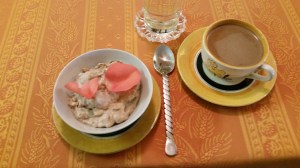
Rosee-a medieval dish flavored with rose petals

rosee, a dish flavored with rose petals

As I was envisioning this series on foods of the Middle Ages, I was told of a renaissance happening here in our city: we have been chosen as one of eight finalists in a national competition called America’s Best Communities.  Its goal is community revival in America.  This makes me aspire towards Tualatin leading the United States in the regeneration of its local people.

The best is always saved for last-dessert!  This medieval recipe, rosee, reproduces more of the excellent flavors of King Richard II’s court.  However there is a greater value in this post; here I share my vision for revival along with this delicious dish.

Some historians say the Renaissance, or birth of humanism, had its heritage in the beliefs and customs of the Middle Ages.  I discovered this truth in The Encyclopedia of the Renaissance.  This movement’s inheritance is defined there, for its patrons were often the medieval church and the papacy, while its artistic themes reflected the lives of the saints and stories from the Bible.  The questions of the Christian faith and morals were its issues, while the prayers and canons of the Mass constituted the texts for its music. Indeed the burgeoning of the Renaissance is founded in the spiritual and intellectual traditions of the medieval church. 1

A number of historians made this connection.  Likewise my series on 14th century, medieval foods gave me impetus for a proclamation: I see an awakening happening here in Tualatin, which began with prayer in my Abundant Life Family Church.  Indeed, we will lead our country in renewal, a renaissance.

Our town has already received $100,000, as a finalist in the above competition, to establish this vision.  Mobile Makerspaces, a well-equipped trailer, presently reaches certain schools.  It establishes a powerful birthright in our children, who are our future.  This happens with a bounty of traveling technical equipment, such as creative electronics and 3-D pens.  These ingenious tools give tomorrow’s citizens hands-on experience with big concepts in STEAM (an acronym for science, technology, engineering, arts, and mathematics).  Mobile Makerspaces is igniting our youth with passion for these disciplines.

Our city’s Mayor Lou Ogden, the Tualatin Chamber of Commerce, Mirror & Mask Community Theatre, Tualatin Public Library, and Tigard-Tualatin Public School District are all partnered together to implement our winning project.  Tualatin will grow as a result of this promotion of ‘on-fire learning’.  These powerful activities draw our excited youth into careers in these areas.  Much will be accomplished as a result of this.  Our own underemployed and unemployed will get jobs, while our local industries’ deep need for skilled workers will be met.

I clearly see us as winners; we will lead the nation in community revival.  Tualatin’s future is rosy, so is America’s!

  1.  Paul F. Grendler, ed., Encyclopedia of the Renaissance, 6 volumes (New York:  Charles Scribner’s Sons, 1999), Vol. 1, p.431-436.

Rosee, a Dish Flavored with Rose Petals  Yields: 4 servings.  Total active prep time: 1 hr, with an additional 1 1/2 hr for chilling.  This is adapted from a historical recipe in Lorna Sass’ To the King’s Taste (New York: Metropolitan Art Museum, 1975), pp. 100, 101, 116, 117.

5/8 c whole raw almonds

1 1/4 c boiling water

1 1/2  tbsp honey

dash salt, plus more for garnishing  (Himalayan, pink, or Real salt is critical for optimum health; an inexpensive fine grind Himalayan salt is available at Costco.)

1/4 c dried, crushed rose petals  (You may use the 1/2 c fresh petals that haven’t been sprayed; tear these into small pieces.)

1/4 tsp cinnamon

1/8 tsp dried ginger

1 tsp rice flour  (Rice flour is available in bulk at certain supermarkets, such as our local, upscale New Seasons.)

1/2 c dates, chopped fine

1 1/2 tbsp pine nuts

1/2 c heavy whipping cream

Fresh rose petals for garnish  (These are optional.)

  1. Chill a med/large bowl and beaters for an electric mixer in the freezer; this facilitates the whipping of the cream.
  2. Prepare almond milk: place almonds in a food processor and repeatedly press the pulse button, until nuts are finely ground.
  3. Boil water in a medium saucepan.  Dissolve honey and dash of salt in boiling water.  Stir in ground nuts.  Take off heat, let sit for 10 minutes, stir several times.
  4. Add rose petals to almond milk and let soak for 10 minutes more.
  5. Add cinnamon and ginger.  Cook for 5 minutes over low heat; stir occasionally.
  6. Sprinkle flour over milk mixture; continue cooking, while beating with a wire whisk until thickened.
  7. Add dates and pine nuts.  Mix well with a spoon.  Remove from heat, set aside, and cool to room temperature.  Do not cool in refrigerator.
  8. After custard is cool, easily beat the cream in the frozen bowl, until it forms soft peaks.
  9. Fold whipped cream into cooled custard.  Chill in individual serving dishes.
  10. Lightly salt each serving; garnish with 2 fresh rose petals, if desired.


1950’s Pear Pie

Fresh pear pie

fresh pear pie

The history of sugar is intriguing, spanning the continents.  Here we will examine the major turning points in the background of this substance.

My mother gave her children the choice of birthday cakes.  I was hard put to choose between banana cake-see 2016/08/08-and fresh pear pie.  My soul still thrills with the beautiful taste of baked pears, rich crumb topping, and the best of pie crusts.

I am so health conscious; thus I have experimented with using sugar alternatives here.  Coconut sugar or sucanat (evaporated cane juice) can not compete with cane sugar in this receipt. Only sugar insures the right texture and flavor in pear pie.

Sugar has been around for the longest time.  Saccharum officinarum, sugar cane, originated in the South Pacific’s New Guinea and was subsequently carried by human migration into Asia.  Sometime before 500 B.C., people in India were producing raw, unrefined sugar.  1

Its first known reference was in 325 B.C., when  Alexander the Great’s admiral Nearchus wrote of reeds in India that produce “honey” without any bees.  The word sugar began to appear frequently in Indian literature around 300 B.C.  This Sanskrit word sarkara, meaning gravel or pebble, became the Arabic sukhar, which finally came to be sugar.  2

The use of Indian sugar cane spread.  Around the 6th century after Christ, it was planted in the moist terrains of the Middle East, where the Persians made sugar a prized ingredient in their cooking.  After Islamic Arabs conquered Persia in the 7th century, they took the cane to northern Africa and Syria; it eventually made its way to Spain and Sicily.  3

Sugar in Europe was barely known until around 1100, and it remained a mere luxury until the 1700’s.  The western Europeans’ first encounter with sugar was during their Crusades to the Holy Lands in the 11th century.  Shortly thereafter Venice became the hub of Arabic sugar trade for western Europe, while the first known large shipment went to England in 1319.  4

At first the western Europeans treated it like other exotic imports-e.g., pepper and ginger-strictly as medicine and flavoring: it was produced in small medicinal morsels, as well as preserved fruits and flowers.  These sweets or candy first began being made by apothecaries, or druggists, which were making “confections” to balance the body’s principles.  The word confection is taken from Latin conficere. meaning “to put together” or “to prepare”.  5

The medieval years brought sugary nonconfections to Europe, such as candied almonds, as well as the use of this substance in recipes for French and English courts.  The chefs of royalty employed sugar in sauces for fish and fowl, for candying hams, and in desserts of various fruit and cream/egg combinations.  Around 1475, the Vatican librarian Platina wrote that sugar was now being produced in Crete and Sicily, as well as India and Arabia.  Columbus carried the cane to what is now Haiti and the Dominican Republic in 1493, on his second voyage.  6

By the 18th century, whole cook books were devoted to confectionery, which had become an art no longer associated with medicine.  During this century, sugar consumption exploded in Europe, with the rise of colonial rule in the West Indies and the enslavement of millions of Africans, resulting in the sugar industry becoming the major force behind slavery in the Americas (one estimate holds that fully two-thirds of the twenty million African slaves worked on sugar plantations).  This industry saw rapid decline later in the 1700’s, with the abolition movements, especially in Britain; the other European countries followed, one by one through the mid-19th century, in outlawing slavery in the colonies.  7

Sugar, however, had now become a world staple.  Presently 80% of its production comes from sugar cane, while most of the rest is derived from sugar beets.  8

Wisdom and moderation are needed with this substance.  Today our nation consumes sugar in unhealthy amounts.  Personally I hold fast to the adage of Mary Poppin’s:  “A spoonful of sugar helps the medicine go down.”  My standard is to substitute more beneficial sweeteners wherever possible.  However, there are times when only cane sugar will do.   My precious pear pie is one of them!

Enjoy this carefree, mess-free recipe.

References:

  1. Harold McGee, On Food and Cooking  (New York: Scribner, 1984, 2004), p. 648.
  2. James Trager, The Food Chronology  (New York: Henry Holt and Company, 1995), p. 19.
  3. Harold McGee, On Food and Cooking  (New York: Scribner, 1984, 2004), p. 648, 649.
  4.  Ibid., pp. 648, 649.
  5. Ibid., p. 649.
  6. Ibid., pp. 649, 650.
  7. Ibid., pp. 650, 651.
  8. https://en.wikipedia.org/wiki/Sugarcane
Pear pie, whipped cream, and freshly ground nutmeg

pear pie, whipped cream, and freshly ground nutmeg

Pear Pie with Hot Water Pastry Crust  Yields: 1-10″pie.  Total prep time: 1 1/4 hr/  active prep time: 30 min/  baking time: 45 min.

1 1/4 c unbleached white flour  (Bob’s Red Mill is high quality.)

1 1/3  c whole wheat pastry flour  (May grind 1 c soft white winter wheat berries for 1 1/2 c total fresh ground whole wheat pastry flour, carefully measuring needed amounts.)

1 tsp salt (Himalayan, pink, or Real Salt is critical for optimum health; a fine grind Himalayan salt is available very reasonably at Costco.)

2/3 c oil  (Grapeseed or avocado oil is best, available inexpensively at Trader Joe’s and Costco.)

1/3 c boiling water.

1 c sugar  (Organic cane sugar id preferable; available in 2 lb packages at Trader’s, but more economical  in 10 lb bags at Costco)

1/3 c butter, softened

5 lg Bartlett pears, ripened  (May use Anjou pears as well, but Bartletts are best, must be ripened.)

1 c heavy whipping cream  (Lightly sweeten this with powdered sugar.)

Nutmeg  (Freshly ground is superb!)

  1. Preheat oven to 450 degrees.
  2. Blend unbleached white flour, 1 c of whole wheat pastry flour, and salt in a large bowl.
  3. Add oil and boiling water; mix lightly with a fork.
  4. Divide into two balls, one much larger than the other; cover balls with plastic wrap and place on hot stove to keep warm.  (You will need to use 3/5’s of dough for this single crust for a 10″-pie plate; may bake leftover 2/5’s of dough in strips with butter and cinnamon sugar.)
  5. Roll out the large ball of dough between 2-18″ long pieces of wax paper. Form a very large, oblong circle which reaches to the sides of the paper.
  6. Gently peel off the top sheet of wax paper; turn over and place piece of rolled dough, wax paper side up, over a 10″-pie plate. Very carefully peel off the second piece of wax paper.
  7. Patch any holes in crust by pressing warm dough together with fingers. Form rim of crust on edge of pie plate by pressing dough together gently, using excess dough from heavier areas to make up for areas where dough is sparse.
  8. Mix 1/3 c of whole wheat pastry flour and sugar in same bowl in which you made the pie crust.  Blend in butter with a fork, until mealy in texture.
  9. Sprinkle 1/3 of this mixture in bottom of unbaked pie shell.
  10. Fill crust with peeled pear halves.  Fill in spaces with smaller pieces.
  11. Evenly spread remaining flour mixture on top of pears.
  12. Bake at 450 degrees for 15 minutes.  Reduce heat to 350 degrees and bake for 30 minutes more, or until crust is golden brown.
  13. Cool, serve with whipped cream and freshly grated nutmeg.  Mouthwatering!

Williamsburg Orange Cake

Williamsburg Orange Cake

Williamsburg Orange Cake

This Williamsburg Orange Cake dates back to the mid-twentieth century.  Personally, the spring and summer of 1973 brimmed with vitality for me; I had taken the quarter off from college “to find myself.”  However, I forgot my mother’s birthday in the midst of my prosperity.

My heart broke when I soon realized my mistake.  To make amends I baked and delivered this glorious cake; I drove it 200 miles across Montana’s Big Sky country, from Missoula to East Glacier Park.  My benevolent mother graciously welcomed both me and this exquisite confection!

This beloved parent learned the powerful lesson of forgiveness in her youth; she is always eager and ready to forgive as a result of this.  Mom taught me this precious wisdom, which exempts us from much disruption when mistakes are made: immediately we amend all with our Father in heaven; next, we lavishly forgive others and ourselves; finally as needed, we seek compassion from those we have hurt in our wrongdoing. This spells freedom for our emotions and minds!

Me, my brother Paul, mother Pat, sister Maureen

me, my brother Paul, mother Pat, sister Maureen-June 2016

That was Mom’s 50th birthday and the first time I made this Williamsburg Orange Cake.  I went home to Montana to celebrate her 93rd birthday this past June.  We had a repeat of this treasured sweet!

The recipe calls for zesting oranges.  I like to equip my sister’s kitchen with gadgets which I find helpful in cooking.  This year I blessed her with a GoodGrip zester and thus insured my ease in making this cake. GoodGrip is high quality and economical.  A large array of this brand’s useful gadgets is available at our local Winco.  This particular zester is most efficient; it makes a difficult job super easy.

My recipe appears lengthy.  It is actually very simple, for I have included many baker’s tips. Don’t be daunted by deceptive looks!

Williamsburg Orange Cake  Yields: 2-9 inch round layers, 3-8 inch rounds, or 2-9 x 5 inch loaves.  Total prep time: 2 hr, plus 1 hr to freeze cakes for easy frosting/ active prep time: 1 1/2 hr/  baking time: 30 min.

2 1/2 c flour  (Bob’s Red Mill  organic unbleached white flour is of high quality; better yet grind 1 2/3 c organic soft white wheat berries to make 2 1/2 c of flour.)

1 c raisins, soaked in boiling water  (Organic raisins are available inexpensively at Trader Joe’s.)

1 1/2 c milk or cream, soured

lemon juice from a squeeze ball for souring

1 1/2 tsp baking soda

3/4 tsp salt  (Himalayan, pink, or Real salt is critical for optimum health; an inexpensive, fine grind Himalayan salt is available at Costco.)

3/4 c butter, softened  (This 1970’s cake called for a mixture of butter and the then popular Crisco; see Ozark Honey-Oatmeal Cookies, 2017/10/30, for history of Crisco.)

1 1/2 c sugar  (May use coconut sugar, or sucanat, which is evaporated cane juice; if using sugar, organic cane sugar is premium.)

3 lg eggs, at room temperature

1 1/2 tsp vanilla

3 oranges  (It is important to use organic, as the zest of regular oranges taste of pesticides.)

1 c pecan pieces

Spray oil  (Coconut spray oil is best.)

Flour for dusting pans

Williamsburg Orange Frosting  (This is for 2-9 x 5 inch loaf pans or 2-9 inch round layers; 1 1/2 recipes will be needed if making 3-8 inch round layers.)

1/2 c butter, softened

4 c powdered sugar  (Organic is available at Trader Joe’s.)

1 1/2 tbsp orange zest

3/8 c orange juice, freshly squeezed from above oranges

1/2 tsp vanilla extract

1/4 tsp salt

10 narrow slices of orange rind, cut lengthwise on surface of orange (see top photo).

Cake

  1. Preheat oven to 350 degrees.
  2. If using freshly ground flour, begin grinding now.
  3. Cover raisins with water in a small saucepan, bring to a boil, remove from heat, and set aside.
  4. Place milk or cream in a medium bowl; sour with about 6 squirts of lemon juice from ball; let sit.
  5. Stir together flour, salt, and baking soda in a med/large bowl with a fork.
  6. In a large bowl, beat 3/4 c butter until light and fluffy, mix in sugar gradually, beating thoroughly.  Add 1 egg at a time, mixing well with each addition.  Blend in vanilla.
  7. Add 1/2 the flour to butter mixture, beating only until all is incorporated; then, mix in 1/2 the soured milk. Repeat these steps to use all the flour and milk; do not over-beat, as this toughens cakes and cookies.
  8. Wash and dry oranges.  Zest 2 oranges and set zest aside; save these two oranges for juice for frosting.  The third unpeeled one will be used for optional decorative strips.
  9. Drain the raisins, which have been become plump in the hot water. Blend the raisins, l tbsp of zest, and nuts into the cake batter.
  10. Spray pans with coconut oil and dust with flour lightly. (Rinse nozzle on can with hot water, for easy spraying in future.)  Pour batter in the prepared cake pans.
  11. Bake for 30-35 minutes, or until toothpick comes out clean.  Cake should respond, bounce back, when pressed with your finger.  Do not over bake!
  12. Cool in pan for 5 minutes to facilitate removal; slide knife around edges to gently remove; then, freeze cakes on separate paper plates for about an hour-this prevents cake from crumbling while frosting.

Frosting  (Note: make 1 1/2 recipes for 3-8 inch round layers.)

  1. Cut 10 narrow slices of rind, lengthwise on surface of third orange for optional decoration: using a sharp knife, cut just below rind from top to bottom of orange, gently peel stripes off orange, set aside (see top photo of decorated cake).
  2. Squeeze oranges to extract 3/8 c juice, set aside.
  3. In a med/large bowl, beat 1/2 c butter until light and fluffy, preferably with an electric hand mixer.
  4. Mix in 2 c of powdered sugar.
  5. Beat in 1/4 c of orange juice, 1 1/2 tbsp zest, vanilla, and salt.  Add remaining sugar, 1 c at a time, blending well; set aside.  (Save extra orange juice.)
  6. Frost frozen cake layers or loafs.  (Add the extra orange juice 1 tbsp at a time, only if frosting is too stiff to spread easily.)  Optional: decorate with slices of orange rind while frosting is still wet, arranging narrow slices back-to-back on top of cake (see top photo).
  7. If making the loaf cakes, to keep in freezer for unexpected company, be sure to freeze the frosting on cake, before sealing in gallon-size freezer bag.
  8. Enjoy this delightful cake!

1950’s Banana Cake

1950's banana cake

1950’s banana cake

My mother let each child choose his own birthday cake while we were growing up.  My little heart worked overtime each year to decide between banana cake and fresh pear pie.  Both are awe-inspiring!

I spell out the wonders of my mother’s banana cake here. The delectable pie will follow this fall in a series of recipes extolling my family’s favorite meal since the 1950’s; until then you will be pleased with this memorable confection.

I grew up in the small tourist village of East Glacier Park, Montana.  It is the east entrance to the spectacular display of Rocky Mountains in Glacier National Park.  I have seen mountain ranges all over the world; none compare with that of my home.

There my young mother was mentored by several “older” women as I was maturing; one was Leone Brown.  She was all of 50 at the time, but she seemed very old to me.  This knowledgeable woman taught Mom much about cooking.  She created many beautiful crafts for her as well; my 93-year old mother still has her handmade Easter eggs, made out of delicate egg shells.

This beloved cake is the fruit of Leone’s bountiful wisdom; personally I have been making it with joy since the early ’70’s.  Believe me, it will knock your socks off!

Banana Cake  Yields: 2-9 inch layer or 2-9 x 5 inch loaf pans.  Total prep time: 2 1/4 hr (with  inactive prep time of 1 hr or longer for freezing cakes to facilitate easy frosting)/  active prep time: 50 min/  baking time: 25 min.

Note:  1 1/2 recipes will be needed for 3-8 inch layers.  I like to make 2-loaf cakes and freeze them separately on paper plates, sealed in gallon-size freezer bags, for cutting off frozen slices as needed.  Dessert is always on hand for unexpected guests!

1/4 c milk, soured with few drops of lemon juice from a squeeze ball

3/4 c butter, softened

1 1/2 c sugar  (I prefer coconut sugar, or sucanat, evaporated cane juice.)

2 lg eggs

2 1/2 c flour  (Bob’s Red Mill unbleached flour is high quality, or grind 1  2/3 c organic soft white winter wheat berries to make 2 1/2 c fresh ground flour.)

1 tsp baking soda

1/2 tsp baking powder

1/2 tsp salt  (Himalayan, pink, or Real Salt is critical for optimum health; Himalayan salt is available inexpensively in fine grind at Costco.)

3 ripe medium bananas  (1 1/2 c mashed)

1 tsp vanilla

Spray oil  (Coconut spray oil is best; Pam is available in most supermarkets; our local Winco brand, however, is cheaper.)

Flour for dusting the sprayed pans

  1. Preheat oven to 375 degrees.
  2. Sour milk in a med/large bowl with a few drops of lemon juice from a squeeze ball, set aside.
  3. Cream butter in a large bowl, add sugar, and beat until light.  Add eggs, 1 at a time, beating well with each addition.  Set aside.
  4. Shake together flour, baking soda, baking powder, and salt in a sealed gallon-size storage bag, or stir all together in a large bowl with a fork.
  5. Add bananas and vanilla to sour milk, mash bananas with a fork, and blend all (set aside).
  6. Mix 1/2 the flour mixture into butter; then, add 1/2 the mashed bananas into this, beating only until all is incorporated, as over-beating toughens cakes and cookies.  Repeat steps, using remaining flour and bananas.
  7. Spray cake pans; dust with flour.
  8. Pour batter in prepared pans.  Bake for about 25 minutes, or until a toothpick comes back clean and cake lightly springs bake when you press with finger.  Do not over-bake (time varies with size of pans).
  9. Cool in pan for 5 minutes.  Then, slide a knife around the edges, gently remove cakes, and freeze these on paper plates for at least 1 hour, to facilitate frosting (this inhibits the crumbling of cake as you frost).

Cream Nut Frosting  (Note: make 1 1/2 recipes for a 3-layer cake.)

2 1/2 tbsp flour

1/2 c cream  (Heavy organic whipping cream is best for health.)

1/2 c butter, softened

1/2 c sugar  (Preferably organic cane sugar; available at Costco or Trader Joe’s.)

1/4 tsp salt

1/2 tsp vanilla

4 c powdered sugar (Trader’s has organic powdered cane sugar.)

1 c pecan pieces (Least expensive when bought in bulk at local supermarket.)

  1. Blend flour and cream in a small saucepan with a wire whisk.  Cook over med/low heat, stirring constantly, until a thick paste is formed.  Set aside to cool to room temperature.
  2. Cream butter in a large bowl with an electric mixer, add 1/2 c regular sugar, beat until light and fluffy.
  3. Blend in salt and vanilla.
  4. Mix in cooled cream paste, beat well.
  5. Add 1 c of powdered sugar, beating thoroughly.  Add rest of powdered sugar, 1 c at a time, beating with each addition until all is incorporated.
  6. Frost the frozen layer or loaf cakes.  Cover top and sides with pecan pieces. (If freezing cakes for future use, be sure to freeze frosting on cakes before sealing in gallon-size freezer bags.)

19th Century French Lemon Meringues a la Ude

Meringues a la Ude

meringues a la Ude

This is the third and final post on my simple 19th century French dinner.  These tart, gluten-free meringues a la Ude are a summer delight!  They are easy to prepare, though it takes about one hour of light labor; a child can follow these care-free steps of preparation.

These lemon meringues are effortless, because it’s another recipe from Louis Eustache Ude’s The French Cook, 1813; the lemon filling, however, is mine.  Ude also created the easy, delightful chicken a l’oignon of this series (see 2016/07/04).

This man’s incredible mind conceived elegant foods with the simplest preparations. His extraordinary talent placed him in the illustrious palace of King Louis XVI, before the fall of the monarchy; after his escape in 1795, he taught England his secrets.

Teaching young Nat how to cook.

teaching young Nate how to make meringues

I discovered this privileged information in Esther B. Aresty’s The Delectable Past  (New York: Simon and Schuster, 1964).  This recipe is even easier for us today than it was for Ude’s followers, for we have the electric mixer to beat the egg whites!

Organic cane sugar works well for this receipt.  Nevertheless you may use regular refined cane sugar (C & H is a good brand.)

I tried to make the meringues with coconut sugar, which was a huge disaster. Sucanat, evaporated cane juice, doesn’t work either, as it is not fine enough to be incorporated in the beaten egg whites.  So stick with cane sugar, using either organic or regular.

19th century French costumeThis post includes a photo of my period costume for my 19th century French meals, which I wear when doing public events.  It is very beautiful, though it is quite bulky on me now, for I weighed 226 pounds when my costume designer fashioned it.

My Lord has healed my body and mind!  The result is a very voluminous dress on my small frame, which is joy unspeakable-health and more health!


Meringues a la Ude with Lemon Filling Adapted from a recipe in Esther B. Aresty’s The Delectable Past (New York: Simon and Schuster, 1964).  Yields: 1 dozen gluten-free meringues.  Total prep time: 1 3/4 hr/  active prep time: 1 hr/  baking time: 1 hr.

3 large egg whites (save 2 yolks for filling)

2 pinches salt

1 cup of sugar (Organic cane sugar is best; available in a 2 pound package at Trader Joe’s, or in a cheaper 10 pound bag at Costco.)

1/2 tsp lemon or orange extract, optional

  1. Preheat oven to 225 degrees.
  2. Separate egg whites in a large bowl (save 2 yolks).  Add salt and beat the whites until quite stiff, using an electric mixer.
  3. Add sugar very slowly-a scant teaspoon at a time-keeping the beaters going constantly.  As whites get really thick, after about 3/4 cup of sugar is added, increase additions to 2 tablespoons at a time.  When all the sugar is incorporated, continue to beat for several minutes.  Mix in optional extract.
  4. Cover a cookie sheet with parchment paper; spoon egg whites on the paper in small mounds, about 2 1/2 inches long, in the shape of an egg.
  5. Bake for about 60-70 minutes, or until golden brown and rather sturdy.
  6. While warm, gently cut an indentation in the meringue with a small sharp knife.  Scooping delicately with your finger, make a hollow in each.
  7. Set aside and cool completely.
  8. Fill each meringue with lemon filling just before serving.

Lemon Filling (about 3 cups, enough for a dozen meringues)

3 medium organic lemons  (Regular lemons will have taste of pesticides.)

1/4 cup cornstarch

1/4 cup sugar  (Organic cane sugar is best.)

1/4 tsp salt

2 cup cold water

2 large egg yolks

2 tbsp of butter

  1. Clean and zest lemons; juice and set aside.
  2. Mix cornstarch, sugar, and salt in a medium sauce pan.
  3. Add water; mix well with a wire whisk.
  4. Beat in egg yolks thoroughly.
  5. Bring to a boil over medium heat, whisking constantly; continue boiling for 1 minute more, or until thickened.
  6. Add butter, lemon zest, and juice; blend well with whisk.
  7. Remove from heat. Cool in refrigerator, covering the top of filling with a piece of plastic wrap, once cool.
  8. Spoon filling into meringues just before serving.
  9. Serve open face.  The tart, yellow lemon filling shouts summer’s blessings!