Nutty/Lemon/Coconut Bars

nutty/lemon/coconut bars

This recipe for nutty/lemon/coconut bars is from the mid-1960’s, given to me by my beautiful aunt Sheila.  She made them for her family, while living in East Glacier Park, Montana.

My Personal Background Surrounding these Bars

A decade later, after moving 90 miles away to Kalispell, this same aunt watched over me like a hen over her chick, as I was then recovering from bulimia and anorexia (for more on my history of healing, see 1970’s Atomic Muffins, Quinoa Dishes, 1950’s Sweet and Sour Meatloaf, and Williamsburg Orange Cake).

Having overcome much in her own life, she was willing to share her victories.  She approached her covering of me, as a humble friend, coming along side me gently. We spent numerous hours in each others company, usually over food, while we frequently perused the daily reading from her treasured God Calling, an inspired devotional written by two women in England.  How I recall our immense excitement over the accuracy, with which these prophetic, living words touched our souls!

Sheila loved good edibles.  From the seventies on, after her move to the city, her delight, however, was to indulge in fine cuisine at restaurants; she had given up spending the necessary preparatory time in the kitchen.  Her constant discovery of new establishments blessed us here in Portland, Oregon, where we both resided before she passed away in the 90’s.

From Shopping to Consumption: the Process of Nourishment

Unlike my aunt, for me the height of indulgence in food is found in the strength imparted by the whole hands-on process, from the beginning to the end stages, of preparing and receiving nourishing substance.  This starts initially with the act of shopping, it intensifies as I press in over a stove, and it culminates in a grand finale as I partake of pleasures at the table.  For me, each level is essential in the mastery of the art of fine cuisine; likewise all require diligence in their practice,

For instance, shopping can bring joyful breakthrough.  The hunting for specials at Fred Meyer recently benefited me greatly: the produce worker John and I were chatting, while he was doing his work and I was examining artichokes; he suddenly broke out excitedly, “I can teach you how to test this vegetable for freshness.”  He proceeded to show me how to squeeze its middle, instructing that if it flattens out it is past its prime.  Eagerly he promised that when watermelon season arrives, his expertise will be at its prime, for he never misses with this fruit-I can’t wait to share this tidbit with you also.

From the grocery store, I go to my kitchen, equipped with the best.  There I purpose to set my day’s thoughts aside, as I settle into cooking, striving for the critical peace, so mistakes don’t happen.

Julia Child’s Help with Forthcoming Chefs

Julia Child comes to mind, with her passion for every aspect of fine food, especially her fervency in sharing her knowledge with the world; this can be seen clearly in her approach to helping young, aspiring chefs.  As with so many others, I was taken under her wings, with five encouraging letters in the 80’s and 90’s.  Her covering was a gift from God, who longs to envelop us with such protective shelter, as he did for me with my aunt in earlier years.  Indeed, I have become who I am today, by humbly receiving such guidance from authorities.

Sheila’s nutty coconut bars satisfy the child within, with their lemon savor; it’s my joy to share these with you.  See NuttyCoconut Pie for history of coconut and coconut oil.

Bon appetit!

finished product

Nutty/Lemon/Coconut Bars  Yields: about 30 bars.  Total prep time: 1 hr.

1 c plus 2 tbsp flour  (Bob’s Red Mill organic unbleached white flour is ideal.)

1/2 c butter, softened

1 1/2 c brown sugar  (Organic is preferable, available at Costco, also at Trader Joe’s in an 1 1/2 lb bag.)

1/2 tsp baking powder

2 large eggs, beaten

1 tsp vanilla

1 tsp salt

1 c unsweetened coconut shredded flakes (This is available in Bob’s Red Mill packages at most grocery stores, where it is also frequently sold in bulk.)

1 c pecans

1 1/2 c powdered sugar  (Organic can be found at Costco and Trader’s.)

1/3 c fresh lemon juice  (3 small/med lemons will be needed.)

  1. baked crust

    Preheat oven to 375 degrees.

  2. Cream butter and 1/2 c brown sugar in a bowl; add 1 c flour, over which baking powder is sprinkled evenly; work together with a fork, until it becomes mealy, like pie crust.  Pat this down firmly in the bottom of an ungreased 9” x 12” pan (this size pan is out-dated; you may substitute the equivalent in square inches, or around 108″.  2-8” x 8” pans will work; 2-9″ x 9″ pans, however, will be too large).  Bake for 12 minutes; then, remove from oven; see photo above.
  3. Meanwhile beat eggs well; mix in vanilla and salt; blend in 1 c brown sugar, 2 tbsp flour, coconut, and pecans.  Spread this mixture over baked-crust (see photo below).  Return to oven and bake for 25 minutes more, or until golden brown (see photo at top of recipe).  Prepare frosting next.
  4. spreading coconut mixture over crust

    First, place 1 1/2 c powdered sugar in a medium bowl; then, measure and pour lemon juice over sugar; beat with a spatula until lumps are gone; set aside.

  5. When bars are through baking, immediately pour lemon frosting over top; cool before cutting.  How I love these!
Holiday Dips

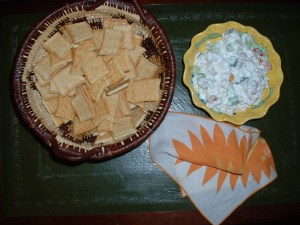
cottage cheese/apricot/green onion dip

Let healthy, creative dips enhance your holiday entertaining; two of my favorites are made in just minutes, using protein-rich cottage cheese for a base.  One, which only adds salsa, dates back to my profound, childhood experience at a restaurant in Tucson, Arizona (see “About”).  The other was inspired by my recent need for additional potassium in my diet; thus, dried apricots, rich in this element, and green onions make another pleasing combination for this dairy product.

When I lived in Switzerland briefly in the 1970’s, I was captivated by their cottage cheese, which to my amazement was without the coagulated lumps that we are used to in the U.S.  Their smooth, thick, creamy substance was more like our cream cheese, though not as stiff.  These soft, uniform curds were excellent with muesli, fruits, raw vegetables, crackers, breads, and more.  (Some European cottage cheese is dry and salty, not so with my rhapsodic Swiss cottage cheese.)

In trying to learn more about this blessing from Europe, I discovered a good source for making one’s own; this site provides a recipe that produces either the creamy smooth or dry salty versions, simply by adjusting the heating time.  Access this incredible treat, which can’t be found in any U.S. grocery store, at: https://cheese.wonderhowto.com/how-to/make-your-own-cottage-cheese-european-way-352742/

Different textured and flavored cheeses are produced by variations in the temperature the milk is heated to, the diverse procedures of draining and pressing the resultant curds, and aging.  For instance, soft, semi-soft, semi-hard, and hard cheeses are often categorized according to their moisture content, which is determined by whether they are pressed or not, and if so, the pressure with which the cheese is packed in molds, as well as upon aging.

“Fresh cheeses” are the most simple of all, in which milk is curdled and drained, with little other processing.  Among these “acid-set cheeses”, cottage cheese, cream cheese, fromage blanc, and curd cheese (also known as quark) are not pressed; when fresh cheese is pressed, it becomes the malleable, solid pot cheese; even further pressing makes a drier, more crumbly farmer’s cheese, paneer, and goat’s milk chevre, for instance.  All are easy to spread, velvety, and mild-flavored.

The unpressed quark/curd cheese is common in the German-speaking countries and those of northern Europe, the Netherlands, Hungary, Belgium, Albania, Israel, Romania, as well as with the Slavic peoples.  It is also found in some parts of the United States and Canada.

Quark is usually synonymous with cottage cheese in Eastern Europe, though these differ in America and Germany, where cottage cheese has lumps (the flavor of German cottage cheese is much more sour than ours).  Curd cheese or quark is similar to French fromage blanc, Indian paneer, Spanish queso blanco, as well as the yogurt cheeses of south and central Asia and parts of the Arab world.

These (fresh) acid-set cheeses are coagulated milk, which has been soured naturally, or by the addition of lactic acid bacteria; this in turn is heated to a 20-27 degrees C, or until the desired curdling is met; then, the curds are drained, but not pressed, such as in the link above.

In America, quark, which is always smooth, differs from our cottage cheese, which has curdled chunks in it.  These lumps are large in the low-acid variant, which uses rennet in coagulating the milk, or small in the high-acid form, without any rennet. In Germany, Sauermilchkase (sour milk cheese) applies to ripened (aged) acid-set cheeses only, not to fresh ones-such as their cottage cheese, which is called Huttenkase.

The world of cheese is a complex one:  I have vivid memories of this smooth European cottage cheese, from my time in the German-speaking part of Switzerland, which has left me with a love for this dairy product.  To this day I frequently employ its American version in my diet.  Enjoy these quick dips!

References:

https://www.thespruce.com/what-is-pot-cheese-591193

https://en.wikipedia.org/wiki/Quark_(dairy_product)

https://en.wikipedia.org/wiki/Cottage_cheese

https://en.wikipedia.org/wiki/Sour_milk_cheese

https://en.wikipedia.org/wiki/Types_of_cheese#Fresh.2C_whey.2C_and_stretched_curd_cheeses

https://cheese.wonderhowto.com/how-to/make-your-own-cottage-cheese-european-way-352742/

Salsa and Cottage Cheese Dip  Yields: about 1 1/2 pint.  Total prep time: 5 min.

1 pint cottage cheese  (Whole milk is best for your health; Trader Joe’s brand is hormone and additive free.)

1/2 c salsa  (Trader’s Pineapple Salsa is superb here.)

Tortilla chips  (Que Pasa makes an organic red chip, colored with beet dye, available in nutrition center at our local Fred Meyer-Kroger-

ingredients for salsa dip

stores.)

  1. Mix cottage cheese and salsa in a bowl.
  2. Serve with chips.  (Keeps well in refrigerator.)

ingredients for apricot dip

Cottage Cheese, Apricots, and Green Onion Dip  Yields: about 1 3/4 pints.  Total prep time: 15 min.  Note: may choose to refrigerate for at least 8 hr for ideal flavor and texture.

1 pint cottage cheese

1/2 c dried apricots, minced

1 c green onion, including green part, chopped

1/2 tsp salt, or to taste  (Real Salt, pink salt, is important for optimum health; available in nutrition center at local supermarket.)

  1. Mix the above together in a bowl.
  2. Serve with a high quality cracker.  (May use immediately, but this is much better when refrigerated for at least 8 hours-the flavors not only meld, but the excess moisture in the cottage cheese is absorbed by the dried apricots, producing superb texture and taste!)

Nutty Coconut Pie-a Variation of Blum’s Coffee Toffee Pie

nutty coconut pie

This nutty coconut pie is my sister’s inspiration from 1980, during her days of running our family’s restaurant, in Montana’s Glacier National Park.

A Variation of Blum’s Coffee Toffee Pie

Among Maureen’s sumptuous creations, this coconut pie was one of my favorites.  It is her modification of Blum’s coffee toffee pie-a recipe we received in 1968, when I had a serious eye operation in San Francisco (see Blum’s Coffee Toffee Pie).  Maureen ingeniously produced multiple variations of this basic receipt, which likewise thrill; their unique directions will follow over time.

Origins of Coconut

As a child, I loved coconut: my father’s coconut cream pie, the favored coconut Russell Stover Easter eggs in our yearly baskets, and fresh coconut-to mention but a few of my titillating experiences with that food.

This fruit of the Cocos nucifera has been regarded as the jewel of the tropics; in which it often has been called the tree of life, for their people have depended on it not only for food, but shelter, and much more-every part of it has been used for both culinary and non-culinary purposes.

The Spreading of Coconut by Nature and Man

The powerful coconut originated in India and Southeast Asia; with the floating properties given by its light shell, it apparently made its way independently by marine currents, to every subtropical coastline in both hemispheres.

Historians also agree that it traveled the world at the hands of men; sea-faring Arab traders most likely brought this treasure to East Africa long ago (they actively were obtaining it from India by the 8th century AD).  These same traders were responsible for its introduction to Europeans on the trans-Asian Silk Road; the Venetian adventurer Marco Polo was among those who encountered this food; he named it “Pharaoh’s nut” in Egypt in the 13th century.  Beginning in the early 1500’s, this prized fruit made its way back to Europe following such explorer-colonizers as Portuguese Vasco da Gama.

Our prolific coconut evidently floated to the New World shores, where it prospered in its tropical lands; in addition, the European adventurers brought it to the Caribbean and Brazil, from whence it further spread to the American tropics.

The Arrival of Coconut in the United States

For instance in 1878, the merchant vessel Providencia-carrying this fruit from Trinidad-ran aground the coast of Florida; this resulted in a drastic change in the landscape, which became inundated with palm trees; nevertheless, the coconut didn’t change the economy much here, as was the frequent occurrence in other locales, where multi-products resulted.

The Important Coconut Product: Oil

The coconut product, which interests me most, is oil, for I use this extensively in my cooking.  Many believe that this is the healthiest of all oils for our internal bodies, as well as being ideal in external beauty regimens.  It is held that among its helpful health benefits are: weight loss, boasting the immune system, and “oil pulling” in detoxifying and cleansing the body.

Coconut Oil’s Resistance to Oxidation When Heated

Here, however, I choose to elaborate on its exceptional cooking qualities, for it has the greatest resistance to oxidation (spoilage)-when heated-of any oil on earth; this is due to its 92% saturated fatty acids, which represents the highest percentage in any oil.  This effectual make-up provides extraordinary protection against heat and the formation of free radicals, which are associated with many diseases, such as cancer.  How is this?

Make-up of Saturated Fats

Saturated fats are full of hydrogen atoms in their carbon atom chain, giving them a durable molecular structure; thus, they can be heated to high temperatures, resisting oxidation.  They are crucial for maximum health for this reason-among other sound benefits, which I haven’t room to address in this entry.

Monounsaturated and Polyunsaturated Fatty Acids

On the other hand, monounsaturated fatty acids lack a pair of hydrogen atoms, while polyunsaturated fatty acids are missing two or more.  Monounsaturated and polyunsaturated fatty acids are highly unstable and prone to oxidation, without the durable molecular structure, as found in all saturated fatty acids.

Trans Fat and Interesterified Fat

Trans fat and interesterified fat are manufactured fat molecules that don’t exist in nature; they were generated in an attempt to get more solid, stable fatty substances (examples are shortening and margarine).  Both these types should be avoided all together (for more on the history of Crisco, see 1880’s Ozark Honey-Oatmeal Cookies).

The Most Saturated of All Oils-Coconut Oil

In a natural way, coconut oil achieves these objectives, which man was seeking by forming these fake fats.  Coconut, as the most saturated of all oils, is superlative both in being naturally stable/solid and in having an abundance of health attributes, over and above all other oils on the market, in my estimation.

As I have always loved the taste of coconut, I additionally find this oil enlarges the flavor of my foods.

Coconut in Today’s Recipe

Unsweetened dried coconut enhances our already delightful nutty coconut recipe.  By reducing this pie’s over-all sweetness, it allows for the full impact of the fruit.  (This unsweetened flake is available in bulk in many upscale grocery stores, as well as at our local, inexpensive Winco.)

May I encourage you to slow down and smell the roses: allow yourself the luxury of the time required to produce this memorable pleasure-a gift from God, made with the ease of my sister’s foolproof directions.

References:

  1. Harold McGee, On Food and Cooking (New York: Scribner, 1984, 2004), pp. 508, 509.
  2. Reay Tannahill, Food in History (New York: Three Rivers Press, 1988, 1973 by Reay Tannahill), pp. 141, 220n.
  3. http://www.coconut-oil-central.com/
  4. http://www.aramcoworld.com/en-US/Articles/January-2017/Cracking-Coconut-s-History
  5. https://www.livescience.com/54901-free-radicals.html

a piece of nutty coconut pie

Nutty Coconut Pie, a Variation on Blum’s  Yields: 1-9” pie, 8 servings.  Active prep time: 1 1/2 hr/  inactive prep time for setting up: 1/2 hr.  Note: can be kept in the freezer for long-term use, cutting off pieces as needed; serve partially thawed for a favored ice cream-like texture.

1 1/2 c nuts, chopped small and roasted

1 3/4 c unsweetened coconut flakes, toasted  (Available inexpensively in bulk at our local Winco.)

1 c unbleached white flour  (Optional: may grind 2/3 c organic soft winter white wheat berries to make a total of 1 c fresh ground flour.)

1/2 tsp salt  (Himalayan, pink, or Real Salt is critical for optimum health; a fine grind Himalayan salt is available cheaply at Costco.)

1/2 c plus 3-4 tbsp butter, softened

1/4 c brown sugar, packed down  (Organic is best; available sometimes at Costco and always at Trader Joe’s.)

1 oz unsweetened chocolate, grated  (Baker’s will do.)

1 tbsp water

1 tsp vanilla extract

3/4 c cane sugar  (Organic is ideal; best buy is at Costco; also available in a smaller quantity at Trader’s.)

2 lg eggs, at room temperature  (If sensitive to raw eggs, may use pasteurized eggs for extra safety; available at some grocery stores.)

1 c heavy whipping cream

1/3 c powdered sugar  (High quality organic is available at Trader’s.)

3 tbsp, or more, instant vanilla pudding mix, only if needed as a stabilizer  (Be sure to have on hand for quick correction.)

Ganache

1 c heavy whipping cream

8 oz semi-sweet chocolate chips, or semisweet chocolate of your choice  (These chocolate chips are available at Trader Joe’s.)

1 tsp vanilla

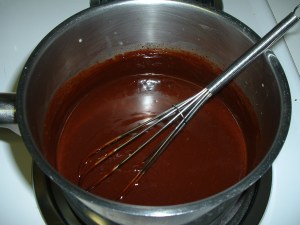
  1. finished ganache

    If grinding fresh flour, do so now.

  2. Preheat oven to 350 degrees.  Place nuts on a cookie sheet in hot oven for 7 minutes, watching closely as not to burn; set aside to cool.
  3. Distribute coconut in a pan with edge; bake until golden brown, about 5-7 minutes, stirring mid-way; set aside.  Leave oven on.
  4. Place bowl for whipping cream in freezer to chill; this greatly facilitates the whipping process (keep beaters at room temperature for filling).
  5. Make ganache-see list of ingredients above-by bringing cream to a very low simmer, over med/low heat (should be hot-steaming-not boiling); add chocolate pieces and continue to cook, beating with a wire whisk, until mixture is glossy/shiny.  Remove from heat, add vanilla, set aside (see photo above).
  6. filling beaten to perfection

    Combine flour and salt in a large bowl; blend a scant 4 tbsp butter with a fork, until mealy in texture (only 3 tbsp will be needed if using fresh-ground flour).

  7. Mix together with flour: brown sugar, 3/4 c cooled nuts, and 1 oz unsweetened chocolate, which has been grated with a sharp knife.  Blend in water and 1 tsp vanilla.
  8. Butter a pie plate generously; press pie dough in pan firmly with fingers. Bake for 18 minutes in preheated oven at 350 degrees; cool in freezer.
  9. Beat 1/2 c butter in a large bowl with an electric mixer until creamy.  Gradually add 3/4 c cane sugar, beating well with each small addition.
  10. Add 1 egg; mix on medium speed for 5 minutes; beat in second egg

    layer of ganache on crust

    for 5 minutes more.  This filling should be like fluffy whipped butter or soft whipped cream when done; see above photo. (The following makes this preparation foolproof.  It is so important to have ingredients at room temperature; if your kitchen is either very hot or cold, this mixture may curdle.  This is easily corrected, by beating in 3 tbsp of instant vanilla pudding mix-more may be needed-to reach the desired soft, full-bodied consistency.  In this way, you will never fail with this recipe!)

  11. Wash and freeze beaters, along with bowl, for whipping cream with exceptional ease.
  12. Pour a thin layer of ganache on bottom of cooled pie crust-about 1/2 inch thick (see photo above); set the rest aside for garnish (leftover ganache can be refrigerated indefinitely in a glass jar; great, when warmed, over ice cream).  Place crust back in freezer for several minutes.
  13. Fold 3/4 c nuts and coconut into filling, SAVING 1/4 c coconut for garnish.
  14. filled pie

    Spoon filling evenly into pie crust (see photo); let mixture set-up by freezing for 1/2 hour.

  15. Meanwhile, using ice-cold utensils, beat cream until it starts to thicken; add powdered sugar and vanilla; continue beating until stiff.
  16. When filling is set, cover pie with whipped cream; drizzle ganache over top; garnish with toasted coconut (see very top photo).
  17. If keeping for long-term use, be sure to freeze uncovered; then, cover extra well with plastic wrap.  I love serving this partially frozen for optimum pleasure.

Blum’s Coffee Toffee Pie

Blum’s Coffee Toffee Pie

The following is the colorful story of the arrival of Blum’s Coffee Toffee Pie in my family’s history; more over it marks the beginning of the hand of Providence saving me for my work as a food historian.

Multiple Variations of this Pie

This recipe served as the basis for numerous delightful variations, which we served in our family restaurant in Montana’s glorious Glacier National Park (see Nutty Coconut Pie and Chocolate Mint Pie).

Blum’s Background

It all started with my need for a unique eye operation in San Francisco in 1968.  As we walked these lively streets, we witnessed our nation’s struggle to discover love through the hippie movement.  We, however, nurtured our hungry souls at the beloved Blum’s everyday.

This confectionery, bakery, and restaurant began charming San Francisco in the 1950’s; it closed in the 70’s.  There we devotedly indulged in its famous Coffee Toffee Pie; my strong mother bravely asked for the recipe, which they gave her.  (They must have given it to many others as well, for numerous recipes of this are now available on-line.)

Over the decades through my family’s development of it, this receipt has emerged in ways that are outstanding, making its preparation simply foolproof.  Among many improvements, we freeze this pie for long-term use, preferring it only partially thawed, which gives it an ice cream-like texture.  Numerous tips make this dessert a pure joy, to be made with ease.

My Destiny as a Food Historian

Without any doubt, our lives have purpose, for we are created to fulfill specific works that only we are equipped to do.  My calling, as a writer of food history, has taken shape over my entire life.  Many times death has tried to steal this precious gift from me.  My mother’s prayers, however, have covered me with the required protection, for without prayer God’s hands are tied.

My first monumental memory of our Father’s intervention was in 1967, when I incurred a near fatal concussion from a car accident.  Mom’s simple faith brought me back from what spelled destruction: I was neither dead nor a vegetable, as doctors were declaring.  Though I didn’t yet know Jesus personally in 1967, Mom’s steadfast heart acted as my shield and miracles occurred.

The preservation of my life was the first wonder, but another ensued.  Due to the concussion, the part of my brain that controlled my oblique eye muscle was severely damaged, resulting in intense double vision.

Unique Eye Operation Taking Us to San Francisco

At that time, there were only three doctors in the U.S. that could perform the needed operation, then with only a 50% chance of any correction.  Thus in the spring of 1968, we were off to San Francisco, where Dr. Paul at University Hospital perfected my sight completely!  As always, Mom’s prayer life brought rich dividends.

This surgeon took my eye out of my head to shorten the errant muscle, so I saw this lively city with only half my vision, as a patch covered the deep blood-red of that, where his skillful hands had been.  Nevertheless, San Francisco charmed me.

Celebration Then and Now

Celebrate, with me, God’s good and entire provision for our lives; receive this outstanding historical receipt, with its foolproof directions!

Blum’s coffee toffee pie

Blum’s Coffee Toffee Pie  Yields: 1-10″ pie.  Total prep time: 1 1/2 hr, plus 1/2 hr for cooling/  active prep time: 1 1/4 hr/  baking time: 15 min.

1 c flour  (Optional: may grind 1/3 c organic hard red spring wheat berries and 1/3 c organic soft winter white wheat berries to make a total of 1 c of fresh ground flour.)

1/2 tsp salt  (Himalayan, pink, or Real Salt is important for optimum health; an inexpensive fine grind Himalayan salt is available at Costco.)

3/4 c butter, softened

1/4 c brown sugar, packed down  (Organic is best; available sometimes at Costco and always at Trader Joe’s.)

3/4 c walnuts, chopped fine

2 oz Baker’s unsweetened chocolate, plus extra for garnish

1 tbsp water

1 tsp vanilla extract

3/4 c cane sugar  (Organic is ideal, best buy is at Costco, also available in a smaller quantity at Trader’s.)

2 lg eggs, at room temperature  (If sensitive to raw eggs, may use pasteurized eggs for extra safety, which are available at some grocery stores.)

8 tsp instant coffee

2 c heavy whipping cream

1/2 c powdered sugar  (High quality organic is available at Trader’s.)

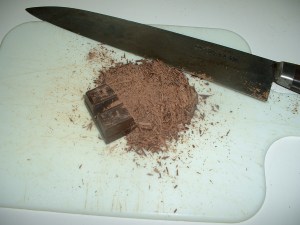
  1. grating of chocolate

    IF grinding fresh flour, do so now.

  2. Preheat oven to 375 degrees.  Place a bowl in freezer for whipping cream (the whipping of cream is greatly facilitated when utensils are ice cold).
  3. Combine flour and salt; blend in a scant 1/4 c butter with a fork until mealy in texture.
  4. Mix in brown sugar, walnuts, and 1 oz chocolate, grated with a sharp knife (see photo); add water and vanilla; blend well.
  5. Butter a pie plate generously; press pie dough in pan firmly with fingers. Bake for 15-18 minutes, or until light brown; begin cooling on a rack, for about 10 minutes, finish cooling in freezer.
  6. While crust is cooling, melt 1 oz chocolate over med/low heat, watching carefully as not to burn. Set aside and cool.
  7. Beat 1/2 c butter in a large bowl with an electric mixer until creamy.  Gradually add 3/4 c cane sugar, beating well with each small addition.
  8. Add 1 egg; mix on medium speed for 5 minutes.  (The following makes this preparation foolproof.  It is so important to have ingredients at room temperature; if your kitchen is either really hot or cold, this mixture may curdle.  You can easily correct this: if it curdles or breaks because it is too hot, make the addition of the second egg a cold one, directly out of the refrigerator, to bring the filling back to its full volume.  If the butter/sugar/egg combination is too cold and curdles, warm the chocolate a little and mix this in before adding the second egg; then, follow the directions for beating.  Ideally when done, this mixture should be like fluffy whipped butter or soft whipped cream, providing ingredients are room temperature, in a moderate kitchen.  In this way, you will never fail with this recipe!)
  9. assembling of pie

    Blend in cooled chocolate and 2 tsp of coffee into whipped filling.

  10. Add second egg and beat for 5 minutes more.
  11. Wash beaters and put in freezer, for whipping cream.
  12. Place filling in cold pie crust; put in freezer for 30 minutes, for filling to set up.
  13. With ice cold bowl and beaters, beat cream until it starts to thicken.  Add powdered sugar and 2 tbsp coffee; continue beating until stiff.  Cover pie with whipped cream and garnish with chocolate curls.  See photo at top of recipe.
  14. May eat now, or for long-term use return to freezer; when frozen, cover well with plastic wrap, to cut pieces as needed.  Serve partially thawed for optimum pleasure.

Creative Caesar Salads

creative Caesar salad topped with serungdeng kacang

When I was growing up, we lived in the small resort town of East Glacier Park, Montana, which is the east entrance to Glacier National Park; there were only 250 residents at the foot of these glorious Rocky Mountains.  Because of our town’s minuscule size, it was necessary to travel to larger cities to take care of our major shopping needs, such as school clothes every late summer.  Usually we traveled within our State, 150 miles east to Great Falls; on special occasions, we ventured as far away as Spokane, Washington.  I can still feel the thrill as we prepared, in the early morning dark, to leave on these revered journeys.

Memories of Ridpath Hotel in  Spokane, WA during  the 1950’s

During the extra special trips to Spokane, the Ridpath Hotel captivated me; we ate many dinners in its plush dining room, often partaking in their Caesar salad, which came with the pomp and flair of table-side service.  My young heart was even then preparing for my career in food history, for I was fascinated by the coddling of the egg, with the torch used for that purpose; in like manner, I rhapsodized over the delight of the powerful garlic on my tender tongue.

To this day I love Caesar salad; I share a recipe here that lives up to this enduring mental monument.  Be prepared to enjoy.

Origins of Caesar Salad

There are several accounts of how this famous dish began.  After much research, I chose to attribute its origin to the Italian chef Caesar Cardini (1896-1956), who created this American classic at his well-known restaurant in Tijuana, Mexico.  There in 1924, he was serving an unusual number of Californian visitors, escaping for the Fourth of July weekend during prohibition.  This original production was served table side, without anchovies, and included whole lettuce leaves, which were eaten by the stems, using one’s fingers.

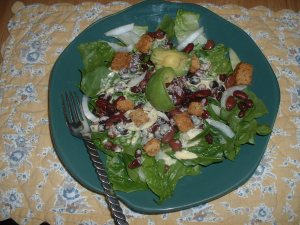
Caesar salad enhanced with beans

Are Coddled Eggs Safe?

There are numerous opposing views on the safety of coddled eggs.  Some profess that they are not a threat: it is adequate to place the eggs in rapidly boiling water, remove the pan from the heat, and then allow the eggs to cook for 60 seconds; indeed, this technique provides the best taste.

Others propound that holding eggs at 140 degrees F (60 degrees C) for five minutes kills potential contaminants, such as salmonella; this can also be achieved instantly by heating them to 160 degrees F (71 degrees C).

Still others declare that uncooked and under-cooked eggs are not safe at all; they rigidly promote the use of either hard-boiled or pasteurized eggs; the latter are available in some grocery stores.  Note: it is important to use caution in highly susceptible populations, such as small children, pregnant women, the elderly, and those with health problems.

Two Resolutions to Problem

Here I cover this dilemma with two good solutions: my favorite version of this dressing is made with coddled eggs, which have been cooked for 60 seconds; nonetheless, for times when extra special care is needed, I provide a method of heating the prepared dressing to 160 degrees; this last procedure, however, thickens our treasured concoction quite a lot.  With both of these two options, the powerful recollected taste from my youth is maintained, which is heightened even further with strong combinations of foods in my creative Caesar salads.

References:

https://whatscookingamerica.net/CaesarSalad.htm

www.reluctantgourmet.com/caesar-salad/

www.foodandwine.com/fwx/food/we-can-thank-tijuana-and-prohibition-caesar-salad

www.ochef.com/447.htm

https://en.wikipedia.org/wiki/coddled_egg

www.safeeggs.com/blog/will-the-real-safe-caesar-salad-recipe-please-stand-up/

finished Caesar dressing (feeder tube in lid at right side)

Caesar Salad Dressing  Yields: about 1 1/2 cups.  Total prep time: 30 min.  If cooking the dressing, total prep time is 45 min.

3 fresh, free-range eggs, at room temperature  (Place in warm water for 10-15 minutes.)

2 tbsp fresh garlic

1 tbsp cider vinegar  (Raw is best; available inexpensively at Trader Joe’s.)

1 scant tbsp Dijon mustard  (Aioli Garlic Mustard from Trader’s is also excellent.)

2 small lemons, juiced

3 dashes of Tabasco

3 dashes of Worcestershire

1/4 c grated Parmesan cheese

1 anchovy, optional

3/4 tsp salt, or to taste  (Himalayan, pink, or Real Salt is critical for optimum health; an inexpensive fine grind Himalayan salt is available available at Costco for $4.95 for 5 lbs..)

1/2 tsp freshly ground pepper, or to taste

3/4 c olive oil  (Personally I prefer a light olive oil for flavor; Trader Joe’s brand, fruity Extra Virgin Olive Oil or Bel’Olio, from Costco, are both great.)

  1. Use room temperature eggs, by placing them in warm water for 10-15 minutes.  For health reasons, it is important that they are washed, free-range, and fresh.  I feel comfortable with coddled eggs, which makes the best dressing.  If, however,  you are sensitive to them (or storing this dressing for more than 4-5 days), take the extra precaution of cooking it as described in step 6, or better yet use pasteurized eggs, which are available in some grocery stores.
  2. coddling eggs

    For coddled eggs, bring a small pan of water to a boil over high heat; prepare an ice bath, using a bowl of cold water with ice cubes.  Place eggs in rapidly boiling water; quickly remove from heat; let them sit for 60 seconds; then, immediately transfer to the ice bath, to the stop cooking process.  Crack them on side of bowl, scooping coddled egg out of shell with a spoon, set aside (see photo).

  3. Meanwhile mince 2 tbsp of garlic: peel cloves, cut in halves; then, chop this in a food processor by repeatedly pressing pulse button; measure 2 tbsp of chopped garlic and place this back in processor.  Set aside.  (TO MAKE DRESSING BY HAND: chop the garlic with a sharp knife; mix all ingredients, except the oil, in a med/small bowl; then, beat in the oil SLOWLY, to emulsify the dressing.  May also make this in a VitaMix or blender.)
  4. Juice the lemons, set aside.
  5. Add all ingredients, except the oil, to the garlic in the processor.  Turn on machine and blend; place oil in the feeder, which is located on the top (see this feeder in above photo of finished product); thus, oil will drip in slowly for an emulsified dressing.  Adjust seasonings.  This will keep in the refrigerator for 4-5 days; for longer storage, go to the next step.  Serve on the creative salads given lastly.
  6. For cooked dressing, prepare an ice bath, using a large bowl with a smaller one inserted in center (see photo).  Prepare Caesar dressing as described in steps 2-

    cooked dressing cooling in ice bath

    5; transfer this mixture to a small, heavy-bottomed saucepan; cook dressing over low heat, stirring constantly, until this egg mixture reaches 160 degrees F (71 degrees C); immediately place in the ice bath to cool, adding more ice as needed.  Note: the dressing will thicken as it cooks. Serve on salads described below.

  7. I like to be creative with my Caesar salads; here are two suggestions for using foods that highly complement this excellent dressing.  First: mix greens, sweet onion, avocado, Parmesan cheese, and homemade croutons (2016/08/15); then, top this with serungdeng kacang, which is crispy coconut chips and peanuts sautéed with a garlic/onion puree (2017/01/09).  Second: mix greens, Parmesan cheese, homemade croutons, and beans; legumes really accentuate the flavor of this dressing!  Enjoy.

1960’s Portuguese Pork

Portuguese pork roast

My gift of hospitality was birthed during my youth in the mid-twentieth century, for then I watched my mother host elaborate dinner parties.  As an excellent cook, she prepared glorious feasts, often with international themes; this 1960’s recipe for Portuguese pork blessed guests repeatedly.  While in college, I meticulously copied her treasured receipts and began my own journey, fostering nourishment of body and soul.

In 1982, God converted this inherent gift into my lifetime work.  Then I began catering meals and teaching a profusion of cooking classes, utilizing researched historical recipes.  One of these classes was on my mother’s Portuguese foods, on which I expanded, incorporating the salad Ensalada Iberica and dessert Figos Recheados, my next weeks’ posts.

Slowing down, smelling the roses, feeding ourselves and others are important traits. In doing such, let us choose pleasure in even the simplest of foods.  These pleasures seem amplified. when someone else prepares the meal; thus, their charity reaches our hearts regardless of what is served.  Macaroni and cheese can thrill us, when made with love by a friend.

There is an element of courage, which results in unexpected joy, when we graciously receive ailments we aren’t sure of.  While living in Billings, Montana, a friend invited me to celebrate Easter with her.  Upon arrival I discovered we were partaking of rabbit; I was challenged in eating this, especially on this holiday!  Expressing gratitude, I bravely proceeded and found it palatable, as long as I didn’t concentrate on it being Easter.  Though I have never again experienced this meat, fond memories flood my mind whenever it is mentioned.

Let us be strong in both giving and receiving benevolent fellowship; use my series of proven receipts to host this cultural affair for your loved ones, or better yet invite someone newly acquainted.

In Culinary Artistry, Andrew Dornenburg and Karen Page note strong compliments to pork; among the most vibrant are vinegar, garlic, black pepper, oranges and onions-all of which are present in this detailed dinner.   Enjoy my creative repast!  1

  1. Andrew Dornenburg and Karen Page, Culinary Artistry (Hoboken, NJ: John Wiley & Sons, Inc., 1996), p. 159.

chopping jalapeno peppers

Portuguese Pork  Yields: 8-10 servings.  Inactive prep time for marinating: 1 day/  active prep time: 30 min/  cooking time: 3 1/2 hr.

4 lb pork loin roast

1 1/3 c water

1 c cider vinegar  (Trader Joe’s carries an inexpensive raw version, which has great health benefits.)

5 med/lg cloves of garlic, minced

3 tepino peppers  (If desired, use jalapeno peppers, which are milder.)

Salt and pepper  (Himalayan, pink, or Real Salt is critical for optimum health; a fine grind is available at Costco for $4.95/5 lb.)

1 c sliced green olives  (May serve additional in a bowl at table.)

Baked yams  (Yams and sweet potatoes are different varieties of the same vegetable, they are interchangeable.)

  1. Place water and vinegar in a 9 1/2″ x 7 1/2″ x 3″ pan, or 3-quart baking dish).
  2. Mince garlic, add to vinegar mixture.
  3. Cut peppers in half lengthwise, scoop out seeds with a spoon, chop fine, and add to vinegar mixture (see photo).  Note: be sure to wash hands thoroughly, as burning will result from touching eyes, if you don’t.
  4. Place pork in marinade and marinate in refrigerator for at least 24 hours, turning roast halfway through, at about 12 hours.
  5. Preheat oven to 300 degrees.  Before placing in oven, turn roast again, salting and peppering the top well.  Bake for 1 3/4 hours.  Proceed immediately to next step.
  6. Wash yams and pierce several times with a fork.  Cover with foil; place top of foil on potato, where sealed, face-up in the oven while baking; this keeps juices from leaking out.  Start baking these at the same time you begin roasting the meat; bake for about 3 hours, as the oven is only set at 300 degrees.
  7. After baking for first 1 3/4 hours, turn roast for the last time.   Once more, salt and pepper the top well.  Bake for another 1 3/4 hours.
  8. When cooking is complete, remove roast from oven, cool for 15 minutes.  Toward the end of this time, take yams out of oven and place on plates; next, cut pork in thick slices and arrange on dishes; top with sliced olives.  (It is good to serve additional olives in a small bowl at table.)
  9. This pork is superb with the Portuguese salad Ensalada Iberica and dessert Figos Recheados, my next weeks’ posts.

1950’s Pear Pie

Fresh pear pie

fresh pear pie

The history of sugar is intriguing, spanning the continents.  Here we will examine the major turning points in the background of this substance.

My mother gave her children the choice of birthday cakes.  I was hard put to choose between banana cake-see 2016/08/08-and fresh pear pie.  My soul still thrills with the beautiful taste of baked pears, rich crumb topping, and the best of pie crusts.

I am so health conscious; thus I have experimented with using sugar alternatives here.  Coconut sugar or sucanat (evaporated cane juice) can not compete with cane sugar in this receipt. Only sugar insures the right texture and flavor in pear pie.

Sugar has been around for the longest time.  Saccharum officinarum, sugar cane, originated in the South Pacific’s New Guinea and was subsequently carried by human migration into Asia.  Sometime before 500 B.C., people in India were producing raw, unrefined sugar.  1

Its first known reference was in 325 B.C., when  Alexander the Great’s admiral Nearchus wrote of reeds in India that produce “honey” without any bees.  The word sugar began to appear frequently in Indian literature around 300 B.C.  This Sanskrit word sarkara, meaning gravel or pebble, became the Arabic sukhar, which finally came to be sugar.  2

The use of Indian sugar cane spread.  Around the 6th century after Christ, it was planted in the moist terrains of the Middle East, where the Persians made sugar a prized ingredient in their cooking.  After Islamic Arabs conquered Persia in the 7th century, they took the cane to northern Africa and Syria; it eventually made its way to Spain and Sicily.  3

Sugar in Europe was barely known until around 1100, and it remained a mere luxury until the 1700’s.  The western Europeans’ first encounter with sugar was during their Crusades to the Holy Lands in the 11th century.  Shortly thereafter Venice became the hub of Arabic sugar trade for western Europe, while the first known large shipment went to England in 1319.  4

At first the western Europeans treated it like other exotic imports-e.g., pepper and ginger-strictly as medicine and flavoring: it was produced in small medicinal morsels, as well as preserved fruits and flowers.  These sweets or candy first began being made by apothecaries, or druggists, which were making “confections” to balance the body’s principles.  The word confection is taken from Latin conficere. meaning “to put together” or “to prepare”.  5

The medieval years brought sugary nonconfections to Europe, such as candied almonds, as well as the use of this substance in recipes for French and English courts.  The chefs of royalty employed sugar in sauces for fish and fowl, for candying hams, and in desserts of various fruit and cream/egg combinations.  Around 1475, the Vatican librarian Platina wrote that sugar was now being produced in Crete and Sicily, as well as India and Arabia.  Columbus carried the cane to what is now Haiti and the Dominican Republic in 1493, on his second voyage.  6

By the 18th century, whole cook books were devoted to confectionery, which had become an art no longer associated with medicine.  During this century, sugar consumption exploded in Europe, with the rise of colonial rule in the West Indies and the enslavement of millions of Africans, resulting in the sugar industry becoming the major force behind slavery in the Americas (one estimate holds that fully two-thirds of the twenty million African slaves worked on sugar plantations).  This industry saw rapid decline later in the 1700’s, with the abolition movements, especially in Britain; the other European countries followed, one by one through the mid-19th century, in outlawing slavery in the colonies.  7

Sugar, however, had now become a world staple.  Presently 80% of its production comes from sugar cane, while most of the rest is derived from sugar beets.  8

Wisdom and moderation are needed with this substance.  Today our nation consumes sugar in unhealthy amounts.  Personally I hold fast to the adage of Mary Poppin’s:  “A spoonful of sugar helps the medicine go down.”  My standard is to substitute more beneficial sweeteners wherever possible.  However, there are times when only cane sugar will do.   My precious pear pie is one of them!

Enjoy this carefree, mess-free recipe.

References:

  1. Harold McGee, On Food and Cooking  (New York: Scribner, 1984, 2004), p. 648.
  2. James Trager, The Food Chronology  (New York: Henry Holt and Company, 1995), p. 19.
  3. Harold McGee, On Food and Cooking  (New York: Scribner, 1984, 2004), p. 648, 649.
  4.  Ibid., pp. 648, 649.
  5. Ibid., p. 649.
  6. Ibid., pp. 649, 650.
  7. Ibid., pp. 650, 651.
  8. https://en.wikipedia.org/wiki/Sugarcane
Pear pie, whipped cream, and freshly ground nutmeg

pear pie, whipped cream, and freshly ground nutmeg

Pear Pie with Hot Water Pastry Crust  Yields: 1-10″pie.  Total prep time: 1 1/4 hr/  active prep time: 30 min/  baking time: 45 min.

1 1/4 c unbleached white flour  (Bob’s Red Mill is high quality.)

1 1/3  c whole wheat pastry flour  (May grind 1 c soft white winter wheat berries for 1 1/2 c total fresh ground whole wheat pastry flour, carefully measuring needed amounts.)

1 tsp salt (Himalayan, pink, or Real Salt is critical for optimum health; a fine grind Himalayan salt is available very reasonably at Costco.)

2/3 c oil  (Grapeseed or avocado oil is best, available inexpensively at Trader Joe’s and Costco.)

1/3 c boiling water.

1 c sugar  (Organic cane sugar id preferable; available in 2 lb packages at Trader’s, but more economical  in 10 lb bags at Costco)

1/3 c butter, softened

5 lg Bartlett pears, ripened  (May use Anjou pears as well, but Bartletts are best, must be ripened.)

1 c heavy whipping cream  (Lightly sweeten this with powdered sugar.)

Nutmeg  (Freshly ground is superb!)

  1. Preheat oven to 450 degrees.
  2. Blend unbleached white flour, 1 c of whole wheat pastry flour, and salt in a large bowl.
  3. Add oil and boiling water; mix lightly with a fork.
  4. Divide into two balls, one much larger than the other; cover balls with plastic wrap and place on hot stove to keep warm.  (You will need to use 3/5’s of dough for this single crust for a 10″-pie plate; may bake leftover 2/5’s of dough in strips with butter and cinnamon sugar.)
  5. Roll out the large ball of dough between 2-18″ long pieces of wax paper. Form a very large, oblong circle which reaches to the sides of the paper.
  6. Gently peel off the top sheet of wax paper; turn over and place piece of rolled dough, wax paper side up, over a 10″-pie plate. Very carefully peel off the second piece of wax paper.
  7. Patch any holes in crust by pressing warm dough together with fingers. Form rim of crust on edge of pie plate by pressing dough together gently, using excess dough from heavier areas to make up for areas where dough is sparse.
  8. Mix 1/3 c of whole wheat pastry flour and sugar in same bowl in which you made the pie crust.  Blend in butter with a fork, until mealy in texture.
  9. Sprinkle 1/3 of this mixture in bottom of unbaked pie shell.
  10. Fill crust with peeled pear halves.  Fill in spaces with smaller pieces.
  11. Evenly spread remaining flour mixture on top of pears.
  12. Bake at 450 degrees for 15 minutes.  Reduce heat to 350 degrees and bake for 30 minutes more, or until crust is golden brown.
  13. Cool, serve with whipped cream and freshly grated nutmeg.  Mouthwatering!

1950’s Sweet and Sour Meatloaf

When we were young, my siblings and I chose the meals for our birthdays and holidays; we always picked sweet and sour meatloaf.  How we loved it!  There was never a Christmas Eve that our home didn’t boast of its tantalizing smells, for they arose from the roasting of beef, with its contrast of vinegar and brown sugar, mustard and tomato sauce.  The aroma was remarkable.

My memory of festivities back then was that of heightened anxiety, with my troubled soul.  Celebrations  made me deeply aware of the void in my being, as I suffered greatly from lifelong mental illness.  But no more.  The powerful word of God has completely healed me; it removed all wreckage from my mind and body, just as it promises to do.

I asked Jesus into my life on December 16, 1994, but my healing didn’t begin to materialize with clarity until Mother’s Day of 2013; this marked the start of my attendance at Abundant Life Family Church (alfc.net), where the word is taught in all its pure simplicity.

I am indeed set free!  Now I thoroughly enjoy gala affairs; moreover everyday is a glorious party.  May you realize that heaven is here on earth.

My family still holds fast to our traditional repast of sweet and sour meatloaf.  It is ever-present at celebrations, and blesses us on my every trip home.  Always I envision this mouth-watering dish when I think of family and food, for it’s an inseparable part of our clan.  It is extremely easy to prepare; I guarantee you will be wowed by it.

1950's sweet and sour meatloaf

1950’s sweet and sour meatloaf

Sweet and Sour Meatloaf Yields: 4 servings.  Total prep time: 2 hr/ active prep time: 20 min/ cooking time: nearly 2 hr.  Note: You may double this for superb sandwiches from leftovers.

4 med russet or baker potatoes, cleaned and wrapped in tin foil

1 lg egg, beaten

1/2 c fresh bread crumbs

1 med yellow onion, chopped

1 1/3 c tomato sauce

3/4 tsp salt and 1/4 tsp pepper  (Himalayan, pink, or Real Salt is critical for optimum health; an inexpensive fine grind Himalayan salt is available at Costco.)

1 lb ground beef  (Beef fat MUST be 15% /85%; natural or organic ground beef is best; available frequently at a very good price at our local Grocery Outlet.)

2 tbsp brown sugar, packed down  (Organic is best, available at Trader Joe’s.)

2 tbsp apple cider vinegar  (Raw has health benefits; most economical at Trader’s.)

2 tbsp yellow mustard  (Only use yellow mustard, such as Frenchies)

1 c water

  1. Preheat oven to 350 degrees 2 hours before serving.
  2. Place potatoes in oven; bake for nearly 2 hours, for medium-size potatoes.
  3. In a large bowl, mix egg, bread crumbs, onion, 1/3 c tomato sauce, salt, and pepper; then, thoroughly blend the hamburger into the sauce (it works best to use your hand to do this.)
  4. Form a loaf in a 9 1/2 x 7 1/2 x 3 inch Pyrex pan, or other deep baking dish.  Use a 13 x 9 1/2 inch pan if doubling.  Make a deep indentation in the center of the loaf, so it looks like a boat (this will hold the sauce in the center of meatloaf); therefore, basting isn’t necessary.  Place meat in oven.
  5. Using the same bowl, mix all the remaining ingredients: 1 c tomato sauce, brown sugar, vinegar, mustard, and water.
  6. Remove loaf from oven, pour the sauce over the meat, and bake for 1 1/2 hours.
  7. Serve with unwrapped, split baked potatoes, on which lots of sauce is poured.  SO GOOD!

Williamsburg Orange Cake

Williamsburg Orange Cake

Williamsburg Orange Cake

This Williamsburg Orange Cake dates back to the mid-twentieth century.  Personally, the spring and summer of 1973 brimmed with vitality for me; I had taken the quarter off from college “to find myself.”  However, I forgot my mother’s birthday in the midst of my prosperity.

My heart broke when I soon realized my mistake.  To make amends I baked and delivered this glorious cake; I drove it 200 miles across Montana’s Big Sky country, from Missoula to East Glacier Park.  My benevolent mother graciously welcomed both me and this exquisite confection!

This beloved parent learned the powerful lesson of forgiveness in her youth; she is always eager and ready to forgive as a result of this.  Mom taught me this precious wisdom, which exempts us from much disruption when mistakes are made: immediately we amend all with our Father in heaven; next, we lavishly forgive others and ourselves; finally as needed, we seek compassion from those we have hurt in our wrongdoing. This spells freedom for our emotions and minds!

Me, my brother Paul, mother Pat, sister Maureen

me, my brother Paul, mother Pat, sister Maureen-June 2016

That was Mom’s 50th birthday and the first time I made this Williamsburg Orange Cake.  I went home to Montana to celebrate her 93rd birthday this past June.  We had a repeat of this treasured sweet!

The recipe calls for zesting oranges.  I like to equip my sister’s kitchen with gadgets which I find helpful in cooking.  This year I blessed her with a GoodGrip zester and thus insured my ease in making this cake. GoodGrip is high quality and economical.  A large array of this brand’s useful gadgets is available at our local Winco.  This particular zester is most efficient; it makes a difficult job super easy.

My recipe appears lengthy.  It is actually very simple, for I have included many baker’s tips. Don’t be daunted by deceptive looks!

Williamsburg Orange Cake  Yields: 2-9 inch round layers, 3-8 inch rounds, or 2-9 x 5 inch loaves.  Total prep time: 2 hr, plus 1 hr to freeze cakes for easy frosting/ active prep time: 1 1/2 hr/  baking time: 30 min.

2 1/2 c flour  (Bob’s Red Mill  organic unbleached white flour is of high quality; better yet grind 1 2/3 c organic soft white wheat berries to make 2 1/2 c of flour.)

1 c raisins, soaked in boiling water  (Organic raisins are available inexpensively at Trader Joe’s.)

1 1/2 c milk or cream, soured

lemon juice from a squeeze ball for souring

1 1/2 tsp baking soda

3/4 tsp salt  (Himalayan, pink, or Real salt is critical for optimum health; an inexpensive, fine grind Himalayan salt is available at Costco.)

3/4 c butter, softened  (This 1970’s cake called for a mixture of butter and the then popular Crisco; see Ozark Honey-Oatmeal Cookies, 2017/10/30, for history of Crisco.)

1 1/2 c sugar  (May use coconut sugar, or sucanat, which is evaporated cane juice; if using sugar, organic cane sugar is premium.)

3 lg eggs, at room temperature

1 1/2 tsp vanilla

3 oranges  (It is important to use organic, as the zest of regular oranges taste of pesticides.)

1 c pecan pieces

Spray oil  (Coconut spray oil is best.)

Flour for dusting pans

Williamsburg Orange Frosting  (This is for 2-9 x 5 inch loaf pans or 2-9 inch round layers; 1 1/2 recipes will be needed if making 3-8 inch round layers.)

1/2 c butter, softened

4 c powdered sugar  (Organic is available at Trader Joe’s.)

1 1/2 tbsp orange zest

3/8 c orange juice, freshly squeezed from above oranges

1/2 tsp vanilla extract

1/4 tsp salt

10 narrow slices of orange rind, cut lengthwise on surface of orange (see top photo).

Cake

  1. Preheat oven to 350 degrees.
  2. If using freshly ground flour, begin grinding now.
  3. Cover raisins with water in a small saucepan, bring to a boil, remove from heat, and set aside.
  4. Place milk or cream in a medium bowl; sour with about 6 squirts of lemon juice from ball; let sit.
  5. Stir together flour, salt, and baking soda in a med/large bowl with a fork.
  6. In a large bowl, beat 3/4 c butter until light and fluffy, mix in sugar gradually, beating thoroughly.  Add 1 egg at a time, mixing well with each addition.  Blend in vanilla.
  7. Add 1/2 the flour to butter mixture, beating only until all is incorporated; then, mix in 1/2 the soured milk. Repeat these steps to use all the flour and milk; do not over-beat, as this toughens cakes and cookies.
  8. Wash and dry oranges.  Zest 2 oranges and set zest aside; save these two oranges for juice for frosting.  The third unpeeled one will be used for optional decorative strips.
  9. Drain the raisins, which have been become plump in the hot water. Blend the raisins, l tbsp of zest, and nuts into the cake batter.
  10. Spray pans with coconut oil and dust with flour lightly. (Rinse nozzle on can with hot water, for easy spraying in future.)  Pour batter in the prepared cake pans.
  11. Bake for 30-35 minutes, or until toothpick comes out clean.  Cake should respond, bounce back, when pressed with your finger.  Do not over bake!
  12. Cool in pan for 5 minutes to facilitate removal; slide knife around edges to gently remove; then, freeze cakes on separate paper plates for about an hour-this prevents cake from crumbling while frosting.

Frosting  (Note: make 1 1/2 recipes for 3-8 inch round layers.)

  1. Cut 10 narrow slices of rind, lengthwise on surface of third orange for optional decoration: using a sharp knife, cut just below rind from top to bottom of orange, gently peel stripes off orange, set aside (see top photo of decorated cake).
  2. Squeeze oranges to extract 3/8 c juice, set aside.
  3. In a med/large bowl, beat 1/2 c butter until light and fluffy, preferably with an electric hand mixer.
  4. Mix in 2 c of powdered sugar.
  5. Beat in 1/4 c of orange juice, 1 1/2 tbsp zest, vanilla, and salt.  Add remaining sugar, 1 c at a time, blending well; set aside.  (Save extra orange juice.)
  6. Frost frozen cake layers or loafs.  (Add the extra orange juice 1 tbsp at a time, only if frosting is too stiff to spread easily.)  Optional: decorate with slices of orange rind while frosting is still wet, arranging narrow slices back-to-back on top of cake (see top photo).
  7. If making the loaf cakes, to keep in freezer for unexpected company, be sure to freeze the frosting on cake, before sealing in gallon-size freezer bag.
  8. Enjoy this delightful cake!