1960s French Dinner

Cotes de porc braises a la moutarde

cotes de porc braisees a la moutarde

I have a repertoire of what I call my childhood recipes, of which the following is one of my favorites.  It stretches my imagination every time I eat it: I can hardly believe that food tastes this good!

My Culinary Heritage

My mother taught me so much about cooking; she was excellent at this endeavor in her day.  My mentor exercised her expertise with hospitality in our home, rather than in our family restaurant, inspiring me to follow in her footsteps with her extensive gourmet preparations.

The passing on of tradition from generation to generation is so important.  I’ve never married, but I have a vast quiver full of spiritual children-more than I can count!  Thus, I have a desire to give them what was so freely given to me, which is wisdom.  I gaze at this precise diamond through the perspective of food, with all its joys and health-providing benefits.  I am so grateful to God, my parents, and my entire family for this knowledge that was birthed in me.

Childhood Comfort Foods

We all identify with comfort foods, especially those from our youth.  I will offer numerous ones, with which my mother nurtured our family’s souls.  Cotes de porc braisees a la moutarde is my first choice in this marvelous journey into the past.

Time-Life Books Foods of the World

Time-Life Books put out a series of cook books entitled Foods of the World, showcasing the cuisines of numerous countries in the mid-twentieth century.  Mom subscribed to these superb sequel; my family and our guests experienced incredible pleasure as a result.  Hence I grew to appreciate the world, through its food in the confines of my home at a very young age.  This instilled an appetite in me, which was gratified in my twenties and thirties, when I went to the nations to study their eating habits.

Receipts for Braised Pork Chops

For another great pork recipe, using cream and mustard, inspired by Julia Child, see Cotes de Porc Sauce Nenette.

I have greatly simplified the following recipe for pork loin chops from its original complex detail in Time-Life Books.  My version is uncomplicated and literally explodes with unforgettable flavor!  Enjoy…

Cotes de Porc Braisees a la Moutarde  Yields: 4 servings.  This recipe is adapted from Foods of the World: The Cooking of Provincial France, M.F.K. Fisher and the Editors (New York: Time-Life Books, 1968).

4 center-cut, boneless pork loin chops, about 1 1/4″ thick

salt and fresh ground pepper, to taste  (Himalayan, pink, or Real Salt is critical for optimum health; an inexpensive, fine grind Himalayan salt is available at Costco.)

flour for dusting meat

2 tbsp butter, 2 tbsp oil  (Coconut or avocado oil is best, as olive oil is carcinogenic when heated to high temperatures.)

1 lg yellow onion sliced, about 2 c of 1/8″ slices

3 tbsp wine vinegar

3/4 c heavy cream

2 tsp Dijon mustard

1/4 tsp lemon juice

Serve with brown rice  (My favorite is brown basmati rice; available at Trader Joe’s.)

  1. Heat butter and oil in a large, heavy skillet, over medium heat.  Wash pork chops and lightly pat dry; salt and pepper generously.  Dredge in flour, shaking off all excess.  Sautee in hot oil for 2 minutes on each side; do not overcook. Remove from pan; set aside.
  2. Add onions to pan, stirring in pan drippings well.  Sweat onions (cook until translucent).  Add vinegar, scraping the bottom of the pan; cook until most of moisture is gone.
  3. Add cream.  Stir well and bring to a boil over medium heat.  Place pork chops in onion mixture, coating well with onions/sauce.
  4. Cook until pork chops are hot; do not overcook.
  5. Take off heat; stir in mustard and lemon juice, mixing into the onions by moving around the chops with a spatula or spoon.  Adjust seasonings.
  6. Serve immediately with steamed rice and be wowed!

Cocoa Bread from 1920’s Portland, Oregon

Roaring twenties' cocoa bread

‘roaring twenties’ cocoa bread and fresh rosemary loaf

The spell-binding Cupid’s Book was a cookbook published twice in this city of roses in the 1920’s.  The downtown retailers enticed the brides-to-be into their shops with colorful advertisements, bountiful recipes, and good instructions on how to be a wife in these two editions.

The recipe for cocoa bread is the best of this collection.  It is a slice of heaven!  Unsweetened cocoa powder lends a flavor to this yeast loaf that makes one think of pumpernickel, with the first bite.  Hints of chocolate surface as one experiences it further.

I discovered this blessing, while I was researching at the Oregon History Center’s excellent library, during my graduate work.  1991 marked the completion of  my Master’s Degree, at which point I had exhausted every inkling to food in this archive.  My 114 page thesis, which they have on file,  closely documents the library’s details on nutrition.  It was here that I found the two romantic cook books appropriately named Cupid’s Book.

Bread is the staff of life!  It sustains one’s soul when made with love from scratch.  I grind the flour for all my bread from organic hard red spring wheat berries.  My understanding is these-of all the wheat berries-have the highest content of protein.  One serving has 7 grams of this compound, the same as an egg.

The superb quality of the freshly ground flour allows the bread to last for up to six weeks in the refrigerator.  It is, however, necessary to wrap it in paper towel to absorb the moisture, which keeps it from molding; always store the bread in an air tight storage bag.  Toasting it brings out optimum freshness.

Making bread with a food processor is quick and mess-free.  I encourage you to venture out using my technique; learning this will bless you with easy, homemade bread forever.

Be nourished by the baking and eating of this luscious loaf.!  Also recommended is my receipt for chocolate scones (see chocolate scones).

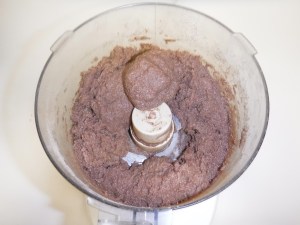
bread dough in food processor

bread dough after kneading twice in processor

Cocoa Bread  This is adapted from a recipe in Cupid’s Book (Portland, Oregon: Oregon History Center, 1921, 1925). Yields: 1 loaf.  Total prep time: 3 hr/  active prep time: 30 min/ inactive prep time: 2 hr/  baking time: 30 min.

1/4 c tepid water (Temperature should be 105-115 degrees.)

1  individual package active dry yeast  (May use 3 level tsp of Red Star Active Dry Yeast, available in a 2 lb package at Costco, which keeps well sealed in the freezer.  Yeast is best at room temperature for proofing.)

1/3 c, plus 1/4 tsp sugar  (Organic cane sugar is ideal; available at Trader Joe’s in 2 lb package, or less expensive at Costco in 10 lb package.)

2 1/2 c whole wheat flour  (Bob’s Red Mill flour is high quality.)

1 1/2 c unbleached white flour  (You may grind 2 2/3 c organic hard red spring wheat berries to make the total 4 c of flour.)

1/3 c unsweetened cocoa powder

1 1/4 tsp salt  (Himalayan, pink, or Real Salt is critical for optimum health; a fine grind Himalayan salt is available inexpensively at Costco.)

1 1/4-1 1/2 c tepid milk, 110-115 degrees  (May use alternative milks, such as hazelnut or almond.)

3 tbsp oil  (Any kind of oil will do, for oiling the inside of a 13-gallon plastic bag.)

Spray oil  (Coconut spray oil is best.)

  1. Dissolve yeast and 1/4 tsp sugar in 1/4 cup water.  Let sit until it foams, looks creamy, and is nearly doubled in size, about 10 minutes.
  2. In an 11-c-or-larger food processor, blend well the flour, sugar, cocoa powder, and salt.
  3. dough after first kneading of 35 seconds

    Add yeast mixture and 1 1/2 c milk to flour mixture (only 1 1/4 c milk will be needed, however, if grinding your own flour, as the grind is coarser and doesn’t absorb as much liquid.)  Knead for 35 seconds, see photo.

  4. Let rest for 4 minutes; then, knead one more time for 35 seconds (see photo at top of recipe). Note: processing dough will heat it and kill the yeast if cooling isn’t allowed.
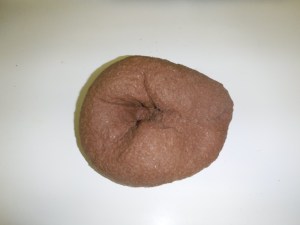
  5. dough after kneading by hand

    Take out and knead by hand for about 8 minutes, or until satiny smooth (see photo).  This process is relatively foolproof, but if dough is too wet and sticky, add flour to board to facilitate kneading; it helps to wash hands, if dough is sticking to them.  Dough should be firm, elastic, and smooth to the touch after kneading.  If, however, it is too stiff to knead easily, place in machine, and knead in 1 tbsp water.  Repeat this last step, if needed, until severe stiffness is gone, it is flexible, and kneading by hand is facile, carefully resting dough as not to overheat.  It should be firm and satiny smooth when finished kneading by hand.

  6. Place in a 13-gallon plastic bag, in which several  tbsp of oil are evenly distributed. Let rise in a warm place for 60 minutes, or until double.  (Only if you’re grinding your own flour, punch dough down and allow to rise an additional 30 minutes. for lighter bread with coarser freshly ground flour.)
  7. Punch down and form into a loaf.  Place in a bread pan sprayed with oil; loosely drape a piece of plastic wrap also sprayed with oil over loaf.
  8. Let rise 50-60 minutes, or until double.
  9. Important: 30 minutes into the last rising process preheat oven to 400 degrees; this insures oven is ready when bread has fully risen.
  10. Remove plastic wrap when loaf is double.  Bake for 27-30 minutes, or until loaf sounds hollow when tapped on the bottom.
  11. Cool on rack.  Enjoy!